

Last Updated: July 2026
Reviewed by the Yoganiro Editorial Team — This guide has been researched and fact-checked using official sources, publicly available information, trusted industry references, and verified resources where applicable to help ensure accuracy and usefulness.
Rolling out a mat with someone else changes the entire feel of a yoga practice. Partner yoga poses ask you to lean, balance, and breathe in rhythm with another person, turning a routine or solo yoga session into something closer to a conversation without words. Whether you practice with a spouse, a close friend, or a family member, couples yoga brings a physical honesty that solo stretching rarely offers. You cannot fake balance when someone else’s weight depends on your stability, and that small pressure builds real trust fast.
This guide walks through everything you need to start practicing partner yoga poses to build trust, from the gentlest seated stretches to AcroYoga moves that require real strength and coordination. You will find fourteen poses organized by skill level, plus guidance on preparation, gear, common mistakes, and who should sit this one out.
Quick Answer: Partner yoga poses to build trust and connection work best when you start with seated, low-risk stretches like Partner Seated Twist and Double Child’s Pose before moving into standing balance poses. Beginners should hold each pose for 20 to 30 seconds, communicate constantly, confirm consent before any weight-sharing, and warm up individually for five to ten minutes before attempting any pose that involves shared weight.
What Is Partner Yoga (and How Is It Different From Solo Practice)
Partner yoga, also called couples yoga or two-person yoga, is a style of practice where two people move through poses together, using each other’s body weight for balance, resistance, and support. Instead of holding a stretch alone, you and a partner share the load, which often creates a deeper stretch than either of you could reach solo. It’s worth noting up front that “couples yoga” is sometimes confused with tantric yoga, a separate practice centered on mindfulness and synchronized breathing rather than a sexual one — the poses in this guide are the trust-and-strength kind, suited equally to romantic partners, friends, siblings, or parents.
The biggest difference between partner yoga and a regular practice comes down to dependency. In solo yoga, your alignment and balance rely entirely on your own body. In partner yoga, every pose becomes a small negotiation. If one person shifts weight too fast or forgets to communicate, both people feel it immediately. That built-in feedback loop is exactly what makes this style so effective for trust-building poses. You learn to read subtle cues, adjust in real time, and trust that your partner will hold their end of the pose. People practice partner yoga with romantic partners, close friends, siblings, or parents, and the format works for any pairing willing to communicate openly.
The practice traces back to AcroYoga, a discipline formally developed starting in 2003 by Jason Nemer and Jenny Sauer-Klein, who blended the strength and alignment principles of yoga, the lifts and balances of acrobatics, and the therapeutic touch of Thai massage into a single system. That lineage explains why partner yoga splits naturally into two moods: the more athletic “Solar” side, built on strength and balance (most of the standing and acro poses in this guide), and the slower “Lunar” side, built on assisted stretching and massage-like support (most of the seated and restorative poses). Knowing that distinction helps you choose a session that matches how much energy you and your partner actually have that day.
Yoga studios across the United States have expanded partner yoga offerings over the past few years, often pairing it with AcroYoga workshops for couples looking for a more adventurous date activity — boutique studios like Spirit Lab Yoga Studio in NYC and community-focused spaces like the Portland Yoga Project both now run sessions built around shared, prop-supported practice. That said, you do not need a studio to start. A living room floor and a willing partner are enough to begin.
Benefits of Partner Yoga for Your Body and Relationship
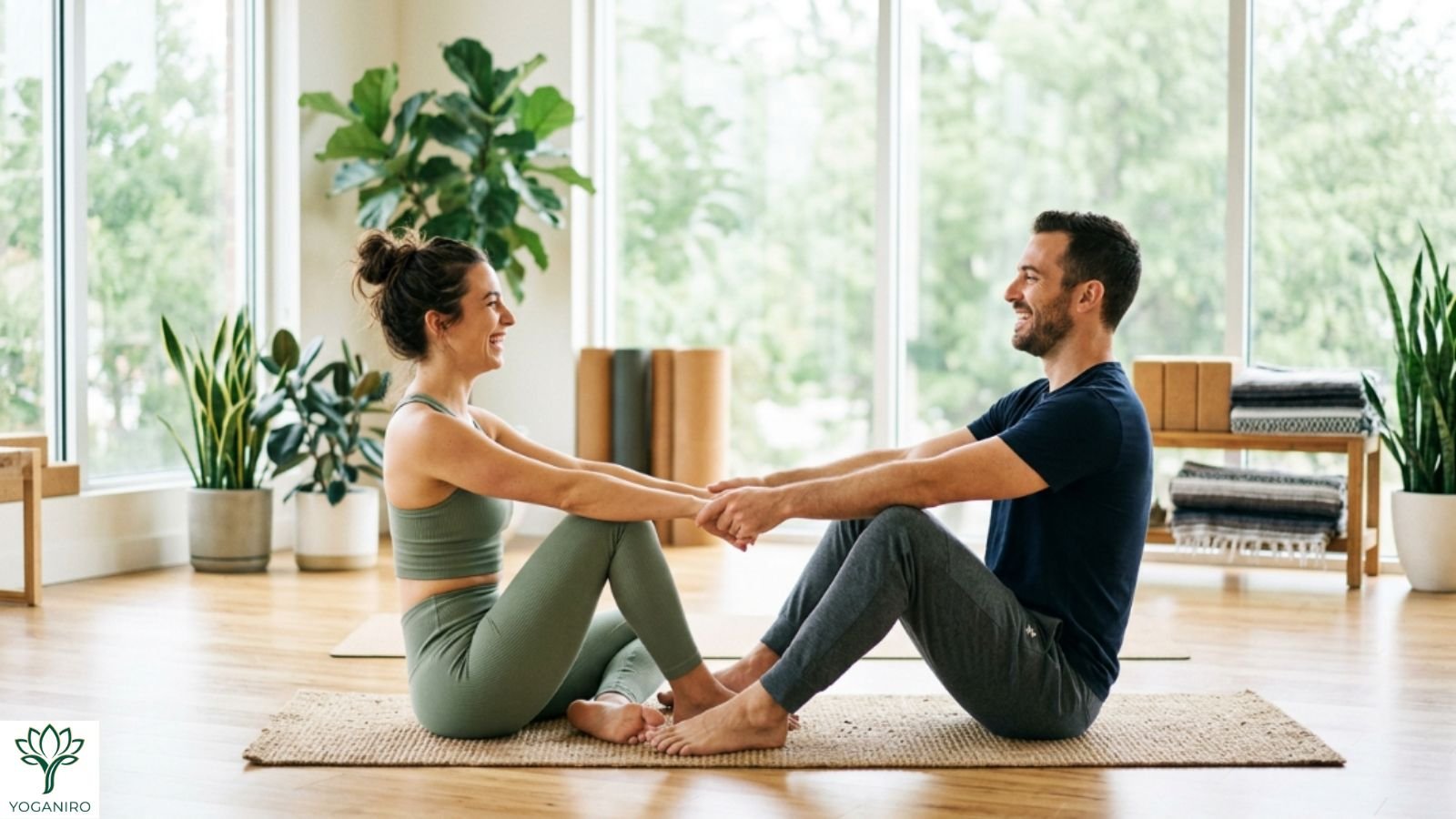
Partner yoga delivers two categories of benefit at once: physical gains like flexibility and core strength, and relational gains like communication and emotional closeness. Few other activities combine both so directly.
On the physical side, partner-assisted stretches consistently reach further than anything you can do alone. A friend gently pulling you into a forward fold, for example, releases tension in the hamstrings that a solo stretch often cannot touch. Poses like Partner Boat Pose and Back-to-Back Chair Pose build core strength poses and leg endurance because you are working against another person’s resistance instead of gravity alone. Balance and stability also improve faster in partner work, since your nervous system has two reference points instead of one — a mechanism related to proprioception, or your body’s sense of where its limbs are in space, which sharpens quickly when you’re calibrating against a partner instead of a mirror.
The relationship benefits are just as concrete. Practicing yoga for connection means learning to communicate before you feel discomfort, not after. Couples who practice together report better non-verbal communication in daily life, since partner yoga trains you to notice tension, hesitation, and readiness in another person’s body language.
A 2019 review published in the journal PAAH on group exercise dynamics found that partnered physical activity increases motivation and adherence compared to exercising alone, largely because of the accountability that comes from a shared commitment. Slow, synchronized breathing during partner poses has also been linked to improved heart rate variability, a marker of how well your body recovers from stress; a worksite-based hatha yoga study found measurable HRV improvements after ten weeks of regular practice.
Sustained physical touch and cooperative movement of this kind are also commonly associated with the release of oxytocin, a hormone tied to bonding and stress reduction, which may explain why partner sessions tend to leave people feeling calmer than an equivalent solo practice. Mindfulness-based practices more broadly have been linked to better heart health outcomes, reinforcing why the breath-focused pacing in partner yoga is worth taking seriously rather than rushing through. Off the mat, that translates into calmer conversations and quicker recovery from an argument.
If you’re weighing partner yoga poses for date night against a typical dinner-and-a-movie routine, consider that shared physical vulnerability tends to build intimacy faster than passive activities. You cannot scroll your phone mid-pose.
How to Prepare: Consent, Communication, and Trust Before You Begin
Every partner pose in this guide depends on one thing before anything else: clear, enthusiastic consent from both people, renewed at each new pose rather than assumed from the last one. Consent here means more than a general “sure, let’s try it” — it means actually checking that your partner is comfortable with the specific contact, weight, and duration a pose involves before you begin, and treating “not this one” as a complete answer with no follow-up questions needed.
On top of that baseline, agree on a simple verbal cue such as “ease off” or “too much,” and use it the moment something feels wrong. If you’re new to partner work, it also helps to define three roles you’ll see referenced throughout this guide: the base is the person on the ground providing the foundation and stability; the flyer is the person being lifted, balanced, or supported; and a spotter is a third person standing by, not participating in the pose, whose only job is to catch a fall or help stabilize a wobble. Beginner and intermediate poses in this guide don’t require a spotter, but several advanced poses do.
Spend five to ten minutes warming up individually before you touch a single partner pose. Gentle neck rolls, cat-cow stretches, and a few rounds of deep breathing prepare your muscles and calm your nervous system. Skipping this step is one of the fastest ways to pull a hamstring in a forward fold that otherwise would have felt fine. Once you’re both warmed up, talk through any current injuries, tight areas, or days when one of you is simply not feeling steady. A partner recovering from a rough week at work may need a gentler session than usual, and that’s a completely normal adjustment to make out loud rather than guess at silently.
Trust-building poses work best when you treat the first few sessions as practice for consent and communication themselves, not just physical alignment. Start with poses where both people stay seated and grounded, since these carry the lowest risk of injury while you build a shared vocabulary for pace and pressure.
What You’ll Need: Mats, Space, and Gear for Partner Yoga
Very little equipment stands between you and a first session: one or two non-slip mats and about three to four feet of open floor space around you cover most of what you need. That clearance matters more in partner work than solo practice, since falls and wobbles tend to land sideways rather than straight down.
A single extra-wide mat works well for seated poses where you and your partner sit close together, while two standard mats placed side by side give more room for standing poses like Back-to-Back Chair Pose. Comfortable, close-fitting clothing helps too, since loose fabric can catch on a partner’s hands during a twist or fold — see our guide to what to wear with yoga shorts if you’re building out a practice wardrobe, and current Alo or Beyond Yoga promo codes can take some of the cost out of it.
Props are optional but genuinely useful. Yoga blocks help bridge a flexibility gap when one partner is noticeably more flexible than the other. A yoga strap lets you connect hands in a forward fold when your arms simply don’t reach, which happens often with height differences. A folded blanket or a yoga bolster softens knee pressure in poses like Double Child’s Pose or supports the reclining partner in Reclined Bound Angle, particularly on hard floors. None of these props are required for a first session, but keeping one of each nearby removes the excuse to skip a stretch that would otherwise feel just out of reach.
Pose Comparison at a Glance
| Pose | Level | Primary Benefit | Hold Time |
|---|---|---|---|
| Partner Seated Twist | Beginner | Spinal mobility | 20–30 sec/side |
| Double Child’s Pose | Beginner | Hip & chest opening | 8–10 breaths |
| Partner Forward Fold | Beginner | Hamstring stretch | 5–8 breaths |
| Partner Seated Cat-Cow | Beginner | Spinal warm-up | 5–10 rounds |
| Back-to-Back Breathing Pose | Beginner | Grounding, HRV | 2–3 min |
| Reclined Bound Angle (Partner Version) | Beginner | Deep relaxation | 3–5 min |
| Partner Boat Pose | Intermediate | Core strength | 20–30 sec |
| Back-to-Back Chair Pose | Intermediate | Leg & glute strength | 5–8 breaths |
| Double Tree Pose | Intermediate | Balance, proprioception | 5–8 breaths/side |
| Partner Warrior III | Intermediate | Balance, focus | 3–5 breaths/side |
| Assisted Camel Pose | Advanced | Guided backbend | 3–5 breaths |
| Double Downward Dog | Advanced | Full-body strength | 5 breaths |
| Double Plank Pose | Advanced | Core & shoulder strength | 3–5 breaths |
| Flying Bow Pose | Advanced | Acro backbend, trust | 3–5 breaths |
Easy Beginner Partner Yoga Poses
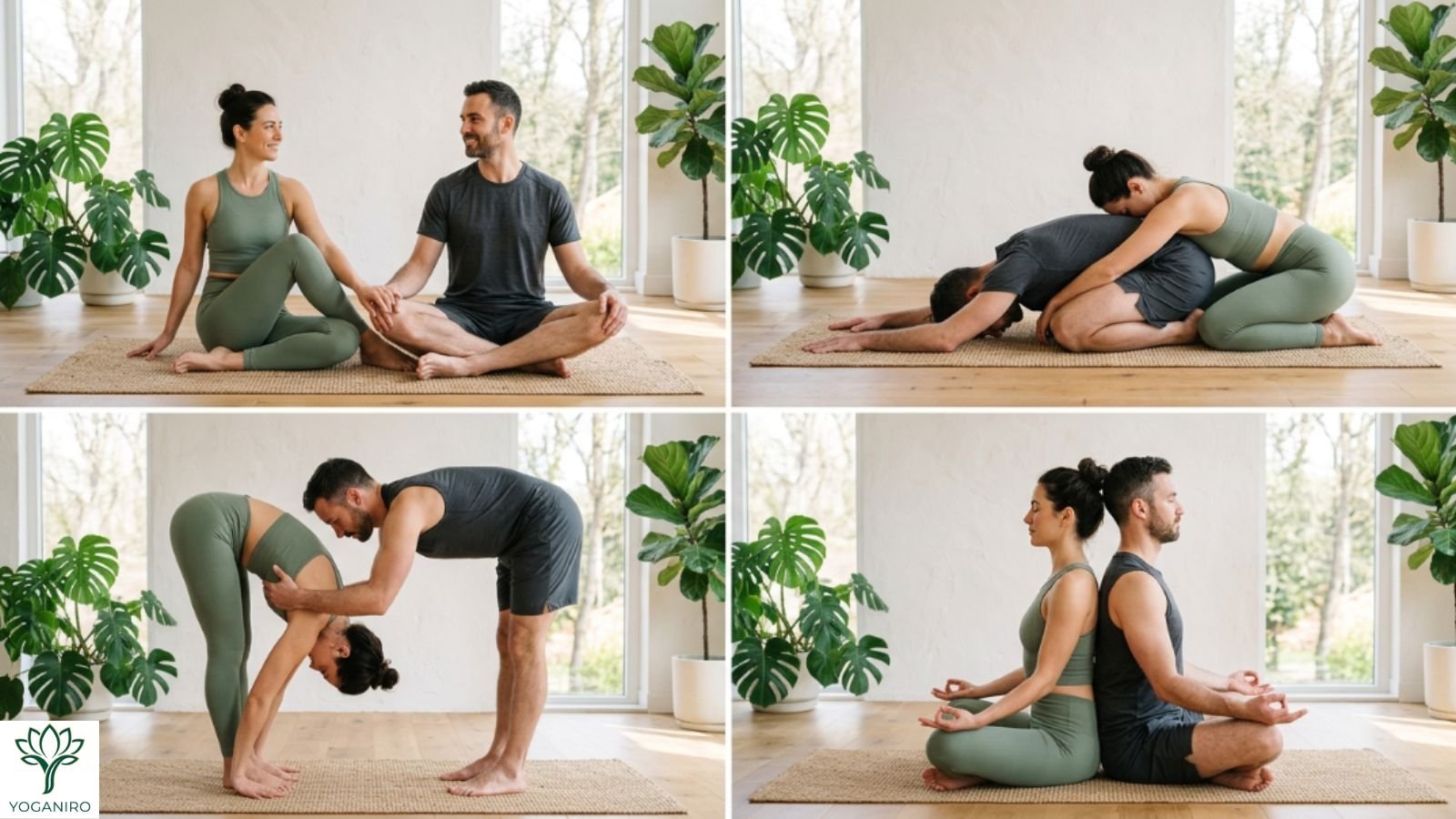
Beginner partner yoga poses focus on seated stability and gentle stretching rather than balance or strength, which makes them the safest entry point for two people yoga poses to build trust. Each pose below can be held for 20 to 30 seconds and repeated two to three times per side unless noted otherwise.
Partner Seated Twist
This pose targets spinal flexibility and gentle digestion support while keeping both people fully grounded. Sit back to back with your partner in a cross-legged position, spines lightly touching. On an inhale, lengthen your spine upward, and on an exhale, twist gently to the right, resting your left hand on your right knee while your partner mirrors the movement in the opposite direction. Hold for 20 to 30 seconds, then switch sides. A common beginner mistake here is twisting from the shoulders instead of the waist, which strains the neck rather than the spine.
Double Child’s Pose
Double Child’s Pose combines a hip and shoulder stretch with a light chest-opening effect for the partner resting on top. One person settles into a wide-legged child’s pose with arms extended forward, while the other partner gently drapes their upper body over the first person’s back, arms reaching overhead. Breathe slowly together for eight to ten breaths before switching roles. The partner on top should rest only part of their body weight down, not their full weight, especially if there is a noticeable size or weight difference between partners.
Partner Forward Fold
Sit facing your partner with legs extended and the soles of your feet touching theirs. Hold each other’s wrists or forearms, inhale to lengthen the spine, then exhale as one partner folds forward gently while the other leans back for counterbalance. Hold for five to eight breaths before switching. This is one of the most effective hamstring stretch poses in partner yoga, since your partner’s counterweight lets you fold deeper than you could alone. Keep a slight bend in the knees if your hamstrings feel especially tight.
Partner Seated Cat-Cow
Kneel on hands and knees facing your partner, about one foot of space between you. Inhale to arch your spine into cow pose, lifting your head and tailbone, then exhale to round your spine into cat pose, tucking your chin toward your chest. Move together for five to ten rounds, matching each other’s pace. This pose warms up the spine before standing poses and works well as an opening sequence for any partner yoga session.
Back-to-Back Breathing Pose
Sit cross-legged, backs resting against each other, hands resting on your knees. Close your eyes and simply notice your partner’s breath moving through their rib cage against yours. Stay here for two to three minutes. This is less a stretch and more a grounding ritual, and it works particularly well mid-session as a reset if either partner feels rushed or distracted.
Reclined Bound Angle (Partner Version)
Close a session the same way many advanced AcroYoga classes do: with total stillness. One partner sits with soles of the feet pressed together, knees relaxed open in a bound-angle shape, then leans back so the second partner can settle their upper body gently onto the first partner’s chest, facing up, arms resting wherever feels natural. Stay here for three to five minutes, breathing slowly and matching pace where you can. This restorative shape asks for very little physical effort and a lot of stillness, which is exactly why it works well as a closing pose — it gives both nervous systems time to settle after any standing or balance work earlier in the session.
Intermediate Partner Yoga Poses
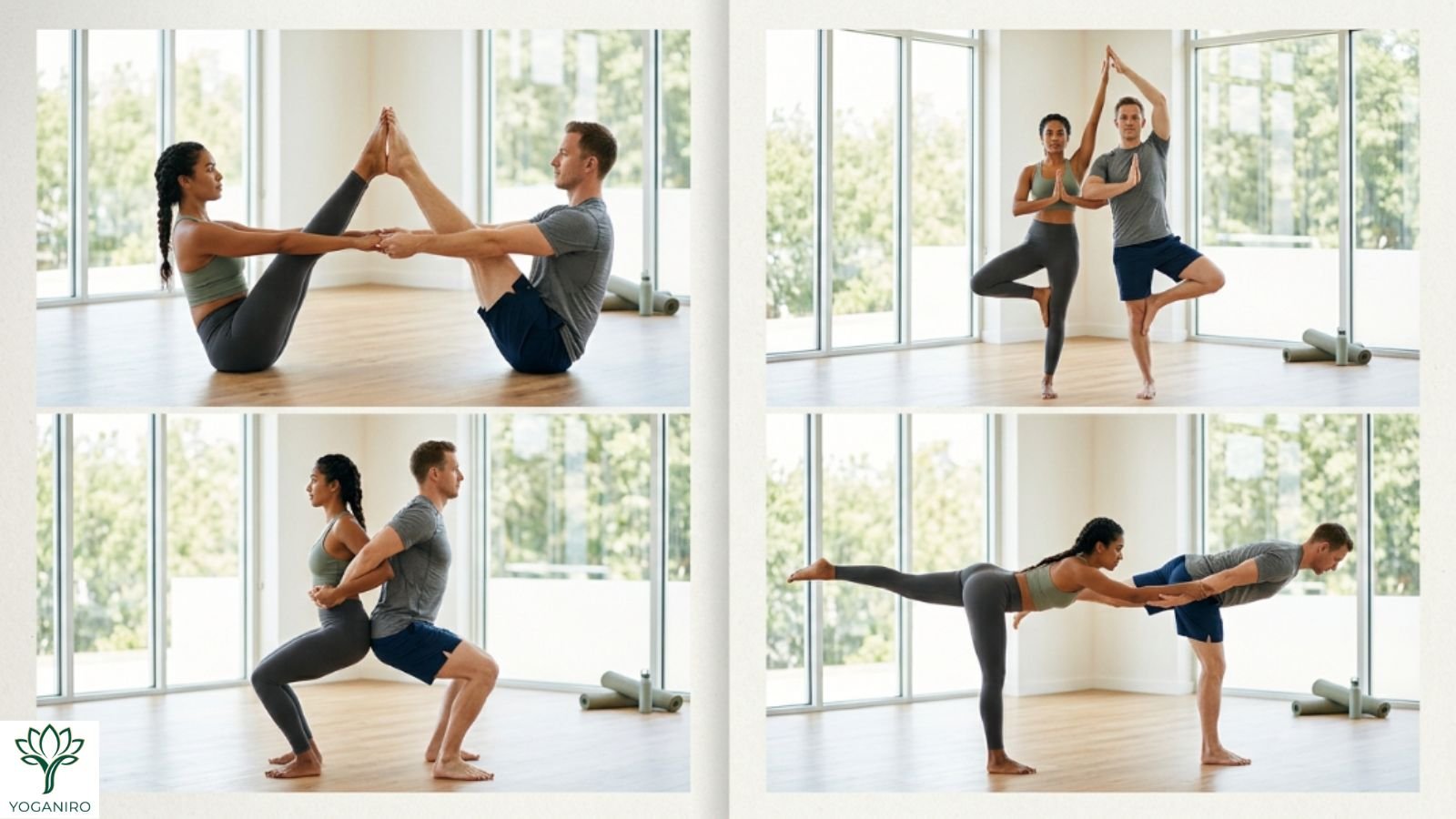
Building on that seated foundation, intermediate partner yoga poses add a balance or strength requirement on top of the flexibility work above. Most intermediate poses ask you to stand, which raises the stakes slightly and rewards clear communication.
Partner Boat Pose
Sit facing your partner with knees bent and the soles of your feet pressed together. Hold hands or wrists for support, then slowly straighten your legs to form a V shape while keeping your core engaged. This pose is one of the more demanding core strength poses in a partner sequence, since both people need to balance simultaneously rather than relying on the floor. If the full extension feels too intense, keep one foot on the floor while extending the other leg.
Back-to-Back Chair Pose
Stand back to back with your partner, heels roughly hip-width apart. Press your backs into each other and slowly bend your knees, lowering into a seated position as though sitting in an invisible chair. Keep your thighs parallel to the floor and hold for five to eight breaths. This pose strengthens the legs and glutes quickly, and rising back up together at the same pace is a small but real test of coordination.
Double Tree Pose
Stand side by side, about a foot apart, and wrap your inner arms around each other’s backs for support. Lift your outer foot and rest it on your standing leg’s calf or inner thigh, then press your free palms together overhead or at chest height. Hold for five to eight breaths before switching legs. Double Tree Pose is easier when partners are similar in height, but height differences just make the shape less symmetrical rather than impossible.
Partner Warrior III
Stand facing your partner about an arm’s length apart, holding each other’s forearms for support. Exhale and hinge forward while lifting one leg straight back, keeping your spine and lifted leg in one line. Hold for three to five breaths before switching legs. This pose demands real focus, and locking eyes with your partner instead of looking down actually helps stabilize the pose rather than distracting from it.
How Long Should You Hold an Intermediate Partner Yoga Pose?
Most intermediate partner yoga poses should be held for 20 to 30 seconds, or roughly five breath cycles, before switching sides or releasing. Holding longer than that tends to fatigue the smaller stabilizing muscles first, which increases wobble and raises injury risk rather than building additional strength.
Advanced Partner Yoga Poses
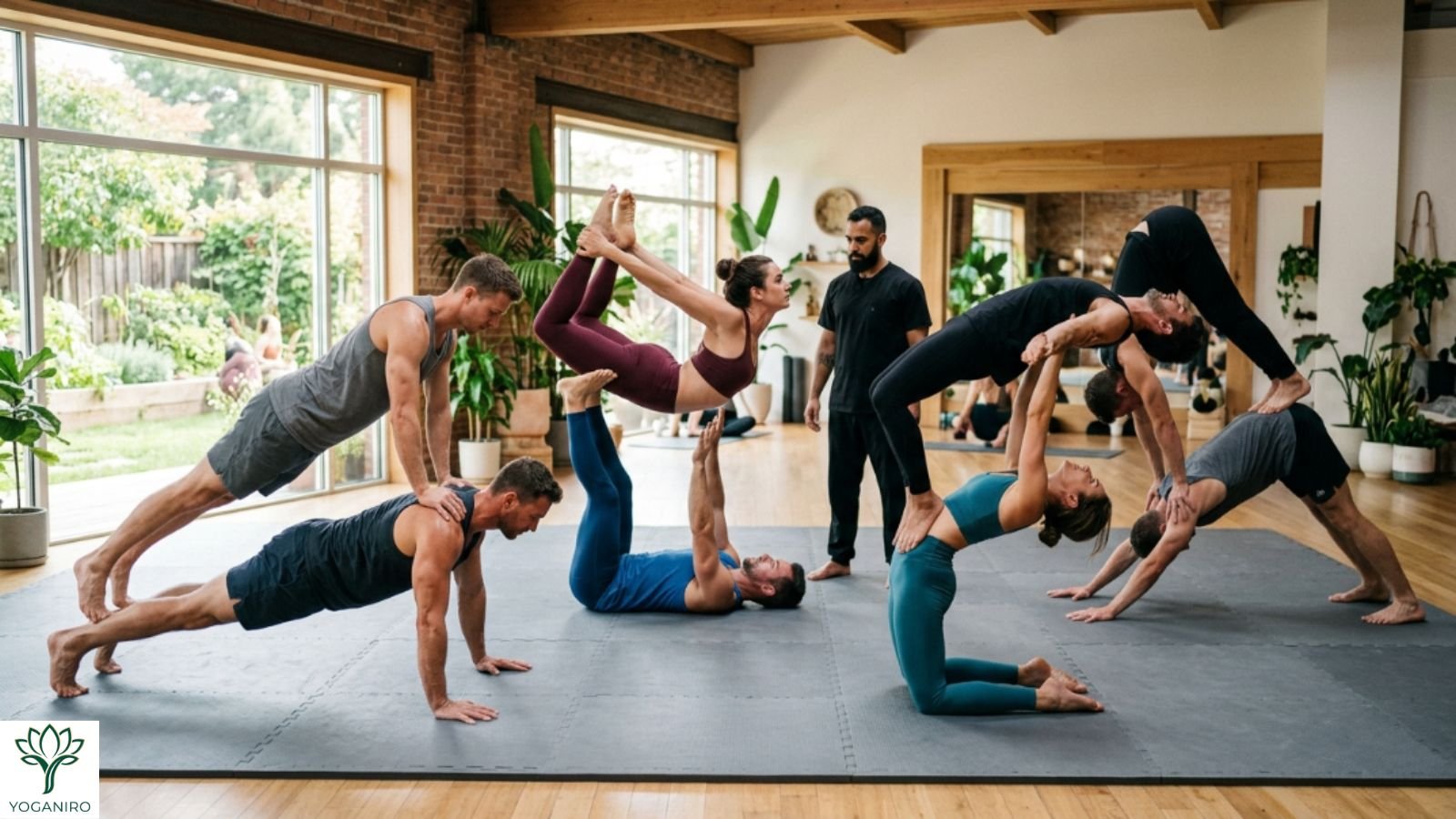
Advanced partner yoga poses lean firmly into the Solar, acrobatic side of AcroYoga, where one partner often bears significant weight or lifts the other partially off the ground. These poses require solid core strength, prior experience with the intermediate poses above, and ideally a spotter for the first several attempts. Two named acro shapes worth knowing even if you don’t attempt them right away are Throne Pose, where the flyer sits balanced on the base’s feet and hands as if seated on a chair, and Folded Leaf, a forward-folding counterbalance shape often used as a transition between bigger lifts — both common enough in AcroYoga classes that instructors assume you’ve at least heard the names.
Assisted Camel Pose
This grounded backbend bridges intermediate strength work and the full lifts below. The kneeling partner comes into a traditional camel pose, hips stacked over knees, reaching back toward their heels. The standing partner steps in from behind, placing steady hands under the kneeling partner’s shoulder blades or upper arms for support as they lean back, offering just enough counter-resistance to help the kneeling partner control the depth of the backbend rather than free-falling into it. Hold for three to five breaths, then the standing partner helps guide their partner back to upright slowly. Depth should always be set by the kneeling partner, not pushed from behind.
Double Downward Dog
Partner A moves into a standard downward dog position. Partner B places their hands a few feet in front of Partner A’s hands, then carefully steps their feet up onto Partner A’s lower back or hips, forming a second downward dog stacked on top of the first. A useful technique here is bone stacking — keeping your arms and legs straight rather than bent, so weight transfers down through the skeleton instead of loading the muscles. Hold for five breaths before stepping down slowly and switching roles. Communication matters most here, since Partner A needs to speak up immediately if the weight feels too heavy.
Double Plank Pose
The stronger or taller partner holds a standard plank position on the floor. The second partner faces the first partner’s feet, places their hands on the first partner’s ankles, and carefully steps one foot at a time onto the base partner’s shoulders, forming a second plank facing the opposite direction. As with Double Downward Dog, bone stacking through straight arms and legs keeps the weight distributed safely through both hands and feet. Hold for three to five breaths, then step down one foot at a time. Rushing the step-up is the most common cause of a fall.
Flying Bow Pose
This is a full AcroYoga pose and should not be attempted without a spotter the first few times. The base partner lies on their back, bends their knees, and places their feet on the flying partner’s hips. The flying partner holds the base partner’s ankles for stability while the base partner slowly straightens their legs, lifting the flyer off the ground. Once stable, the flyer bends their knees and reaches back to hold their own ankles, forming a bow shape in midair. Hold for three to five breaths before the base partner slowly lowers the flyer back down.
Is Advanced Partner Yoga Safe Without an Instructor?
Advanced partner yoga poses involving lifts, such as Flying Bow Pose or Double Plank Pose, are safer with a certified instructor or experienced spotter present, especially for the first several attempts. Once both partners understand the weight transfer and communication cues involved, many couples continue practicing these poses independently at home with confidence.
Common Mistakes to Avoid in Partner Yoga
Skipping the individual warm-up tops the list of frequent partner yoga mistakes, since it leaves muscles cold right when a partner pose asks them to stretch further than usual. Five to ten minutes of solo movement before any shared pose prevents most minor strains.
A second common mistake is attempting an advanced pose before mastering the intermediate poses that build the necessary strength and trust. Jumping straight to Flying Bow Pose without first practicing Partner Boat Pose and Back-to-Back Chair Pose means neither partner has built the core stability the lift actually requires.
Poor communication mid-pose causes a third category of mistakes: staying silent through discomfort instead of using the verbal cue agreed on beforehand. Silence during a wobble almost always ends worse than a quick “ease off.” Finally, forcing a partner deeper into a stretch than their body wants to go, particularly in Partner Forward Fold, can strain the hamstrings badly. Depth should always be led by the person being stretched, not the person applying pressure.
Who Should Avoid Partner Yoga
People with a recent injury, an unstable joint condition, or an unmanaged cardiovascular concern should avoid partner yoga poses that involve shared weight-bearing or inversion until a doctor clears them for physical activity. Pregnant practitioners should consult a doctor or a prenatal yoga instructor before attempting any partner pose, since even gentle twists and forward folds may need modification.
A significant size or weight difference between partners doesn’t rule out partner yoga, but it does mean choosing poses thoughtfully — weight-bearing poses like Double Child’s Pose, Double Downward Dog, and Double Plank Pose are easier and safer when the base partner is the larger or stronger of the two, and any lift should start light and build gradually rather than assuming it will work on the first try.
This guidance is general in nature and does not replace personalized medical advice. If you have a chronic condition, a recent surgery, or ongoing joint pain, talk to a physician or a certified yoga instructor before starting any new partner yoga practice.
This guidance is general in nature and does not replace personalized medical advice. If you have a chronic condition, a recent surgery, or ongoing joint pain, talk to a physician or a certified yoga instructor before starting any new partner yoga practice. For additional guidance on professional yoga standards and safe practice, refer to the Yoga Alliance Scope of Practice.
Once you and your partner feel steady, invite a friend and try our three-person trio poses to add a new layer of balance and trust.
Frequently Asked Questions
Can Beginners Do Partner Yoga?
Yes, beginners can absolutely do partner yoga. Starting with seated poses like Partner Seated Twist and Double Child’s Pose builds comfort and trust without requiring balance or strength. Most beginners can safely attempt these poses on their very first session, as long as they warm up first and communicate openly throughout.
What Equipment Do I Need for Partner Yoga?
You need at minimum one non-slip yoga mat and three to four feet of clear floor space. Optional props like yoga blocks, a strap, or a folded blanket help with flexibility gaps and joint comfort, but none of them are required to start a basic partner yoga session at home.
How Do You Practice Partner Yoga at Home?
Start by clearing enough floor space for both partners to move freely, then warm up individually for five to ten minutes. Move through two or three beginner poses first, communicating constantly about comfort and pressure. A full home session can run anywhere from 20 to 45 minutes depending on how many poses you include.
Do You Need a Romantic Partner to Try Partner Yoga?
No. Despite the “couples yoga” nickname, partner yoga works with any pairing willing to communicate and consent openly — friends, siblings, parents and adult children, and coworkers all practice it regularly. The poses in this guide, especially the beginner and intermediate ones, don’t assume a romantic relationship at all.
Is Partner Yoga the Same as Tantric Yoga?
No, and the two get confused often. Partner yoga, as covered in this guide, is a physical practice built around shared balance, strength, and assisted stretching. Tantric yoga is a separate tradition centered on mindfulness and synchronized breathing rather than the acrobatic or trust-building poses described here, and it isn’t inherently sexual despite a common misconception.
What Is the Difference Between Partner Yoga and AcroYoga?
Partner yoga typically involves two people performing grounded poses together without lifting either person off the floor. AcroYoga goes further, involving one partner lifting the other partially or fully into the air, often with a spotter present for safety. AcroYoga generally requires more strength, flexibility, and prior partner yoga experience, and formally combines yoga, acrobatics, and Thai massage.
Is Partner Yoga Good for Couples Going Through a Rough Patch?
Partner yoga can help rebuild communication and physical trust between couples navigating tension, since it requires constant verbal check-ins and mutual reliance. It is not a substitute for counseling when deeper relationship issues are present, but many couples find the shared, low-pressure activity a helpful way to reconnect.
How Often Should Couples Practice Partner Yoga?
Two to three sessions per week is a reasonable starting frequency for couples building a regular partner yoga habit. Even a single 20-minute session focused on three or four beginner poses can measurably improve flexibility and communication when practiced consistently over several weeks.
About the Reviewer
This article has been reviewed using guidance from Yoga Alliance standards, reputable yoga education resources, peer-reviewed research, and current best practices for partner yoga safety to help ensure accuracy and usefulness.

Yoganiro was founded by Abdul Rehman with a passion for yoga, wellness, and mindful living. The goal behind Yoganiro is to inspire people through simple yoga practices, wellness tips, and healthy lifestyle content that promotes balance, peace, and overall well-being.