

By the Yoganiro Editorial Team · Last Updated: August 2026
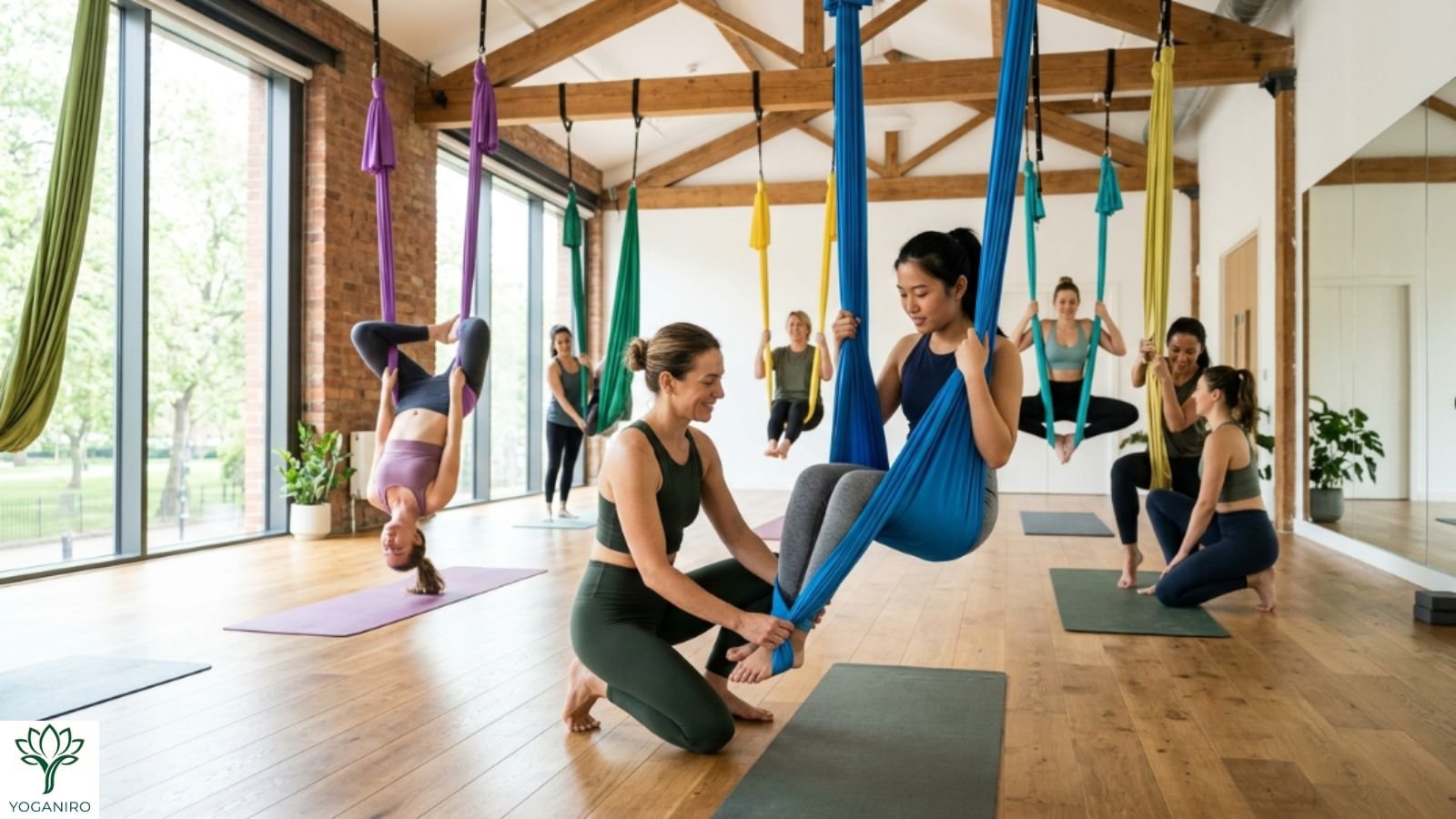
Few practices feel as quietly indulgent as aerial yoga. You settle into a suspended silk hammock, exhale, and let it cradle your weight while gravity releases the tension held along your spine. It looks like something reserved for performers. In truth, aerial yoga was designed for everyone, including complete beginners who have never once unrolled a yoga mat.
At Yoganiro, we believe in luxury in every stretch, and this guide honors that promise. If you have wondered what aerial yoga is or searched for aerial yoga for beginners, everything you need waits below: what the practice involves, its benefits for body and mind, what to wear, what to expect in your first class, the safety essentials, and how to book. Consider this your invitation to take your yoga practice gracefully off the ground.
Aerial yoga is a form of yoga that uses a hammock of strong silk fabric to support your body through yoga poses, deep stretches, and gentle supported inversions. It eases pressure on the spine, improves flexibility, and builds core strength. Beginners need no experience, strength, or flexibility to begin safely.
What Is Aerial Yoga?
Aerial yoga is a style of yoga that blends traditional yoga postures with a soft silk hammock suspended from the ceiling. The hammock, often called an aerial hammock or silks, holds part or all of your body weight. You move through familiar poses in the air, close to the floor, or fully inverted. Some know it as anti-gravity yoga or flying yoga. Whatever the name, the principle holds steady. The fabric supports you and invites your body to move in ways a flat mat could never allow.
The elegance of aerial yoga lives in how the silk fabric reshapes gravity. Rather than pressing down into the floor, you hang, float, and lengthen. For flowing classes, studios rig a double-point hammock at roughly hip height. For slower, restorative sessions, the fabric hangs much closer to the ground. Advanced classes use a spinning single-point hammock, which invites playful aerial acrobatics and light trapeze-style silks work. That versatility lets a single piece of fabric hold both a serene stretch class and a spirited, sweat-earning one.
Aerial Yoga vs Regular Yoga: What’s the Difference?
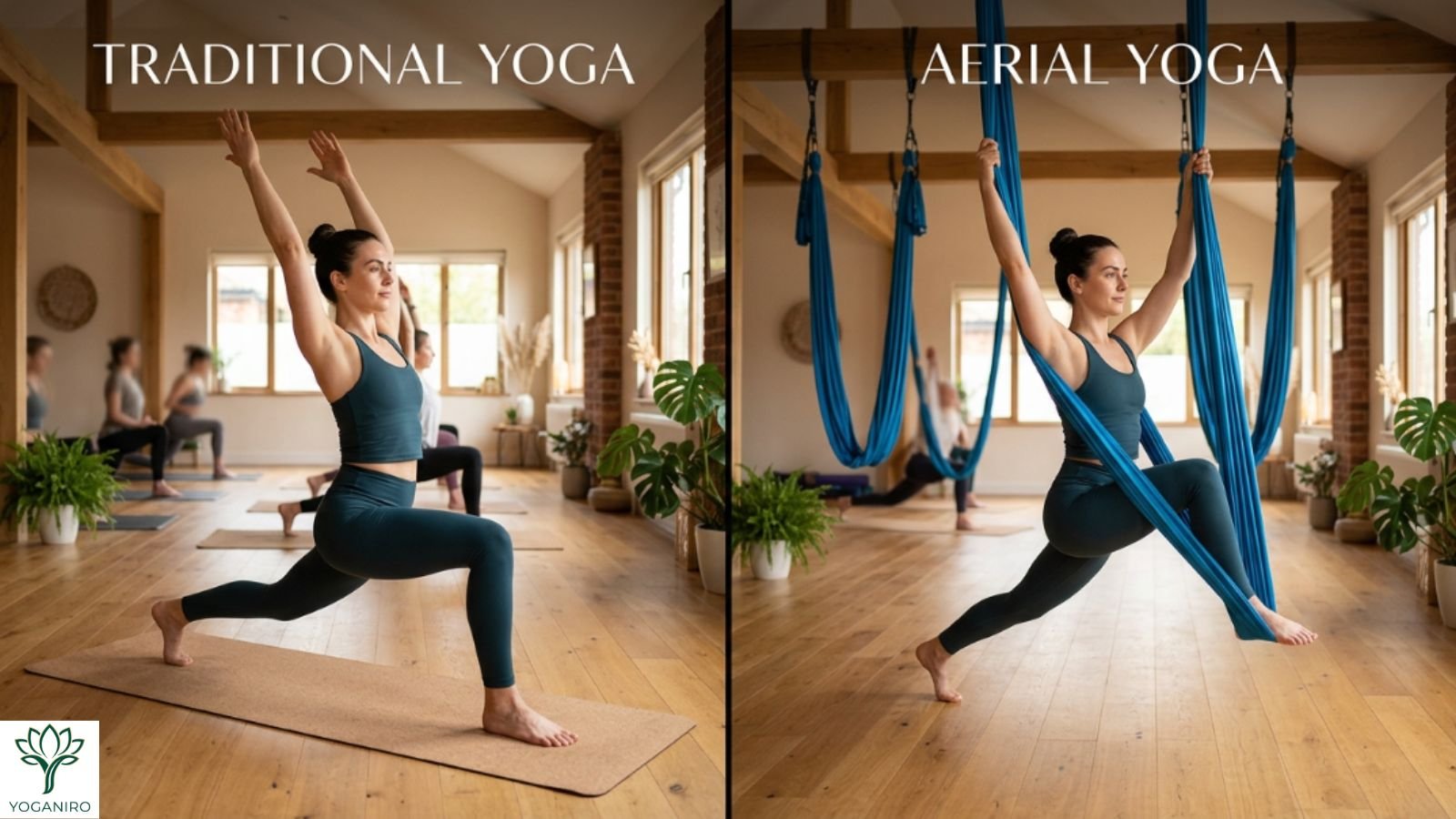
The difference between aerial yoga and regular yoga is simple. Regular yoga keeps you grounded on a mat, while aerial yoga suspends your body in a hammock. That suspension lifts pressure from your joints and spine. You can hold poses longer, ease into a deeper stretch, and attempt inversions that feel daunting on the floor. Regular yoga builds a dependable foundation. Aerial yoga layers on traction, weightlessness, and a refined sense of body awareness that surprises most first-timers.
Aerial Yoga Benefits: Body & Mind
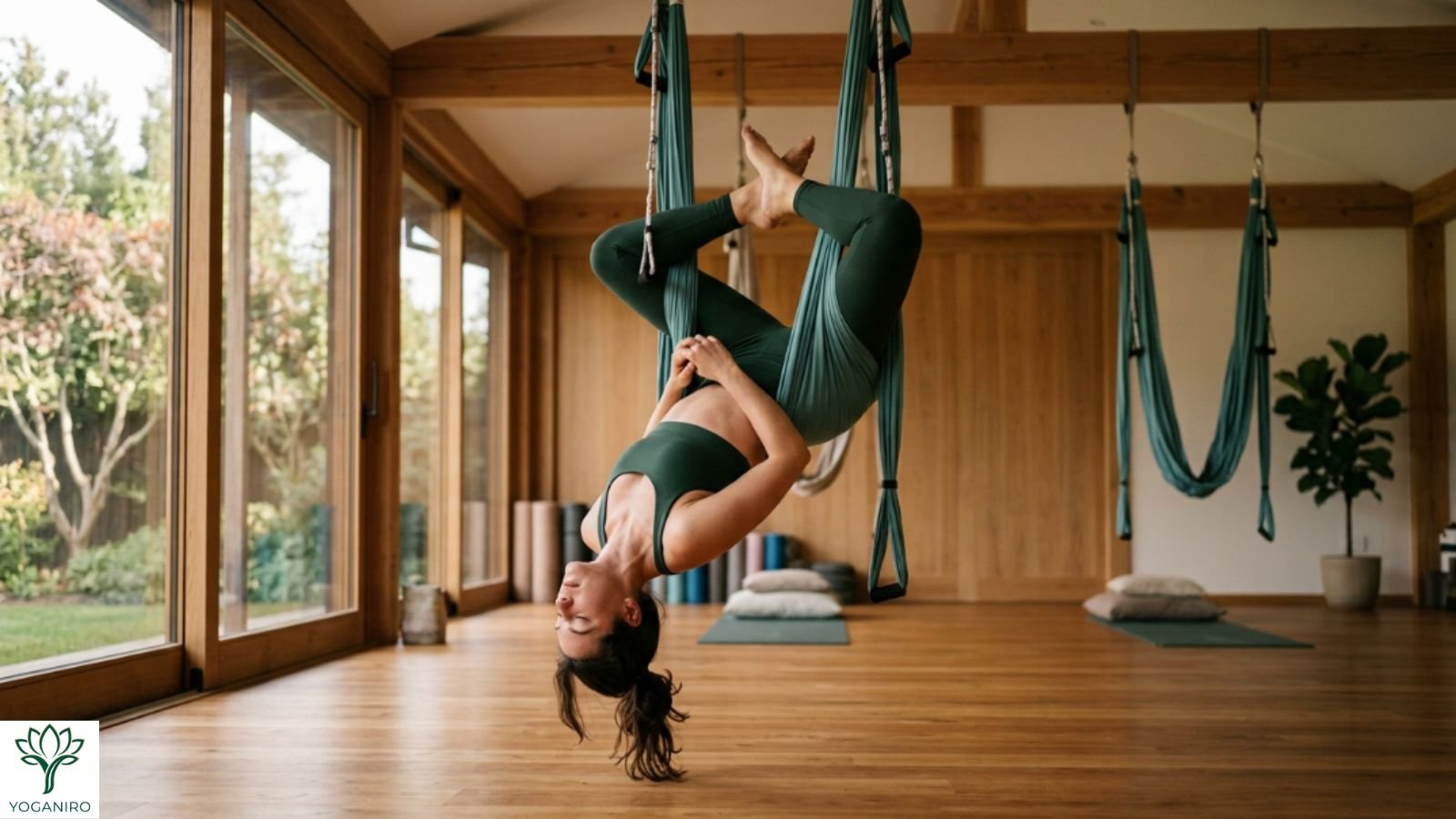
The benefits of aerial yoga reach well beyond the beauty of a single pose. The practice improves flexibility and range of motion, develops genuine strength and endurance, and sharpens balance and stability while quieting a restless mind. Research supports these claims. A study from the American Council on Exercise found that a single 50-minute aerial yoga session burns roughly 320 calories. Over a six-week program, participants also lowered their heart-disease risk factors by about 10 percent, which points toward a reduced risk of heart disease over time.
Spinal decompression earns the most admiration. As you rest in a supported inversion, gravity lengthens the spine and opens space between the discs. That gentle traction and joint decompression brings welcome relief to anyone who sits at a desk all day. Core strength is the quieter reward. Balancing within the fabric asks your deep abdominal muscles to engage through nearly every pose, and some studios cite research suggesting aerial work raises core activation by up to 40 percent compared with floor-based yoga postures. Layered over conditioning exercises and full-body sequences, the result feels playful rather than punishing.
Then comes the quality that turns curious beginners into devoted regulars. Wrapped in the silks, you feel held, almost rocked. That cocooned sensation nurtures mental health and stress relief in a way few workouts manage. Many students weave in pranayama and meditation, deepening the mind-body connection and helping them reconnect with the body after a demanding week.
Is Aerial Yoga Good for Your Back?
Aerial yoga is often wonderful for your back because the hammock delivers gentle spinal decompression that relieves pressure between the vertebrae. Resting in a supported pose lets tight muscles soften and gives compressed discs room to breathe. Many people with stiff, aching lower backs feel noticeably lighter after only a few sessions. Aerial yoga for people with back injuries deserves more caution, though. Serious disc or spine conditions call for a doctor’s clearance first.
Tip from our teachers: When your back feels tight from sitting, begin with a slow restorative class before a stronger one. Long, gentle holds, often supported by yoga bolsters, offer the deep stretch and release of tension your spine craves without demanding hard effort.
Is Aerial Yoga Right for You? Beginners & “New to Aerial” Info
Aerial yoga suits almost everyone. Complete beginners can absolutely start with zero experience. You need not be an athlete. You need not touch your toes. Beginner aerial yoga classes teach the fundamentals gradually, usually with the hammock set low so your feet stay near the floor. Studios label these sessions as open level, basics, or all levels. Each one welcomes every first-time flyer through the door.
Aerial yoga fits a wonderfully wide range of people. Desk workers treasure the relief it brings to a tight lower back, while runners and lifters rely on it to open stubborn hips and shoulders. Nervous newcomers, meanwhile, appreciate the modifications for all levels that keep the practice from ever feeling forced. If the phrase beginner aerial yoga classes near me keeps appearing in your search history, take it as your sign. The hardest part is simply booking that first class.
Do You Need to Be Flexible for Aerial Yoga?
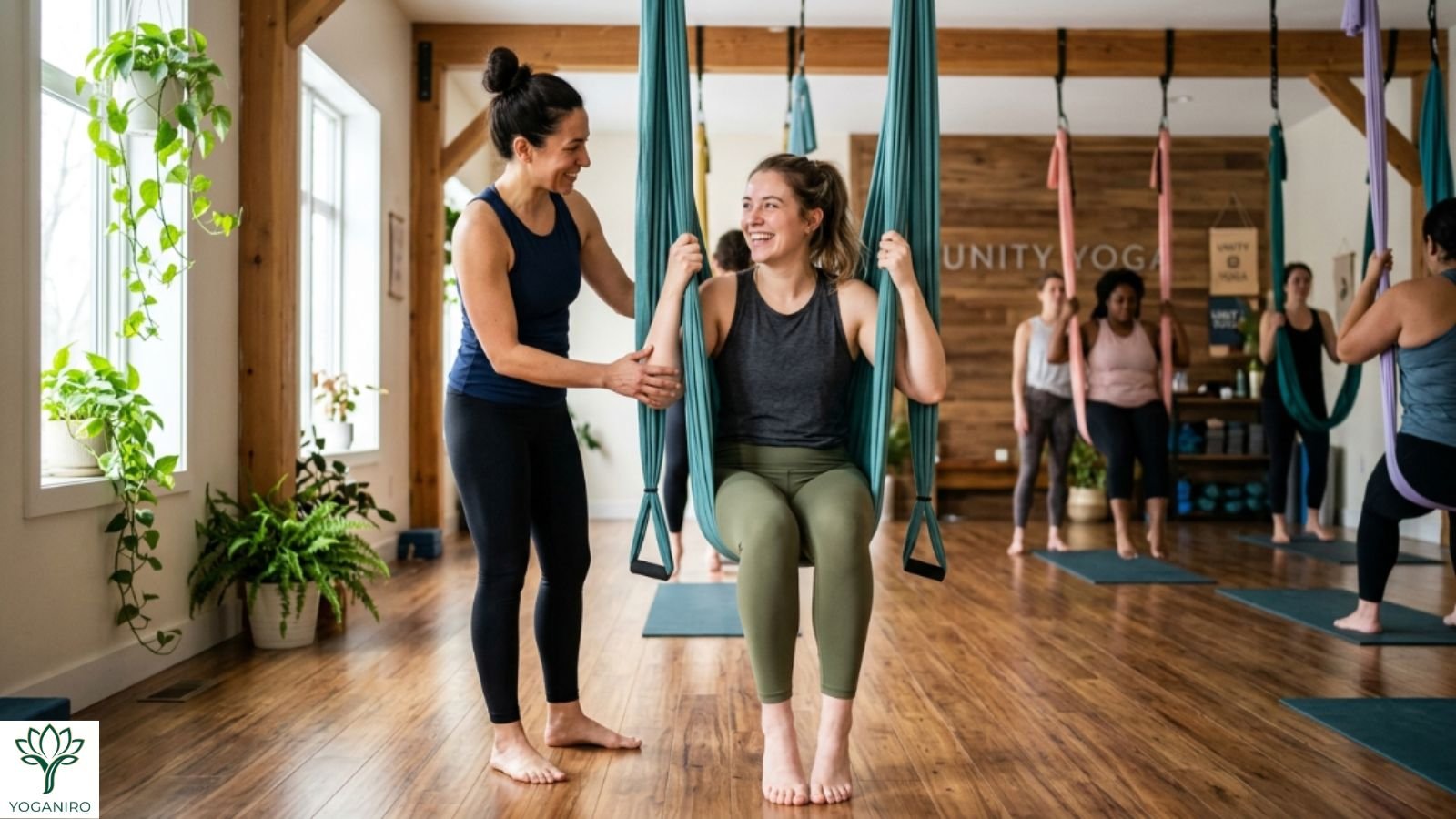
No, flexibility is not required to begin aerial yoga. This myth keeps far too many people away. Flexibility is a result of the practice rather than a prerequisite for it. The hammock does much of the work. It supports your body and guides you into a deeper stretch than you could safely reach on a mat. A common beginner mistake is waiting to feel ready or bendy enough. That day rarely arrives on its own. You build flexibility and range of motion by showing up, not before.
Aerial Yoga Classes & Levels We Offer
Yoganiro’s aerial yoga classes range from serene and restorative to strong and spirited. Every student can choose a class that matches the day’s energy. Beginners should always begin with an open-level class before advancing. The table below outlines the classes on our schedule, along with the student each one suits best.
| Class | Level | Focus | Prerequisites |
|---|---|---|---|
| Aerial Yoga Open Level | Beginner | Hammock foundations, body awareness, supported inversions | None |
| Aerial Morning Bliss | Beginner | Energizing flow with light conditioning exercises | None |
| Aerial Strength & Stretch | All levels | Full-body sequences for strength and endurance, then deep stretch | None |
| Aerial Mellow Flow | Beginner | Restorative, yin-inspired long holds with pranayama and meditation | None |
| Aerial Yoga Core | Intermediate | Core strength and balance | At least one Aerial Yoga Open Level class |
| Aerial Yoga Level 2 | Advanced | Aerial acrobatics, flips, and spins on a single-point hammock | 10+ recent classes |
A few notes will help you choose with confidence. For calm, Aerial Mellow Flow draws on yin yoga principles and keeps the fabric close to the ground. For a challenge, Aerial Strength & Stretch pairs a conditioning warm-up with focused mobility work. Aerial Yoga Core awakens the abdominals beautifully, yet it is not designed for a first-time flyer. Reserve it until your inversions feel steady. Aerial Yoga Level 2 is where genuine trapeze-style silks work begins, rewarding the students who commit to the practice.
What to Expect in Your First Aerial Yoga Class
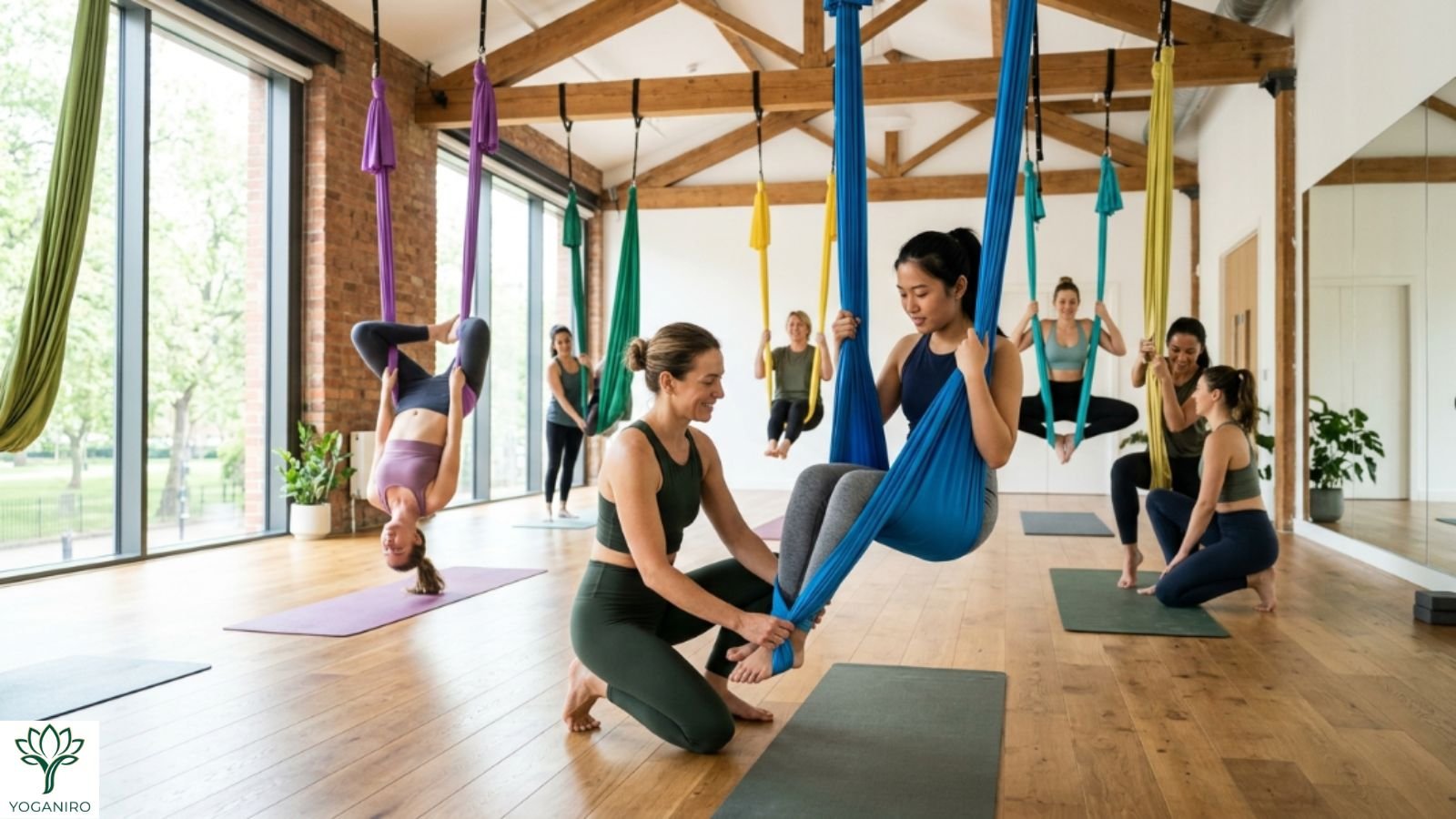
Your first aerial yoga class follows a calm, predictable arc. You begin with a warm-up on the mat, progress to hammock basics near the floor, explore a few supported inversions, and finish cradled in the silks. Plan to arrive about 10 minutes early. Your teacher needs that time to fit the hammock to your exact height. For safety reasons, studios rarely set up latecomers. So the honest answer to what to expect in your first aerial yoga class is this: gentle guidance, small steps, and far more support than you would ever guess.
A few gentle surprises are perfectly normal. Turning upside down for the first time can bring a wave of mild motion sickness, especially as you return upright. Move slowly through each transition and the sensation usually fades within seconds. Your core, arms, and wrists may feel worked the next day, a reassuring sign that your body rose to the occasion. The greatest hurdle is mental. As one longtime student described it, the true breakthrough is learning to trust the fabric, which is load-tested and far stronger than it appears.
A word on clothing, because comfort shapes the entire experience. Wear fitted, stretchy pieces that cover the backs of your knees and your underarms, since bare skin can chafe against the silk fabric.
Our guide on what to wear with yoga shorts offers easy styling ideas that translate beautifully to the hammock. Avoid zippers, buttons, and rough seams that might snag the fabric. Remove all jewelry, watches, and hair clips before class. Eat something light at least 2 hours beforehand so inversions sit easily with your stomach. If you are refreshing your wardrobe, our Alo promo code and Beyond Yoga promo code help you dress the part for less. Once these small details are handled, the rest of your energy flows toward the pure joy of flying.
Safety, Contraindications & Who Should Avoid It
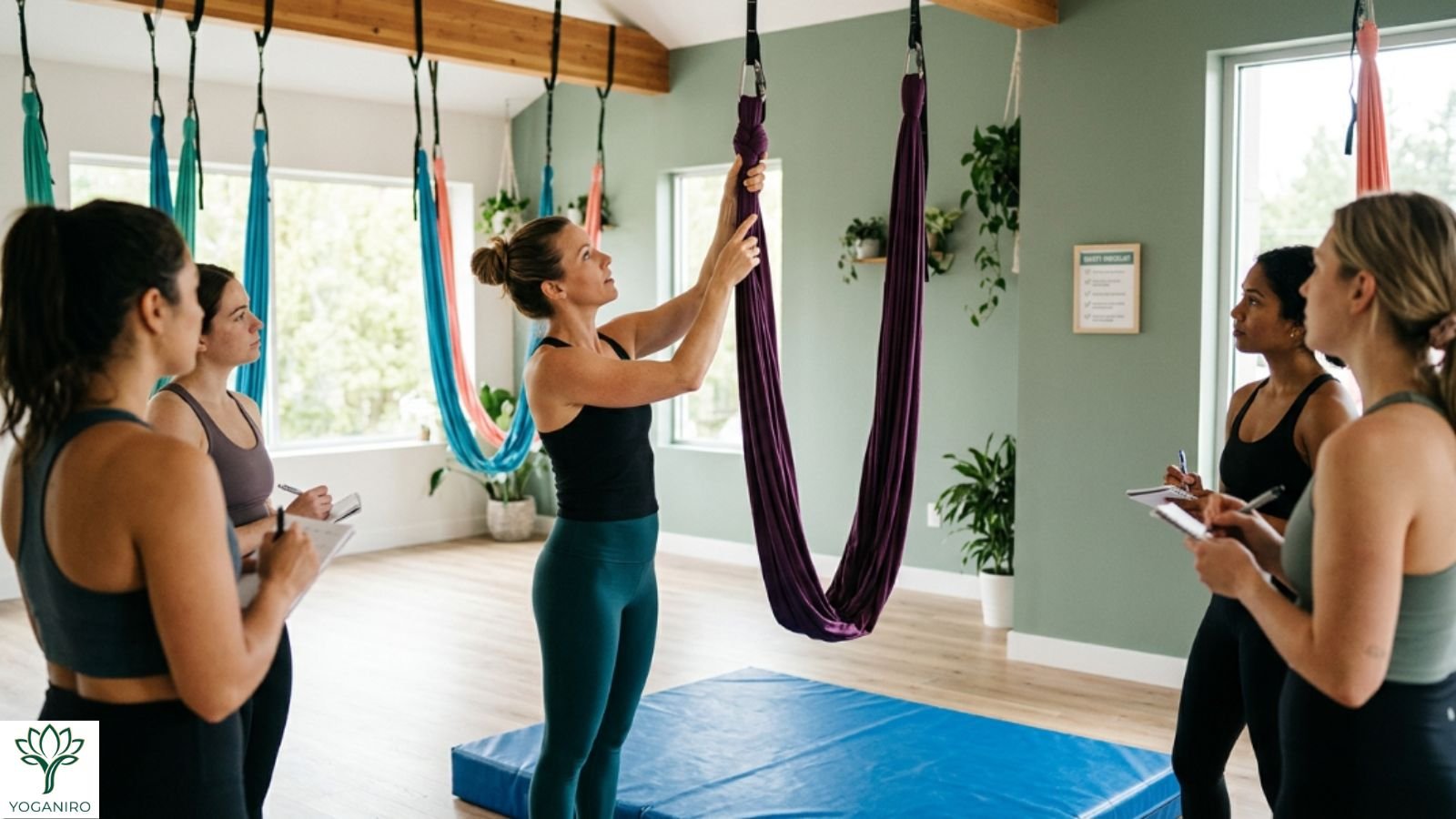
Aerial yoga is safe for most healthy adults when a certified instructor leads the class, though a handful of health conditions make it risky. The reason lies in the inversions. Turning your head below your heart raises pressure in the eyes and head, which is harmless for most people yet dangerous for a few. The Glaucoma Research Foundation advises anyone with elevated eye pressure to avoid head-below-heart positions. Understanding the aerial yoga contraindications before you book protects you and lets you truly relax once you are in the fabric.
Because safety is never the place to guess, the conditions below mean you should skip aerial yoga or seek a doctor’s clearance first. Please talk with your physician if any of these apply to you.
- Pregnancy
- Glaucoma or any condition with raised eye pressure
- Very high or very low blood pressure
- Heart disease or a recent stroke
- Recent surgery, especially on the eyes, back, shoulders, or hips
- Vertigo or a tendency to feel dizzy
- Osteoporosis or weakened bones
- Disc herniation or a serious spine or neck injury
Good habits matter as much as the list above. Never skip the warm-up, since cold muscles raise your risk of injury in the air. Choose a studio whose teachers hold current CPR and first-aid certification alongside formal yoga training. If you are managing an ongoing injury, request a therapeutic-style teacher or a private session, where you will receive closer attention and safer modifications.
Is Aerial Yoga Safe During Pregnancy?
Aerial yoga during pregnancy calls for direct medical guidance. Most studios list pregnancy as a clear contraindication. The concern is genuine. Inversions, deep core compression, and pressure from the fabric can strain a changing body. Some specially trained instructors offer prenatal aerial classes built around gentle, supported movement, though these remain the exception. If you are pregnant and curious, the safe path begins with one conversation with your doctor and another with a prenatal-trained teacher before you ever step into a hammock.
Meet Our Aerial Yoga Teachers

Yoganiro’s aerial yoga teachers are the reason beginners feel safe leaving the ground. Their training sits at the heart of everything we do. Every instructor holds a minimum of 200 hours of yoga teacher training, current CPR and first-aid certification, and aerial-specific credentials earned through dedicated practice. That combination matters more than any single qualification. A gifted aerial teacher does far more than demonstrate a pose. They notice the flicker of fear in your shoulders, offer a thoughtful modification, and celebrate the moment you first lift off the ground.
You will meet a range of styles across the Yoganiro team. Some teachers come from a restorative and yin yoga background, leaning into breath, stillness, and the mind-body connection. Others thrive on strength, guiding conditioning exercises and aerial acrobatics with patient, steady coaching. Full teacher bios live on our schedule page, where you can explore each instructor’s story, specialty, and class times before booking. Beginners remain in exceptional hands here, because we keep groups small and give every first-time flyer genuine one-on-one attention.
Pricing, Packages & New Student Deals
Yoganiro keeps aerial yoga pricing easy to begin, with a new student deal, single drop-in classes, class packs, and monthly memberships. For most beginners, the intro offer is the wisest first step, since it lets you experience the practice without a large commitment. Across the United States, a single aerial class generally runs between $25 and $40, a reflection of the small class sizes and specialized equipment.
| Option | Typical Price (USD) | Best For |
|---|---|---|
| New Student Intro Offer | $20 first class, or $49 for two weeks unlimited | First-time flyers testing the waters |
| Single Drop-In Class | $25–$40 | Trying aerial yoga once |
| 5-Class Pack / Aerial Pass | $110–$175 | Casual, flexible regulars |
| Monthly Membership | $120–$200 | Anyone taking 2+ classes a week |
How Much Does Aerial Yoga Cost?
Aerial yoga typically costs $25 to $40 for a single drop-in class in the United States, with class packs and memberships lowering the per-class price. A first-time intro offer is usually the most affordable entry point, sometimes as little as $20 for your first session. If you plan to practice two or more times each week, a monthly membership almost always saves the most money compared with a single drop-in class or aerial pass.
Studio Policies & What to Know Before Booking
A few studio policies are worth knowing before you book your first aerial yoga class. The essentials cover booking, cancellations, and arrival time. Classes fill quickly because space and hammocks are limited. Reserve your place in advance through our online scheduler or app rather than counting on a walk-in spot. Booking early also secures your hammock, which matters more than most beginners expect.
Our cancellation and makeup rules stay simple and fair. Cancel outside the set window and you will receive a class credit. Cancellations inside that window, along with no-shows, are not eligible for a makeup. Arrive at least 10 minutes early so your teacher can fit the hammock to your height, since latecomers may be unable to join for safety reasons. We limit refunds to class cancellations and genuine medical situations. Read each class description first to confirm you meet any prerequisites. When in doubt, email us or ask at the front desk. We are always glad to help you find the right class.
Frequently Asked Questions (FAQ)
Does aerial yoga hurt?
Aerial yoga should not hurt, though the fabric may press firmly against your skin during your first few sessions while your body adjusts. Mild soreness in your core, arms, and wrists the next day is completely normal and fades quickly. Sharp or sudden pain is not normal. Ease off and tell your instructor right away.
Do you need to be flexible to start aerial yoga?
No, you do not need to be flexible to start aerial yoga. Beginner classes grow your flexibility over time rather than test it on day one. The hammock supports your body and helps you reach a deeper stretch than a mat allows. Stiff newcomers are welcome, and they are very common.
Is there a weight limit for aerial yoga hammocks?
Most aerial yoga hammocks are load-tested to hold several hundred pounds, often between 300 and 600 pounds or more, far beyond the average person’s weight. Studios rig their equipment to strict safety standards and inspect it regularly. If you have any concern about a specific setup, just ask the studio directly and they will share the limits.
Can you do aerial yoga if you’re afraid of heights?
Yes, most people who fear heights can enjoy aerial yoga, because beginner hammocks hang just 1 to 3 feet off the ground. You stay low and close to the floor while you learn, never high in the air. Confidence usually grows within the first class or two as you learn to trust the fabric.
How is aerial yoga different from regular yoga?
Aerial yoga uses a suspended fabric hammock to support your body, while regular yoga keeps you on a mat on the floor. That support removes gravity’s pressure, allowing deeper spinal decompression, easier supported inversions, and stronger core engagement. Regular yoga builds your base. Aerial yoga adds float, traction, and a fresh challenge.
How often should beginners practice aerial yoga?
Beginners should practice aerial yoga 1 to 2 times per week at first, which gives muscles time to adapt and recover between sessions. Focus on technique and breath rather than intensity in these early weeks. After 4 to 6 weeks, you can add a third session if your body feels ready and rested.
How many calories does aerial yoga burn?
Aerial yoga burns about 320 calories in a single 50-minute session, according to a study from the American Council on Exercise. Stronger classes with conditioning exercises and aerial acrobatics push that number higher, while gentle restorative classes burn less. Either way, you gain low-impact movement that supports a reduced risk of heart disease.
Ready to Take Your Practice Off the Ground?

Aerial yoga is safe, welcoming to beginners, and genuinely nourishing for both body and mind. You need no experience, no strength, and no flexibility to begin, only curiosity and a willingness to try something new. The hammock carries more of the work than you imagine. Your very first class may leave you smiling long after you unwrap yourself from the silks.
So take the leap. Book a beginner aerial yoga class or claim the Yoganiro new student deal today. Give yourself the space to stretch, breathe, and reconnect with your body in the air.
Explore More from Yoganiro
Keep the calm going with more guides and inspiration from the Yoganiro collection.
- Practice together: yoga poses for two people, partner yoga poses that build trust, and 3-person yoga poses for larger groups.
- Deepen your practice: what is tantric yoga, expressive and sensual yoga poses, and yoga quotes for 2026.
- Gear and savings: yoga bolsters, what to wear with yoga shorts, plus our Alo promo code and Beyond Yoga promo code.
- Studios and experiences: Spirit Lab Yoga Studio in NYC, the Portland Yoga Project, and puppy yoga in Boston.
- If you love the lift of aerial work, explore the grounded acrobatics of yoga for three people — a playful mix of balance, strength, and trust.
References
- American Council on Exercise. ACE Study Evaluates Health Benefits of Aerial Yoga.
- Healthline. Aerial Yoga: Benefits, What It Is, and How to Get Started.
- Glaucoma Research Foundation. Is Doing Yoga Safe If I Have Glaucoma?
About Yoganiro
Yoganiro is a yoga and wellness publication dedicated to clear, honest, and practical guidance. Every guide is fact-checked against credible sources such as Yoga Journal, Harvard Health, and peer-reviewed research before it is published. Questions or corrections? Reach out through our contact page.

Yoganiro was founded by Abdul Rehman with a passion for yoga, wellness, and mindful living. The goal behind Yoganiro is to inspire people through simple yoga practices, wellness tips, and healthy lifestyle content that promotes balance, peace, and overall well-being.
1 thought on “Aerial Yoga: A Complete Beginner’s Guide to Classes, Benefits & What to Expect”