

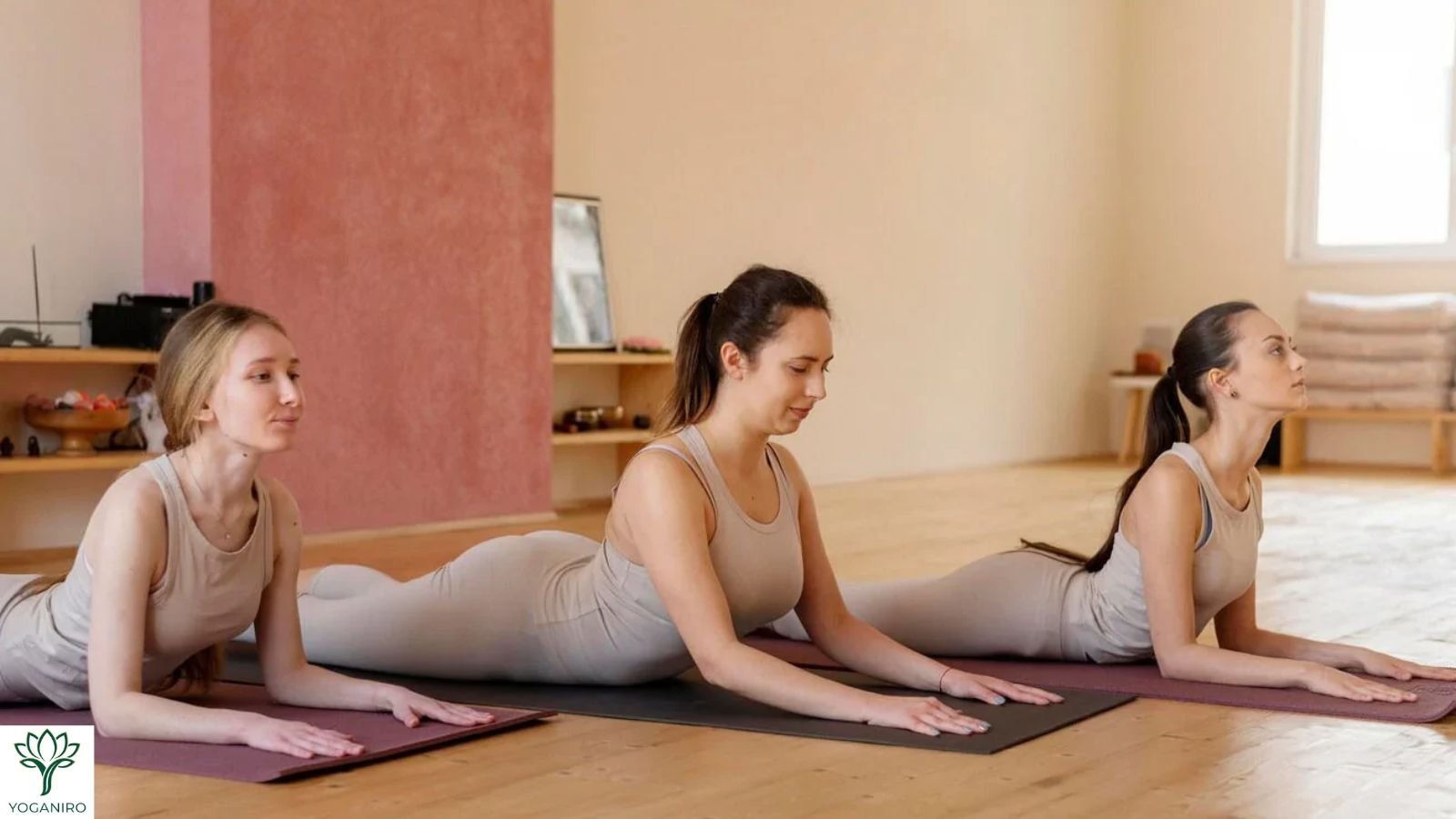
Got two friends who want to practice yoga with you? You don’t need to build a human pyramid to make it a group session. These 3 person yoga poses let three people move together while each person supports their own body. You can start with gentle seated stretches, try standing balances with a wall nearby, and finish with a relaxed group cooldown.
Quick answer: For a first session, try Triple Mountain, Seated Side-Bend Circle, and supported Trio Tree Pose. Give everyone their own space, let one person call the transitions, and choose different variations when needed. No lifting, pulling, or matching flexibility is required.
This guide includes 10 grounded trio arrangements, a pose-selection chart, practical modifications, and a 20-minute beginner routine. If you’re looking for flying poses or stacked balances instead, see the AcroYoga section before trying them.
What Are 3 Person Yoga Poses?
The phrase 3 person yoga poses can describe two different activities:
- Grounded trio yoga: Three people perform familiar yoga postures together, each independently supported by the floor, a wall, or their own props.
- Connected partner yoga or AcroYoga: People use physical contact to share balance or support someone else’s weight. Flying poses and pyramids belong in this category.
This article is about the first type. Names such as Triple Mountain and Trio Child’s Pose are convenient names for group arrangements, not separate, standardized yoga asanas. Some readers may prefer a connected formation; if that’s your goal, look for a qualified AcroYoga class rather than turning the grounded versions below into lifts.
Which Trio Yoga Pose Should You Try First?
| Pose | Level for the variation shown | Best for | Easier choice |
|---|---|---|---|
| 1. Triple Mountain | Beginner | Starting together | Seated Mountain |
| 2. Seated Side-Bend Circle | Beginner | Gentle side movement | Smaller reach or chair |
| 3. Trio Child’s Pose | Beginner, if kneeling is comfortable | Resting | Supported seated rest |
| 4. Supported Trio Tree | Beginner with support | Balance | Toes down and wall support |
| 5. Side-by-Side Downward Dog | Intermediate | Whole-body movement | Tabletop |
| 6. Seated Forward-Fold Trio | Beginner, gentle version | Comfortable hip hinge | Bent knees or stay upright |
| 7. Gentle Standing Twist | Beginner | Small, controlled rotation | Seated rotation |
| 8. Shallow Trio Chair | Beginner, shallow version | Standing leg work | Smaller bend or sit-to-stand |
| 9. Bent-Knee Boat Trio | Intermediate | Balance and trunk control | Keep feet down |
| 10. Wall-Supported Warrior III | Intermediate | Single-leg balance | Keep back toes down |
Not sure where to begin? Choose poses 1, 2, and 3. For balance practice, add pose 4. Save poses 5, 9, and 10 until everyone feels comfortable with the corresponding individual movements.
Why Practice Yoga With Two Friends?
Practicing as a trio can make an ordinary yoga session feel more social. You can take turns choosing the next movement, offer verbal reminders, and build a routine that works for different experience levels. A beginner can keep both feet on the ground while a more experienced participant uses a balance variation; everyone still participates.
The physical challenges come from the individual postures, not from the number of people in the room. Yoga research summarized by NCCIH discusses potential benefits of yoga generally, such as balance and stress management. It does not establish that practicing with two friends is more effective than practicing alone.
How to Set Up a Three-Person Yoga Session
Choose a Layout That Fits the Pose
Parallel mats: Place three mats side by side, all facing the same direction. This is useful for Downward Dog, Child’s Pose, and seated forward folds. Leave space for arms and legs; the mats do not need to touch.
Loose triangle: Give each person a separate position facing the center. This works for Mountain, shallow Chair, and a seated side-bend circle. Keep enough space to move without bumping knees or hands.
Wall stations: For Tree and Warrior III, each person needs a reachable section of a stable wall and clear space behind or beside them. If that isn’t possible, take turns rather than crowding together.
There is no single correct mat spacing: check the actual reach of the people practicing and the space each movement requires. Move furniture, bags, and other trip hazards first.
Agree on Four Simple Group Rules
- Anyone can stop. No one needs to hold a pose until the last person finishes.
- Don’t adjust someone without permission. These no-lift variations don’t require gripping, pushing, or pulling a partner.
- Use clear verbal cues. Try “ready,” “change sides when you’re ready,” and “back to center.”
- Let everyone use their own variation. One person may stand while another uses a chair or keeps both feet on the floor.
Warm up with a few minutes of easy walking, shoulder movements, and comfortable joint motion. Start with familiar poses before trying more demanding balances.
Safety note: Yoga is generally considered safe for healthy people when practiced appropriately, but injuries can occur. The National Center for Complementary and Integrative Health (NCCIH) recommends qualified instruction, especially for beginners, and individual advice for pregnancy, older age, injuries, balance problems, or other health conditions. Stop if you feel pain, dizziness, numbness, or unable to control your movement.
10 Grounded 3 Person Yoga Poses to Try
A few comfortable breaths per attempt are enough to begin. The goal is shared timing, not identical body shapes. Leave a gap between participants so each person can return to a neutral position independently.
1. Triple Mountain Pose
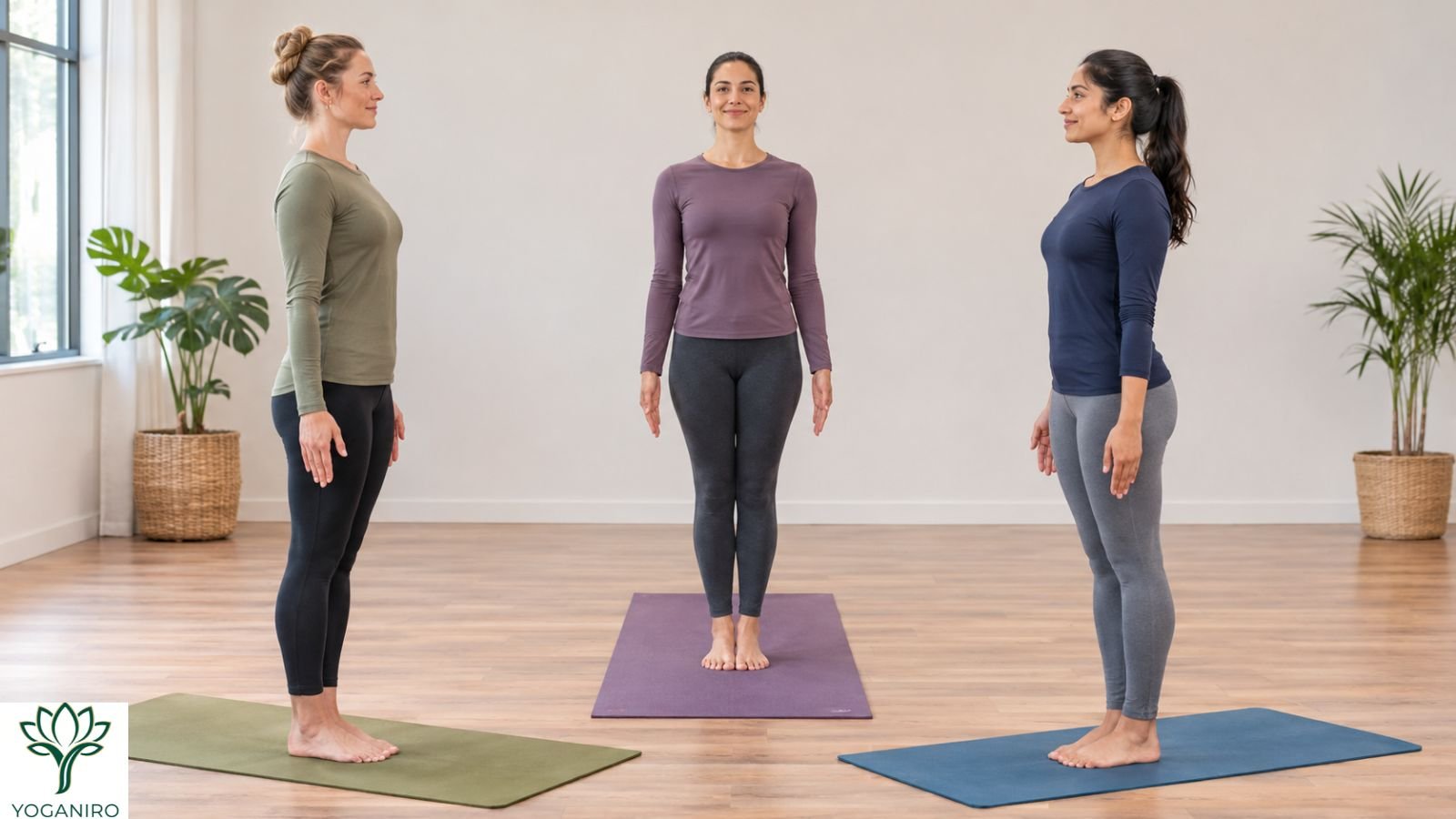
Level: Beginner
Group setup: Loose triangle or three side-by-side mats
Mountain Pose (Tadasana) makes a simple opener because everyone can focus on standing comfortably without balancing on one leg.
- Stand with feet comfortably apart and weight spread across both feet.
- Relax the shoulders and let arms rest by your sides.
- Keep knees soft rather than locking them.
- Take three to five natural breaths, then relax.
Make it a trio: Person A invites the group to begin; Person B calls the end of the round; Person C leads the next round. Nobody needs to match breathing speed.
Easier option: Sit upright on a stable chair with feet supported.
Watch for: Leaning backward, locking the knees, or raising the shoulders toward the ears.
2. Seated Side-Bend Circle
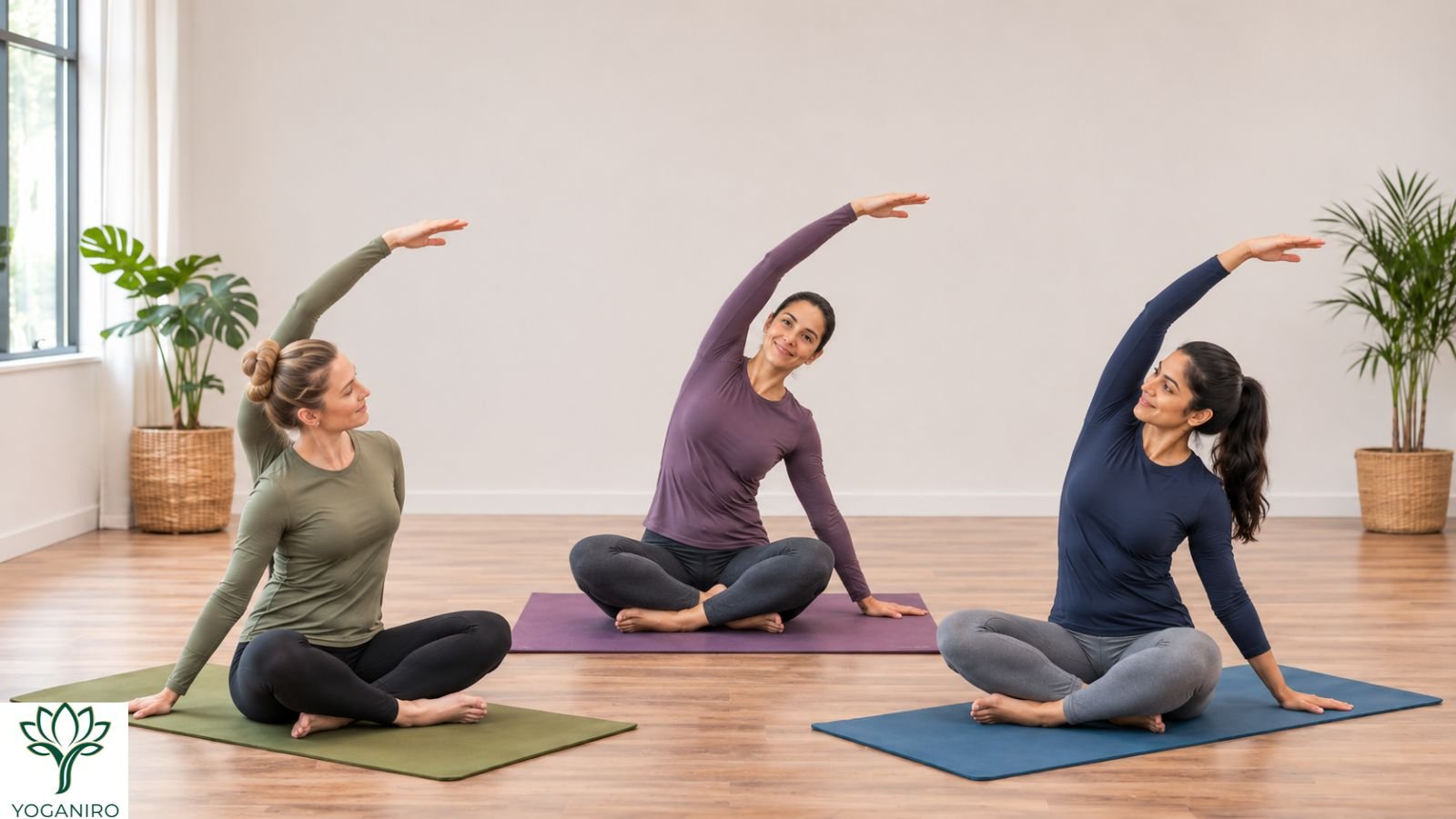
Level: Beginner
Group setup: Three people seated in a spacious circle
- Sit cross-legged, on cushions, or on stable chairs.
- Keep your right hand beside you for light support.
- Reach the left arm up only as far as comfortable, then lean slightly to the right.
- Keep both sitting bones supported; return to the center.
- Repeat gently on the other side.
Make it a trio: One person says “right, center, left, center,” allowing everyone to finish a movement before the next cue.
Easier option: Place your upper hand on your hip, shorten the reach, or use a chair.
Watch for: Lifting a hip off the seat or reaching so far that you lose balance.
3. Trio Child’s Pose
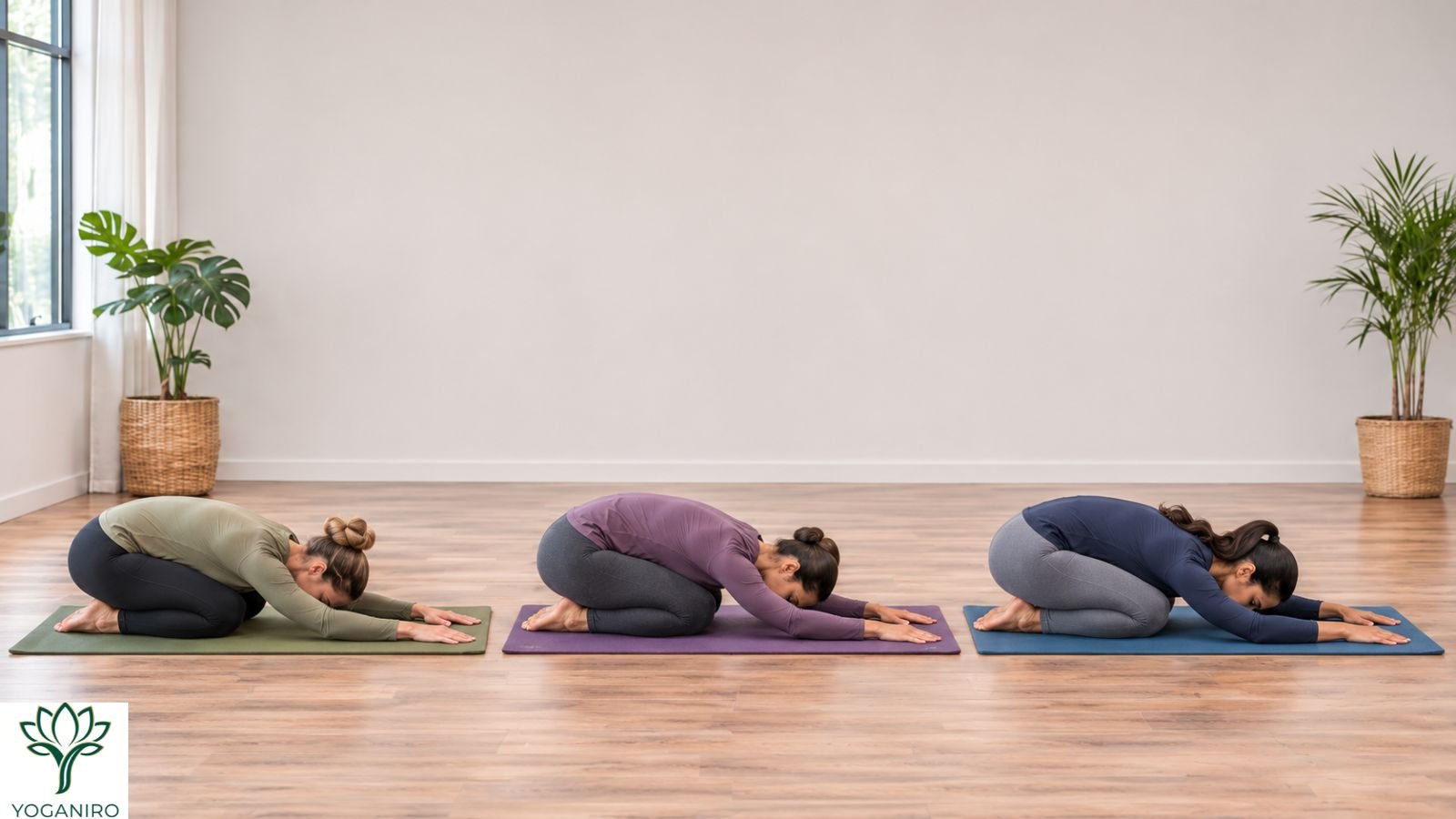
Level: Beginner when kneeling is comfortable
Group setup: Three parallel mats with space between them
- Begin on hands and knees.
- Move your hips gently back toward your heels, letting the knees separate as comfortable.
- Rest your forehead on suitable support if it reaches comfortably.
- Breathe without forcing the stretch.
- Return to hands and knees slowly when ready.
Make it a trio: Use the same start cue, but allow everyone to come out of the pose in their own time. It is a good stopping point between standing movements.
Easier option: Place support under the forehead or torso, or choose an upright seated rest if kneeling is uncomfortable.
Watch for: Pressure at the knees, uncomfortable ankle positioning, or forcing hips toward heels.
For a reference to the traditional individual posture, see ACE Fitness’s illustrated beginner yoga guide.
4. Supported Trio Tree Pose
Level: Beginner with wall support
Group setup: Separate stations near a wall
- Stand tall with one hand lightly touching a stable wall.
- Shift your weight onto one foot.
- Set the other heel near your standing ankle while keeping its toes on the floor.
- If steady, rest the lifted foot lightly against the standing calf, not against the knee joint.
- Look at one still point, take a few comfortable breaths, and lower the foot before switching sides.
Make it a trio: The leader calls “feet down” before the group changes sides. Keep your eyes on a fixed point instead of turning toward the others while balancing.
Easier option: Keep the toes on the ground the entire time.
Watch for: Pressing the lifted foot into the knee or trying to match someone else’s balance level.
For more solo progressions, see Yoganiro’s yoga poses for balance.
5. Side-by-Side Downward-Facing Dog
Level: Intermediate
Group setup: Three parallel mats, all facing the same direction
- Begin in a comfortable hands-and-knees position.
- Position your hands slightly ahead of your shoulders and spread the fingers comfortably.
- If appropriate for your wrists and shoulders, tuck your toes and lift your hips upward and back.
- Bend your knees as needed; heels do not have to touch the floor.
- Lower your knees with control to finish.
Make it a trio: Rather than moving in perfect unison, let the caller give a start cue and a gentle invitation to return to Tabletop. Each person can rest earlier.
Easier option: Remain in Tabletop with hands and knees on the floor, or choose a seated movement if loading the wrists is uncomfortable.
Watch for: Forcing straight legs, shrugging into the shoulders, or remaining in the pose despite wrist pain.
See ACE’s Downward-Facing Dog instructions for the individual exercise.
6. Seated Forward-Fold Trio
Level: Beginner for a gentle, bent-knee version
Group setup: Sit side by side with clear space in front of the legs
- Sit tall with legs extending forward and knees comfortably bent.
- Place hands on your own thighs or shins.
- Hinge forward slightly from the hips; stop at the first comfortable range.
- Stay for a few easy breaths and return upright slowly.
Make it a trio: Everyone begins on one cue but chooses a different depth if needed. Wait until all three participants are upright before moving on.
Easier option: Bend the knees more, sit on a folded blanket, or remain upright.
Watch for: Pulling on the legs, bouncing, or folding into back pain. Avoid partner traction.
The individual movement is described in the Art of Living’s Seated Forward Bend guide.
7. Gentle Standing Twist
Level: Beginner
Group setup: Loose circle with plenty of elbow room
- Stand with feet comfortably apart and knees relaxed.
- Rest your hands on your hips or across your chest.
- Turn your chest a small, comfortable amount to the right while keeping the feet grounded.
- Return to center before turning left.
- Repeat slowly without using momentum.
Make it a trio: Choose one caller for the simple sequence: “right, center, left, center.” Everyone chooses a comfortable range rather than turning to look at a partner.
Easier option: Make the turn smaller or sit upright on a stable chair.
Watch for: Forcing the twist, swinging the arms, or turning the head sharply.
8. Shallow Trio Chair Pose
Level: Beginner for a shallow version
Group setup: Three separate standing positions in a loose triangle
- Stand with feet comfortably apart.
- Bend your knees a little while sending your hips slightly back, as though preparing to sit.
- Keep your feet grounded, your chest comfortably lifted, and arms wherever they feel stable.
- Press through your feet to return to standing.
Make it a trio: Agree on a short round, then have a different person cue the return to standing. No linked arms or shared counterweight are needed.
Easier option: Reduce the bend or use a controlled sit-to-stand from a stable chair.
Watch for: Dropping deeper to match a friend, collapsing inward at the knees, or continuing through knee pain.
For the individual movement, see the Art of Living’s Chair Pose guide.
9. Bent-Knee Boat Trio
Level: Intermediate
Group setup: Seated triangle with enough room between everyone’s feet
- Sit with knees bent and feet on the floor.
- Lean back slightly while keeping the chest comfortably lifted.
- Hold the backs of your thighs if helpful.
- If the position feels controlled, briefly lift your feet while keeping the knees bent.
- Lower your feet before relaxing.
Make it a trio: Choose a short round and keep each person’s feet clear of the others. A participant who keeps both feet down can lead the timing.
Easier option: Keep both feet planted for the entire exercise.
Watch for: Lower-back pain, rounded collapsing posture, or holding your breath. Skip this exercise if you have significant lower-back pain or recent abdominal surgery, as advised in Health and Wellbeing Queensland’s Boat Pose guide.
10. Wall-Supported Warrior III
Level: Intermediate
Group setup: Separate wall stations with clear space behind each participant
- Face a stable wall with your hands resting against it.
- Step back enough to hinge comfortably at the hips.
- Shift your weight onto one foot, keeping that knee soft.
- Extend the other leg behind you; lift it only as far as you can control, or keep the toes down.
- Keep your hips facing toward the floor, then lower the leg and return upright before changing sides.
Make it a trio: Set up one at a time so you can check available space. The leader waits until all three participants have both feet down before cueing the other side.
Easier option: Keep the back toes on the floor, or practice a small supported hip hinge with both feet down.
Watch for: Lifting the leg too high, twisting the hips, or moving away from support before you are ready.
YogaEasy’s beginner Warrior III guide describes using a wall or chair for balance support.
Try This 20-Minute Beginner Trio Yoga Routine
This starter sequence uses eight of the ten arrangements above plus gentle movement. Boat Pose and Warrior III are intentionally left out of the beginner routine; they can be practiced separately after appropriate instruction. Time blocks include transitions, short attempts, and rest—not continuous holds.
| Time | Activity | Trio cue |
|---|---|---|
| 0:00–3:00 | Gentle warm-up and space check | “Find your own comfortable pace” |
| 3:00–5:00 | Triple Mountain, then shallow Chair | “Stand tall; bend only as far as you like” |
| 5:00–8:00 | Supported Tree on both sides | “Feet down before we switch” |
| 8:00–11:00 | Gentle Standing Twist and Seated Side-Bend Circle | “Return to center” |
| 11:00–14:00 | Tabletop or brief Downward Dog attempts | “Rest whenever you need to” |
| 14:00–17:00 | Gentle Seated Forward Fold | “No need to match anyone’s depth” |
| 17:00–20:00 | Supported Child’s Pose or seated rest | “Finish in your own time” |
Only have five minutes? Try one minute each of Mountain, a seated side bend, supported Tree (including side changes), a gentle seated fold, and quiet rest. Leave enough time to move between positions without rushing.
To keep things friendly, rotate the caller for each section. Encourage people to say when a pose is uncomfortable instead of treating the sequence as a competition.
When Do Three-Person Yoga Poses Become AcroYoga?
A trio session becomes a different kind of practice when one person is supporting another person’s body weight or participants must rely on shared balance to stay upright. Stacked planks, human pyramids, Front Bird, and flying Throne are not simply harder versions of these independent yoga arrangements.
AcroYoga commonly uses three roles:
- Base: The person providing support.
- Flyer: The person being supported.
- Spotter: A trained helper who assists with balance and fall prevention for the specific skill.
For the lifted version of 3 people yoga poses, learn from a qualified instructor who can assess prerequisites, establish spotting roles, and teach safe entries and exits in person. An introductory class typically includes basic balances and spotting practice, as described in AcroYoga Montreal’s FAQ. If all three people are inside a formation, ask the instructor whether additional spotting is required.
Do not turn a three-person beginner session into a home pyramid challenge. If you want to explore group practice with more people, Yoganiro also has guides to 4 person yoga poses and 5 person yoga poses; always check the demands of each formation before attempting it.
Can Children and Mixed-Ability Groups Join?
For children, choose familiar grounded movements such as Mountain, a small seated side bend, and supported Tree. An adult should supervise, keep the session playful, and allow children to stop at any time. Avoid climbing on other participants or building human pyramids at home.
Groups with different heights, mobility, or experience levels don’t need to use identical variations. A person can sit while others stand, keep Tree Pose toes down, or choose Tabletop instead of Downward Dog. If someone has an injury or health condition that affects safe movement, seek personalized guidance before including a pose.
Frequently Asked Questions
Can beginners do 3 person yoga poses?
Yes. Three beginners can practice familiar, individually supported movements together. Start with Triple Mountain and the Seated Side-Bend Circle, use support where needed, and learn unfamiliar poses from a qualified teacher.
What are the easiest yoga poses for three people?
Triple Mountain, Seated Side-Bend Circle, and a comfortable resting position are straightforward choices. Supported Tree is another option for those who can balance with a wall. The easiest pose is the one that suits all three people’s needs.
Are these actual connected three-person yoga poses?
These are grounded group arrangements of individual yoga postures, not weight-sharing acrobatic formations. Connected lifts belong to partner yoga or AcroYoga and require different skills and instruction.
Do we have to hold hands or synchronize our breathing?
No. The group can share start and finish cues without touching or trying to match every breath. Each person should breathe naturally and move at a comfortable pace.
How long should we hold each pose?
Start with a few comfortable breaths, then come out and reset. Short attempts are usually more useful for a first group session than competing for long holds. If control or comfort changes, finish earlier.
How much space do three yoga mats need?
Enough for each person to extend their arms, step out of a balance, and change between floor and standing poses without touching someone else. Use a loose triangle for seated circles and parallel mats for side-by-side movements. Take turns at the wall if space is limited.
Do we need yoga blocks or other equipment?
No specialized trio equipment is required for these arrangements. Non-slip mats, a stable wall, folded blanket, or sturdy chair can make individual variations more comfortable. Props should be appropriate for each person, not selected just to make everyone look the same.
Can the same poses work with two people?
Yes. Most of these arrangements work with two participants as well. For additional partner-practice ideas, see Yoganiro’s yoga poses for two people.
Final Thoughts
The best first trio yoga session is simple: choose three comfortable poses, give everyone room, and take turns leading. Triple Mountain, a seated side bend, and supported Tree provide an easy place to begin without lifting or depending on another person’s balance.
If your group enjoys practicing together, build on what feels manageable. The goal is to share movement, communicate clearly, and finish feeling ready to come back next time—not to create the most dramatic shape in the room.

Yoganiro was founded by Abdul Rehman with a passion for yoga, wellness, and mindful living. The goal behind Yoganiro is to inspire people through simple yoga practices, wellness tips, and healthy lifestyle content that promotes balance, peace, and overall well-being.
4 thoughts on “3 Person Yoga Poses: 10 Fun No-Lift Trio Ideas”