

By the Yoganiro Editorial Team · Last updated: September 20, 2026
[VIDEO EMBED — place here] A 60–90 second clip demonstrating 3–4 grounded trio poses. Captures video-search intent and lifts dwell time. Alt/title: “3 person yoga poses demonstration for beginners.”
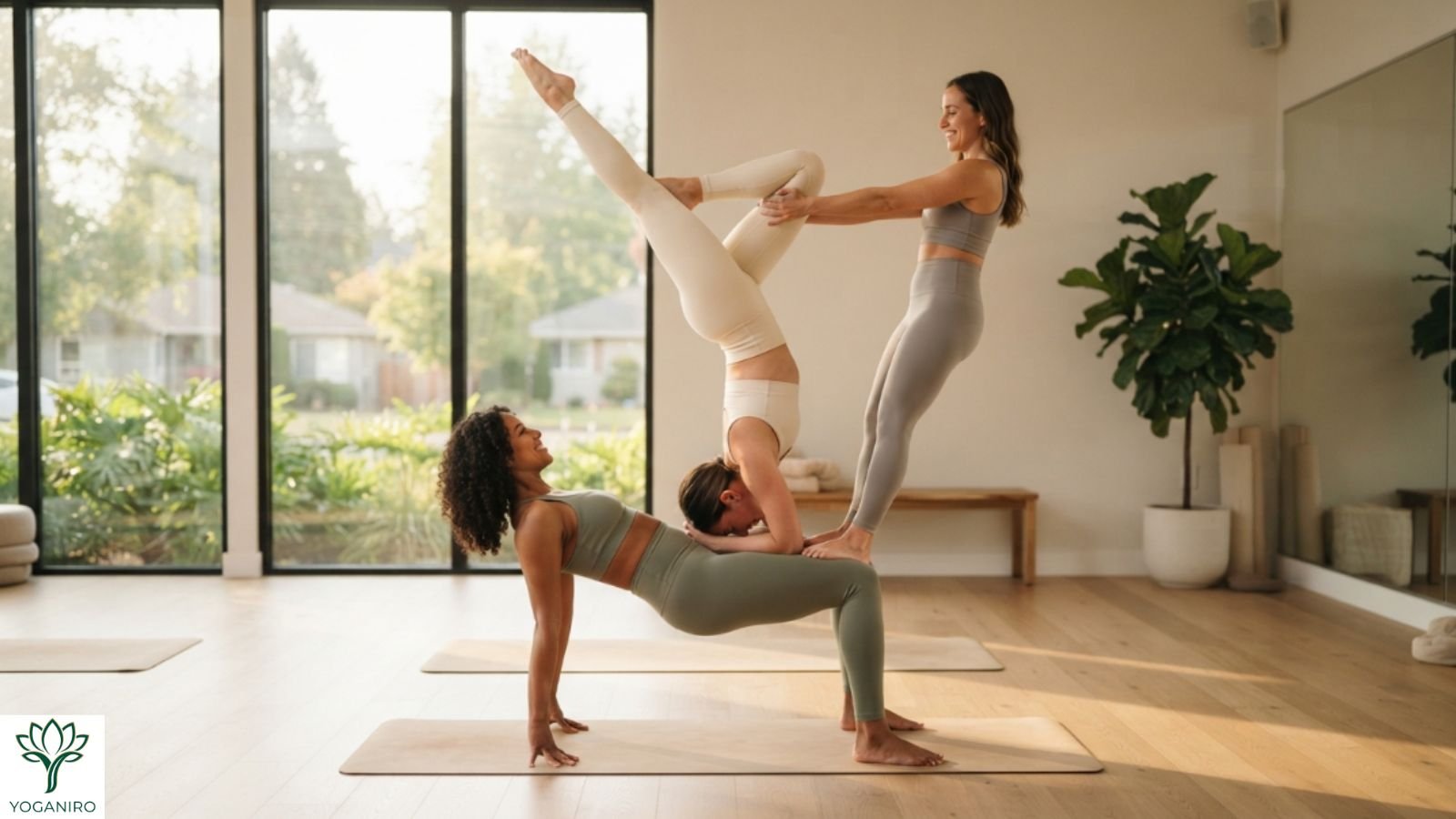
Three friends, one shape, a single shared breath — that is the quiet magic of trio yoga. From across the room it looks like play. Then you step in, feel your partners’ weight shift against yours, and realize how much strength, trust, and focus one steady pose really asks of you. That mix of challenge and laughter is exactly why 3 person yoga poses have blown up on TikTok and Instagram — and why they are so much more rewarding than practicing alone.
3 person yoga poses turn a solo practice into a team effort. You lift, support, and talk to each other — and you laugh when a shape wobbles. Along the way you build flexibility, core strength, and a kind of connection a solo mat rarely offers.
This guide walks you through trio yoga from the ground up — what it is, the three roles that keep everyone safe, and 20 poses arranged from your first grounded formation to advanced flying shapes. You’ll also find a ready-made 30-minute routine, a fun trio challenge, kid-friendly options, the most common mistakes, and honest safety guidance for every level.
Quick Answer: 3 person yoga poses are group formations where three people balance, stretch, and support one another in one shared shape. Every session relies on three roles — a base, a flyer, and a spotter — to stay safe. Beginners start with grounded shapes like Triple Mountain Pose and Trio Child’s Pose, then progress to lifted, acrobatic formations as trust and strength grow.
Pose difficulty at a glance
[IMAGE — place infographic here] Branded “20 Trio Yoga Poses: Easy → Advanced” infographic. This is your Pinterest pin asset (1000×1500). Alt: “Chart of 20 three person yoga poses from beginner to advanced.”
| # | Pose | Level | Best base | Main benefit |
|---|---|---|---|---|
| 1 | Triple Mountain Pose | Beginner | Shared | Breath synchronization |
| 2 | Seated Circle Stretch | Beginner | Shared | Chest & hip opening |
| 3 | Trio Child’s Pose | Beginner | Shared | Rest & recovery |
| 4 | Trio Tree Pose | Beginner | Shared | Balance |
| 5 | Triple Downward Dog Line | Beginner | Shared | Shoulders & hamstrings |
| 6 | Three-Person Seated Forward Fold | Beginner | Shared | Deep hamstring stretch |
| 7 | Standing Trio Twist | Beginner | Shared | Spinal mobility |
| 8 | Three-Person Chair Pose | Intermediate | Shared | Leg strength |
| 9 | Trio Boat Pose | Intermediate | Shared | Core |
| 10 | Trio Staircase | Intermediate | Strongest | Trust & coordination |
| 11 | Supported Warrior III Trio | Intermediate | Shared | Balance & focus |
| 12 | Trio Camel Circle | Intermediate | Shared | Backbend & chest |
| 13 | Double Plank + Spotter | Intermediate | Strongest | Full-body strength |
| 14 | Dancer Pose Trio | Intermediate | Shared | Balance & flexibility |
| 15 | Triple Plank Stack | Advanced | Strongest | Power & stability |
| 16 | Trio Pyramid Tower | Advanced | Two bases | Teamwork |
| 17 | Downward Dog Tower | Advanced | Two bases | Strength |
| 18 | Flying Throne Pose | Advanced | 1 base + spotter | Core & trust |
| 19 | Flying Front Bird | Advanced | 1 base + spotter | The classic first flight |
| 20 | Flying Shared Backbend | Advanced | 1 base + spotter | Deep chest opener |
What Are 3 Person Yoga Poses?
3 person yoga poses are shared formations where three people move into one balanced shape together. The practice blends classic yoga with light acrobatics, so you’ll often hear it called trio yoga or a form of AcroYoga — one of many different yoga styles worth exploring. Instead of flowing through poses alone, you lean on your partners for support, counterbalance, and steadiness. Whether you call them yoga poses for 3 people or trio yoga poses, the practice is the same — and this guide covers every level of it.
The appeal is simple. Trio yoga makes a familiar practice feel social and a little playful. It also builds strength you rarely reach on your own. Because it works for nearly every level, three friends can start with gentle grounded shapes one week and attempt their first lifted formation a month later. The only real requirements are patience, clear communication, and a willingness to wobble.
What Are the Three Roles in Trio Yoga?
Every one of these 3 person yoga poses depends on three clear roles: the base, the flyer, and the spotter. According to Yoga Journal’s guide to AcroYoga, the base is the foundation — usually closest to the ground — and provides the stable platform that holds everyone up. The flyer is lifted or supported into the shape and needs control, lightness, and steady breathing. The spotter stands close, watches every transition, and steps in the moment balance slips.
Understanding these roles makes practice both safer and smoother. Many teachers suggest rotating roles regularly, since each one builds a different skill — grounding as a base, awareness as a flyer, and quick, calm judgment as a spotter. In grounded beginner shapes the roles blur, because all three of you stay on the floor. The moment anyone leaves the ground, the roles become non-negotiable.
What Are the Benefits of 3 Person Yoga?
3 person yoga poses build strength, flexibility, and trust in a single practice. Many formations engage the core, shoulders, legs, and back at once, since your body works against both gravity and a partner’s weight. Research summarized by Healthline links regular yoga practice to better flexibility, balance, and strength — and trio work adds load-sharing that solo practice can’t replicate.
The accountability is real too. In a widely cited study in the Journal of Consulting and Clinical Psychology, 95 percent of people who joined an exercise-based program with friends completed it, compared with 76 percent of those who joined alone. Participants chose their own groups, so motivation surely played a part — but the pattern favors practicing together. Two partners expecting you on the mat is a schedule that keeps itself.
| Benefit | How it helps |
|---|---|
| Better flexibility | Assisted stretches gently expand your range of motion |
| Stronger core | Holding and sharing weight builds deep stability |
| Improved balance | Every shape trains proprioception under real load |
| Trust and communication | No pose works without clear, honest signals |
| Consistency | Group accountability keeps practice regular |
| Stress relief | Shared movement and laughter calm the nervous system |
Who Should Avoid 3 Person Yoga?
3 person yoga poses involve shared weight, balance, and physical contact, so certain conditions call for caution or a doctor’s clearance first. Skip weight-bearing and lifted formations — and stick to grounded, supported shapes — if any of the following applies:
Pregnancy — avoid inversions, deep twists, and any pose where another person’s weight rests on you; choose grounded shapes and confirm your plan with your healthcare provider
Herniated or bulging discs — loaded forward folds and stacked poses increase pressure on the spine
Recent surgery or injury — wrists, shoulders, knees, and backs need full clearance before group load-bearing
Sensitive or painful knees — many kneeling and weight-sharing shapes load the joint; ground down gently and borrow the modifications from our yoga poses for knee pain guide
Severe sciatica — many trio shapes compress or deeply stretch the lower back
Uncontrolled high or low blood pressure — inversions and effort-heavy holds are unsuitable until pressure is managed
Osteoporosis or fragile bones — weight-sharing poses carry a real fracture risk
Balance disorders or dizziness — flying and stacked positions amplify these risks
Stop immediately if you feel sharp pain, numbness, or dizziness at any point. These are general safety guidelines rather than medical advice — when in doubt, a quick conversation with your doctor before starting is always the safer route.
How Do You Prepare for a Safe Trio Session?
Warm up for 5 to 10 minutes before your first pose. A few rounds of Cat-Cow, a slow Downward Dog with pedaling heels, gentle seated twists, and a minute of shoulder rolls and wrist circles prepare exactly the joints that 3 person yoga poses load most. Warm muscles handle shared weight far better than cold ones.
Then talk before you touch. Agree on simple verbal cues — “ready,” “hold,” and “coming down” — and decide who calls the exit from each pose. A two-minute trust drill helps new groups: stand in a small circle and take turns leaning back gently while the other two catch and support you. It sounds basic, and it teaches your body to relax into support instead of resisting it. If partner work is completely new, our guide to partner yoga poses for building trust covers consent, cues, and the first exercises two people should master.
Gear stays minimal. Each person needs a non-slip mat and enough clear space to step out of a shape safely. Blocks help shorter arms reach the floor, and a bolster softens knees and hips in the grounded poses. Practice on a padded floor or grass — never on a slick or hard surface.
A Quick 30-Minute Trio Routine
Use this beginner-friendly sequence of 3 person yoga poses for your first sessions. Begin every pose with three synchronized breaths before moving into position, and always end with a shared rest.
| Pose | Duration |
|---|---|
| Triple Mountain Pose | 2 minutes |
| Seated Circle Stretch | 3 minutes |
| Trio Tree Pose | 2 minutes each side |
| Three-Person Seated Forward Fold | 3 minutes |
| Standing Trio Twist | 2 minutes each side |
| Three-Person Chair Pose | 2 rounds of 5–8 breaths |
| Trio Boat Pose | 2 rounds of 3–5 breaths |
| Trio Child’s Pose, then Savasana | 5 minutes |
Cool down afterward with a few slow yin yoga poses to let the nervous system settle.
What Are the Best Easy 3 Person Yoga Poses for Beginners?
Beginners build confidence fastest with grounded, low-risk 3 person yoga poses. Every pose in this section keeps all six feet — or all three bodies — close to the floor, which makes them the right starting point for a brand-new trio.
[IMAGE — one photo per pose below] Alt text pattern: “[Pose name] — three person yoga pose for beginners.”
1. Triple Mountain Pose
This simple opener teaches the one skill every later shape depends on: breathing as one.
Stand side by side with feet hip-width apart.
Rest a light hand on each neighbor’s shoulder.
Grow tall and take five slow breaths in sync.
2. Seated Circle Stretch
A gentle chest and hip opener that builds shared timing.
Sit cross-legged in a small triangle, knees nearly touching.
Hold your neighbors’ wrists and inhale together.
Lean back gently on the exhale until all three feel an easy stretch. Repeat for three rounds.
3. Trio Child’s Pose
This is the group’s rest stop — return to it between harder poses whenever anyone needs a pause.
Kneel in a ring facing the center.
Fold forward until your fingertips meet in the middle.
Let the lower back and hips soften with every exhale.
4. Trio Tree Pose
Borrowed stability makes this far friendlier than solo Tree Pose.
Stand in a circle and link elbows.
Press your outer foot into the inner calf or thigh — never the knee.
Balance for three to five breaths, then switch sides.
5. Triple Downward Dog Line
This grounded chain builds the shoulder and hamstring awareness you’ll need before anyone climbs anything.
Set up three Downward Dogs side by side with mats touching.
Match your breathing.
Pedal your heels together for five breaths.
6. Three-Person Seated Forward Fold
The shared grip adds gentle traction that deepens the stretch without force.
Sit in a triangle with legs extended toward the center.
Clasp hands or wrists and inhale to lengthen the spine.
Fold forward together on the exhale.
7. Standing Trio Twist
A quiet reset for desk-stiff backs.
Stand in a tight circle.
Reach your right hand across to a partner’s left.
Exhale and rotate gently through the spine, then switch directions after three breaths.
What Are Good Intermediate 3 Person Yoga Poses?
Once the grounded shapes feel steady, these intermediate 3 person yoga poses add coordination, shared weight, and a little height. Each person should be comfortable with the solo version of a pose before attempting the trio format.
8. Three-Person Chair Pose
The shared counterweight supports every back.
Stand in a circle facing outward and link arms firmly.
Sit back together into an invisible chair.
Hold for five to eight breaths, then rise on one agreed exhale.
9. Trio Boat Pose (Goddess Trio variation)
Group timing matters more than flexibility here.
Sit in a triangle facing inward.
Lean back and lift your legs into a shared V.
Touch feet or clasp hands in the center and hold for three to five breaths.
10. Trio Staircase
The result looks like three descending steps.
Stand in a close line.
Fold forward one by one, each person resting their torso lightly on the lower back of the person ahead.
Move slowly and exit in reverse order.
11. Supported Warrior III Trio
Shared fingertip contact turns a wobbly balance into a steady one.
Form a small triangle an arm’s length apart.
Hinge forward together into Warrior III.
Reach arms to meet in the center as the back legs extend long, then switch sides.
12. Trio Camel Circle
A shared backbend that opens the chest.
Kneel in a tight circle facing outward.
Reach back for your neighbors’ hands or ankles.
Lift the chest into a supported backbend and exit together on an exhale.
13. Double Plank with Active Spotter
A strong introduction to shared load.
One partner holds a strong plank.
The second grips the base’s ankles and steps their feet onto the base’s shoulder blades, forming a second plank above.
The third stays hands-on at the top partner’s hips. Hold ten to fifteen seconds and rotate roles.
14. Dancer Pose Trio
Use the shared grip as a counterbalance to lean deeper than solo practice allows.
Stand in a triangle and clasp wrists in the center.
Kick your free leg back into Dancer Pose.
Release together, then switch legs.
What Are the Most Advanced 3 Person Yoga Poses?
Advanced 3 person yoga poses combine strength, flexibility, and complete trust — and they are genuinely risky to learn from text alone. Learn each of these under a certified AcroYoga instructor first, and make sure the base has real strength experience before supporting anyone’s full weight. Agree on one universal signal before you begin: the word “down.” Any of the three can call it at any time, and everyone returns to the ground immediately, no questions asked. For fully stacked shapes where all three of you are in the formation, invite a fourth friend to spot.
15. Triple Plank Stack
The strongest partner planks on the ground.
The second builds a plank on top, feet on the base’s shoulder blades.
The third repeats the pattern above. Each person should hold a comfortable fifteen-breath solo plank first.
16. Trio Pyramid Tower
Two bases take all-fours side by side, shoulders and hips square.
The flyer climbs on one limb at a time into a tabletop across both backs.
Confirm every hand and knee placement out loud, and exit in reverse.
17. Downward Dog Tower
The two strongest partners hold Downward Dog close together.
The flyer presses hands into one base’s lower back and steps feet onto the other’s shoulders.
Lift into a third Dog to crown the pyramid and hold for two to three breaths.
18. Flying Throne Pose
The base lies down with knees bent and places their feet under the flyer’s sitting bones.
The base lifts the flyer into a seated throne with vertical shins.
The spotter stands behind the flyer, hands ready at the hips, through every entry and exit.
19. Flying Front Bird
The classic first flight of AcroYoga.
The base lies back with legs raised, feet at the flyer’s hip creases.
The flyer leans in and keeps the body long.
The base lifts the flyer into a supported horizontal line while the spotter guards at the shoulders.
20. Flying Shared Backbend
A deep chest opener that rewards months of shared practice.
From a supported lift, the base’s feet move under the flyer’s upper back.
The flyer arches into a long, open backbend, arms reaching overhead.
The spotter cradles the space under the head and neck throughout.
The 3-Person Yoga Challenge (5 Poses to Try Today)
Ready to turn practice into a game? This is the trio yoga challenge friends love to film — a five-pose countdown that builds from easy to bold. Keep a spotter on hand for anything lifted, and stop the moment a shape stops feeling fun. If your group loves a dare, follow it up with a few crazy yoga poses for extra bragging rights.
Level 1 — Trio Tree Pose. Link elbows and hold steady for 30 seconds. If nobody wobbles, you pass.
Level 2 — Trio Boat Pose. Lift into a shared V and hold five breaths without dropping your feet.
Level 3 — Three-Person Chair Pose. Sit back together and stand up on one synchronized exhale.
Level 4 — Trio Staircase. Build the human staircase and unstack it smoothly, in reverse order.
Level 5 — Low Pyramid Tower. Two bases, one flyer on tabletop. Nail it, then grab a group photo.
Run each level as a timed hold and see how far your trio gets. The goal is the smoothest stack and unstack — not speed. Try a silent round too, moving through the first three levels using only breath and touch as signals.
3 Person Yoga Poses for Kids and Families
Trio yoga is a wonderful way to move as a family, and kids often pick up the balance and communication faster than adults. Keep it grounded, short, and playful.
Trio Tree Pose — kids love the “human forest,” and the linked arms make balancing easy.
Trio Child’s Pose — a calm reset that doubles as a breathing game.
Triple Mountain Pose — perfect for teaching “breathe together.”
Seated Circle Stretch — gentle, giggly, and safe for most ages.
Keep children out of stacked, lifted, or flying formations — growing joints handle shared weight poorly. An adult should always act as spotter, sessions should stay under 20 minutes, and the moment it stops being fun is the moment to stop.
What Are the Most Common Mistakes in 3 Person Yoga?
Skipping the warm-up tops the list, since cold muscles make 3 person yoga poses riskier than they need to be. Jumping straight to advanced poses comes next — the stacked photo you saw online sits on months of grounded practice, and skipping that progression usually ends in a hard fall rather than an impressive picture.
Silence causes the rest. Saying nothing through discomfort, shifting weight without warning, and skipping the agreed exit cue all turn small wobbles into real falls. Watch alignment too: feet belong on muscle and bone, never on joints or the lower spine, and knees and wrists need honest attention across a session. Finally, respect the surface — a padded mat or grass, never tile or a slick floor.
How Can You Improve Your Trio Yoga Practice?
Consistency turns wobbly 3 person yoga poses into steady ones. Two or three sessions a week beat an occasional marathon, and short solo core work between sessions makes every base stronger. Recording a session now and then reveals alignment habits you can’t feel in the moment.
Sharpen the fundamentals with one partner first — our guide to yoga poses for two people builds the timing and communication that make a third body feel easy. And when your trio is ready for a new kind of height, a supported hammock practice like aerial yoga offers flight with the fabric doing the catching.
Once your trio feels solid, scale up the fun. Add a fourth friend with our 4 person yoga poses guide, or gather the whole crew for 5 person yoga poses — the same roles and safety rules apply, just with more hands to help.
Frequently Asked Questions
Is 3 person yoga safe for beginners? Yes, 3 person yoga is safe for beginners when you start with grounded poses, warm up properly, and communicate clearly. Begin with shapes like Triple Mountain Pose and Trio Child’s Pose, agree on exit cues before starting, and save lifted formations until trust and strength have had weeks to grow.
What are the easiest 3 person yoga poses? The easiest 3 person yoga poses are Triple Mountain Pose, Trio Child’s Pose, Seated Circle Stretch, and Trio Tree Pose. All four keep everyone grounded and rely on breathing and light contact rather than strength. They build the balance, timing, and communication that every harder formation depends on.
What are the three roles in trio yoga? Trio yoga uses a base, a flyer, and a spotter. The base provides the stable foundation closest to the ground, the flyer is lifted or supported into the shape, and the spotter watches every transition, ready to catch a fall. Rotating roles builds strength, awareness, and confidence in each position.
What are the hardest 3 person yoga poses? The hardest 3 person yoga poses include the Triple Plank Stack, Downward Dog Tower, and Flying Shared Backbend. Each demands real strength, precise timing, and complete trust between all three people. Learn them under a certified AcroYoga instructor, and always agree on a universal “down” signal before attempting them.
How long should you hold 3 person yoga poses? Hold grounded beginner and intermediate poses for three to five breaths, roughly twenty to thirty seconds. Hold advanced lifted shapes for shorter bursts, closer to five to ten seconds, because they demand far more from the base. Treat these as starting points and adjust to how stable the trio feels.
Do you need to be flexible for trio yoga? No, flexibility is not required to start trio yoga. Beginner formations rely on balance, timing, and communication more than range of motion, and the shared support actually helps tight bodies stretch more comfortably than solo practice. Flexibility grows as a result of practicing, not as a prerequisite.
Can kids do 3 person yoga poses? Yes, kids can join grounded beginner 3 person yoga poses like Trio Tree Pose and Trio Child’s Pose with adult supervision. Keep children out of stacked or lifted formations, since growing joints handle shared weight poorly. An adult should always act as spotter, and sessions should stay short and playful.
What if one person is much heavier or stronger? A size difference is not a problem — it simply shapes the roles. The strongest or most stable person usually works best as the base, while the lightest often flies. Rotate roles through grounded poses, and let strength and comfort decide positions in any lifted shape.
Trusted Resources
These credible sources informed this guide and offer further reading:
Yoga Journal — Acro Yoga 101: A Classic Sequence for Beginners
Healthline — 12 Science-Based Benefits of Yoga
Final Thoughts
3 person yoga poses reward patience and teamwork more than raw flexibility. The graceful formation you admire online comes from clear communication, steady breath, and trust built one session at a time — never from forcing a difficult shape. Start with the grounded poses, master the three roles, and add height only when every wobble feels manageable. Roll out three mats, gather your people, and find your first shared balance one breath at a time.
About Yoganiro
Yoganiro is a yoga and wellness publication dedicated to clear, honest, and practical guidance. Every guide is fact-checked against credible sources such as Yoga Journal, Healthline, and peer-reviewed research before it is published, and we revisit published guides regularly to keep every recommendation current. Questions or corrections? Reach out through our contact page.

Yoganiro was founded by Abdul Rehman with a passion for yoga, wellness, and mindful living. The goal behind Yoganiro is to inspire people through simple yoga practices, wellness tips, and healthy lifestyle content that promotes balance, peace, and overall well-being.
2 thoughts on “3 Person Yoga Poses: 20 Trio Shapes to Try With Friends Tonight”