

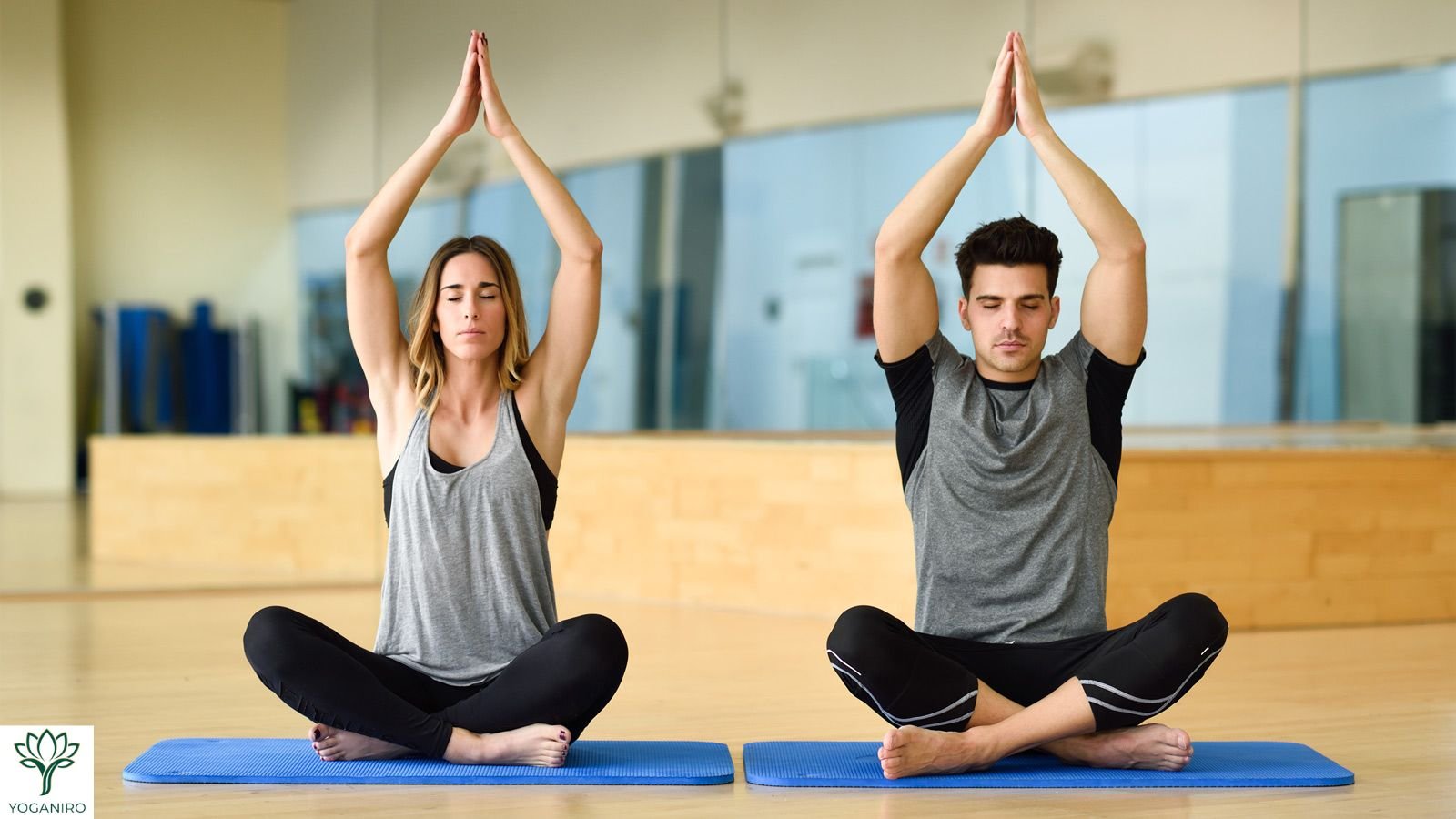
Trying yoga with a friend or partner can begin with a comfortable seat and a few simple movements. These yoga poses for two people combine light partner contact with poses you practice side by side, so you can choose how much interaction feels right.
You don’t need matching flexibility, height, or experience. Each person can use a different variation while following the same sequence.
Below, you’ll find clear instructions, an explanation of what each partner does, easier options, and a suggested 20-minute routine.
Quick answer: Start with back-to-back sitting, gentle seated Cat-Cow, and Mountain Pose. Add a seated twist or supported Double Tree when comfortable. Agree on a stop word, control your own movement, and leave lifts and stacked poses for supervised instruction.
What Is Partner Yoga?
Partner yoga involves practicing with another person through coordinated movement, communication, or physical contact. Some poses use shared support; others let each person remain independently supported.
This guide includes both grounded partner poses and no-contact alternatives. Names such as “Double Tree” describe a two-person arrangement of a familiar posture rather than a separate standardized yoga pose.
If you’re also choosing a class to attend together, our guide to different yoga styles explains options you may encounter on a studio schedule.
Practicing together gives you opportunities to take turns, listen, and spend time moving together. The National Center for Complementary and Integrative Health reports that yoga may support stress management and balance. Those findings do not establish that partner yoga is better than solo practice or guarantees relationship benefits.
Which Two-Person Yoga Pose Should You Start With?
Choose how you want to practice together, then follow the corresponding instructions below.
| Your starting preference | Pose | Partner interaction | Available modification |
|---|---|---|---|
| A quiet seated start | Back-to-Back Comfortable Seat | Optional light back contact | Separate chairs |
| Coordinating movement | Seated Cat-Cow | Take turns setting the pace | Smaller movements |
| Gentle seated rotation | Seated Twist | Coordinate side changes | Separate chairs and a smaller turn |
| A self-controlled stretch | Facing Seated Forward Fold | Coordinate timing without pulling | Bent knees and an upright position |
| A wider seated position | Wide-Legged Seated Fold | Take turns leading the transitions | Narrower leg position |
| Standing without contact | Side-by-Side Mountain | Begin and finish together | Upright sitting |
| A standing balance | Double Tree | Optional light hand contact | Toes down and wall support |
| A short standing effort | Side-by-Side Chair | Coordinate lowering and rising | Shallower knee bend |
| A wall-supported hinge | Temple Preparation | Practice alongside each other | Smaller hinge |
| An optional balance challenge | Wall-Supported Warrior III | Take turns or coordinate side changes | Rear toes remain down |
These are choices, not a progression everyone must complete. Each person controls their own position and can stop independently.
How to Prepare for Partner Yoga
Set out two mats on a stable surface, leaving enough room to extend your arms and step out of a pose. Move nearby furniture and keep a wall accessible for standing variations.
A folded blanket, yoga blocks, and separate stable chairs can help you adjust the setup. If you’re exploring additional props for seated or resting positions, our guide to yoga bolsters and their uses explains the available shapes and setups. A bolster is optional for this routine.
Wear clothing that allows comfortable movement. If you prefer shorts, explore our guide to what to wear with yoga shorts.
Before starting, agree on these basics:
- Ask before touching. Either person can choose a no-contact variation.
- Use a clear stop word. “Stop” means pause and return to a comfortable position.
- Control your own movement. Don’t pull someone farther into a stretch.
- Explain transitions. Say when you are changing sides, releasing contact, or standing up.
- Allow different ranges. You do not need to make matching shapes.
Warm up with a few minutes of comfortable walking, shoulder movements, and gentle movements you already know.
If you are pregnant, have an injury or health condition, or experience balance difficulties, discuss suitable modifications with your healthcare professional and a qualified yoga instructor. NCCIH recommends qualified instruction and adapting yoga to individual needs.
Stop if a movement causes pain, numbness, or dizziness. The suggested breaths and repetitions below are starting points, not targets.
Seated Yoga Poses for Two People
1. Back-to-Back Comfortable Seat
Start here to settle in and establish whether back contact feels comfortable.
- Sit back to back with your legs crossed comfortably or arranged in another suitable position.
- Let your backs touch lightly while each person supports their own posture.
- Rest your hands on your thighs and relax your shoulders.
- Breathe naturally for about one minute.
- Tell your partner before shifting position or standing.
What you do together: Use the opening minute to check in about comfort, contact, and which poses you want to try. Matching breathing rhythms is optional.
Easier option: Sit on a folded blanket. If floor sitting is uncomfortable, face each other in separate stable chairs.
2. Partner Seated Cat-Cow
This version uses shared timing without pulling on each other’s arms.
- Sit facing each other with your hands resting on your own thighs.
- As you inhale, gently lift your chest into a small arch.
- As you exhale, gently round your back and let your chin lower slightly.
- Repeat three to five comfortable rounds.
- Return to an upright seat.
What you do together: One person sets a comfortable pace, then you switch leaders. Follow your own breathing if matching the pace feels awkward.
Easier option: Use separate chairs and make the movements smaller. Avoid pushing against your partner or pulling on your knees.
For additional individual practice, our guide to yoga for better posture includes Cat-Cow and other familiar movements.
3. Partner Seated Twist
Keep this twist small and self-controlled.
- Sit back to back, leaving space if contact restricts movement.
- Both turn gently toward your own right.
- Rest your left hand on your own right thigh and your right fingertips beside or behind you.
- Stay for two or three comfortable breaths without pulling with your hands.
- Return to center, then repeat toward your own left.
What you do together: Agree on the direction before moving. Each person chooses their own range; neither partner adjusts the other’s shoulders or knees.
Easier option: Sit in separate chairs and use a smaller turn.
4. Facing Seated Forward Fold
Your feet do not have to meet, and neither partner needs to pull.
- Sit facing each other with enough space between your feet.
- Extend your legs, bending your knees as much as needed.
- Sit tall, then tip forward gently from your hips.
- Rest your hands on your own legs or the floor.
- Take two or three breaths, then slowly return upright.
What you do together: Coordinate when you enter and leave the fold while keeping separate stretching ranges.
Easier option: Sit on a folded blanket and remain mostly upright. Standard forward-fold guidance emphasizes choosing a suitable variation rather than forcing the final shape.
5. Wide-Legged Seated Fold for Two
This variation changes the leg position while keeping each person in control.
- Sit facing each other with space between your feet.
- Open your legs only as far as you can while sitting comfortably upright.
- Keep your knees and toes pointing upward, bending your knees if needed.
- Place your hands on the floor in front of you and hinge forward slightly.
- Pause for two or three breaths, then walk your hands back and sit upright.
What you do together: Take turns announcing the start and finish. Avoid pressing your feet against your partner to widen either person’s position.
Easier option: Narrow your leg position, sit on a folded blanket, or stay upright.
Avoid bouncing or pushing into pain, consistent with the American Council on Exercise’s seated straddle guidance.
Standing Yoga Poses for Two People
Standing poses add balance and coordination demands. Use a wall when helpful, and skip any position that does not feel steady.
6. Side-by-Side Mountain Pose
Mountain offers a straightforward way to practice shared timing.
- Stand beside each other with feet comfortably apart.
- Distribute your weight across both feet without locking your knees.
- Let your arms rest by your sides and look ahead.
- Take three comfortable breaths.
- Relax before moving to the next pose.
What you do together: Take turns saying “begin” and “release.” If you both want contact, lightly touch your nearest hands without pulling or leaning.
Easier option: Stand near a wall or practice upright sitting in separate chairs.
7. Double Tree Pose
Use light contact only if you can maintain your own balance.
- Stand side by side near a wall.
- Shift your weight onto the leg nearest your partner.
- Turn your outer knee outward and rest that heel against your standing ankle, keeping the toes on the floor.
- If steady, place the lifted foot against your calf or inner thigh, avoiding the knee.
- Hold for two or three breaths, then lower the foot.
- Change positions so you can practice the other side.
What you do together: Lightly touch your nearest hands if comfortable. Tell your partner before releasing contact. If either person wobbles, lower the lifted foot instead of gripping the other person.
Easier option: Keep the toes down and use the wall. These lower-foot options and avoiding pressure on the knee follow standard Tree Pose guidance.
To explore individual variations before practicing together, see our guide to yoga poses for balance, which includes supported Tree and Warrior III.
8. Side-by-Side Chair Pose
This version uses independent stances rather than a shared back-to-back squat.
- Stand beside each other with feet comfortably apart.
- Bend your knees and move your hips backward into a shallow Chair Pose.
- Keep your feet grounded.
- Let your arms reach forward or rest by your sides.
- Stay for one or two breaths, then straighten your legs and rest.
What you do together: Count into the movement and announce when you are standing up. Either person can finish sooner.
Easier option: Bend less and keep your arms low. The Arthritis Foundation’s yoga guide includes an arms-down Chair modification.
9. Double Temple Preparation at a Wall
Practice the hip-hinge shape with the wall supporting your hands.
- Stand next to each other, both facing a clear wall.
- Place your own palms on the wall around shoulder height.
- Step back gradually and hinge at your hips, keeping your knees comfortably bent.
- Stop where your arms, back, and breathing feel comfortable. Your torso does not need to become horizontal.
- After two or three breaths, step toward the wall and return upright.
What you do together: Coordinate the beginning and end while choosing separate hand heights and distances from the wall.
Easier option: Stay closer to the wall with a smaller hinge.
This is a wall-supported preparation for the familiar partner Temple shape, rather than a version that depends on another person’s support.
10. Wall-Supported Warrior III for Two
Treat this as an optional balance challenge.
- Face a wall side by side and place your palms against it.
- Step back slightly, keeping a small bend in your standing knee.
- Extend one leg behind you with the toes touching the floor.
- If steady, lift that foot a few inches while keeping your hips facing down.
- Take one or two breaths, lower the foot, and repeat on the other side.
What you do together: Coordinate side changes or take turns practicing. The observing partner can offer verbal reminders without moving the other person’s body.
Easier option: Keep the rear toes down throughout. A lower lifted leg and a softened standing knee are recognized Warrior III modifications.
A 20-Minute Beginner Partner Yoga Routine
These time blocks include setup, short holds, transitions, and rest. They are not instructions to hold each pose continuously for several minutes.
| Time | What to practice |
|---|---|
| 0–2 minutes | Comfortable seated position and a check-in about contact and modifications |
| 2–6 minutes | Gentle warm-up, seated Cat-Cow, and Mountain Pose |
| 6–10 minutes | Seated twist on both sides and a comfortable forward fold |
| 10–13 minutes | Double Tree with toes down or wall support, resting between sides |
| 13–17 minutes | Short Chair rounds and wall-supported Temple preparation |
| 17–20 minutes | Comfortable seated rest and natural breathing |
For a first session, leave out Warrior III. Replace standing work with seated rest whenever needed.
If you have less time, choose a comfortable seat, Cat-Cow, and Mountain Pose. There is no requirement to finish the entire sequence.
For a separate practice focused on longer floor-based holds, explore our guide to yin yoga poses. Follow the guidance for that practice rather than extending the holds in this partner routine.
When Practicing Together Feels Awkward
| Situation | What to change |
|---|---|
| Your hands or feet do not comfortably meet | Use the independent version instead of stretching farther to make contact. |
| One person moves farther than the other | Keep separate ranges and coordinate only the start and finish. |
| One person does not want physical contact | Choose a no-contact variation and take turns leading the timing. |
| You are unsure which direction to turn | Pause and name your own right or left before moving. |
| One person needs to finish sooner | Let them stop independently; matching hold times is optional. |
| You cannot work out the setup | Skip the pose and ask a qualified instructor to demonstrate it. |
A useful check-in is: “Would you like to continue, change the position, or stop?”
Ask before increasing contact or changing a shared position.
Partner Yoga vs. AcroYoga
Partner yoga is a broad term that can include coordinated poses, light contact, and shared support.
AcroYoga commonly involves a base, a flyer, and a spotter. Lifts and stacked poses require skills beyond following a short written sequence. Effective spotting requires knowledge of the movement; simply standing nearby is not enough.
If you want to explore flying poses or Double Plank, learn with an instructor experienced in AcroYoga and appropriate spotting. Keep those movements separate from this beginner routine.
Frequently Asked Questions About Yoga Poses for 2
What Are the Easiest Yoga Poses for Two Beginners?
A comfortable seated position, small seated Cat-Cow movements, and Mountain Pose are useful starting choices. Add other poses when both people feel comfortable. A “beginner” label does not mean a pose suits everyone without modification.
Do We Need to Hold Hands?
No. You can practice together through shared timing, verbal check-ins, and taking turns leading. Use contact only when both people want it.
What If We Have Different Heights or Flexibility?
Use separate props and choose different ranges of movement. Your feet do not need to meet in seated folds, and your hands do not need to reach the same height. Coordinate your timing rather than trying to look identical.
Are These Poses for Couples or Friends?
Either. These arrangements can work for friends, partners, or family members who want to practice together. Ask permission before touching and respect each person’s preferences.
If another friend joins, explore our guide to yoga poses for three people.
Do We Need Special Equipment?
Two mats are useful for this routine. A folded blanket, blocks, a wall, and separate stable chairs provide additional options. You do not need an extra-wide shared mat.
How Long Should We Hold Each Pose?
Start with the short holds described above and come out sooner when needed. Breathe normally rather than extending a hold to match your partner. Rest before repeating a movement.
Can Partner Yoga Improve Our Relationship?
It can be an activity you enjoy together and an opportunity to practice listening. It should not be presented as a guaranteed way to resolve conflict, increase intimacy, or produce measurable relationship changes.
Final Thoughts
Yoga poses for two people can begin with a shared pace, a comfortable seat, and a few simple movements. Choose contact when you both want it, and use independent variations whenever they work better.
Start with three poses, agree on how to stop, and let each person choose their own range. Build your practice around movements you both feel comfortable returning to.

Yoganiro was founded by Abdul Rehman with a passion for yoga, wellness, and mindful living. The goal behind Yoganiro is to inspire people through simple yoga practices, wellness tips, and healthy lifestyle content that promotes balance, peace, and overall well-being.
7 thoughts on “Yoga Poses for Two People: 10 Moves, No Lifting Needed”