

By the Yoganiro Editorial Team · Last Updated: August 2026
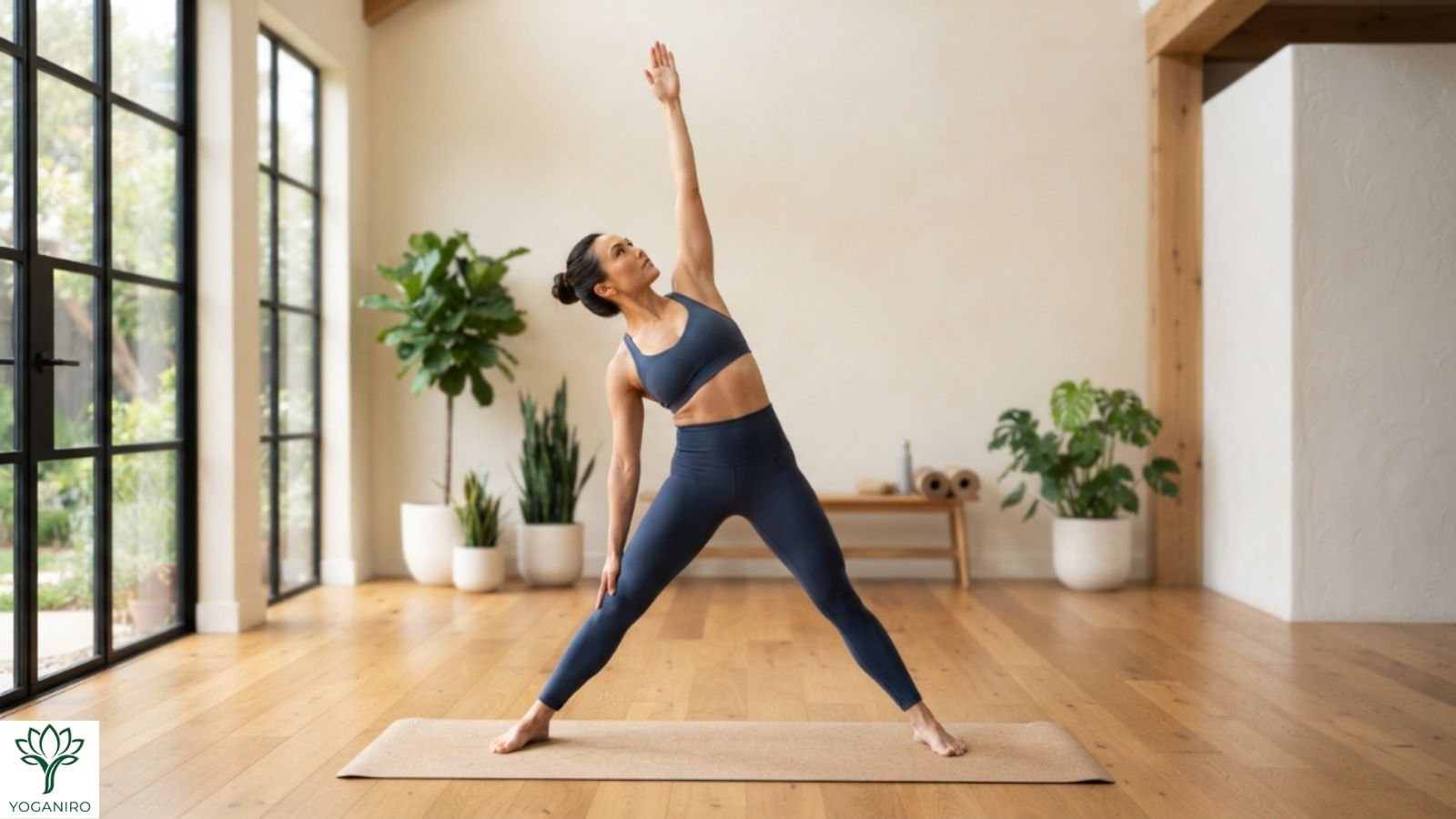
Triangle Pose looks simple from across the studio. One long diagonal line, two straight legs, an open chest reaching toward the ceiling. Then you try it and feel how much is happening beneath that clean shape.
Triangle Pose, or Trikonasana, is one of the first standing poses most yoga students learn. It stretches the whole side of your body while asking your legs to stay strong and steady. Done well, it feels less like a stretch and more like length pouring out in every direction.
This guide walks you through triangle pose yoga from the ground up — what it is, why it helps, how to move through it in seven clear steps, and how to keep it safe. You’ll also find the mistakes to avoid, ways to modify for your body, and how Triangle differs from the poses it’s often confused with.
Quick Answer: Triangle Pose (Trikonasana) is a standing yoga pose that stretches your hamstrings, hips, and side body while opening your chest and shoulders. Keep your front leg straight, hinge from your front hip, and rest your bottom hand on your shin, a block, or the floor. Hold for 5 breaths, up to one minute, on each side.
What Is Triangle Pose (Trikonasana)?
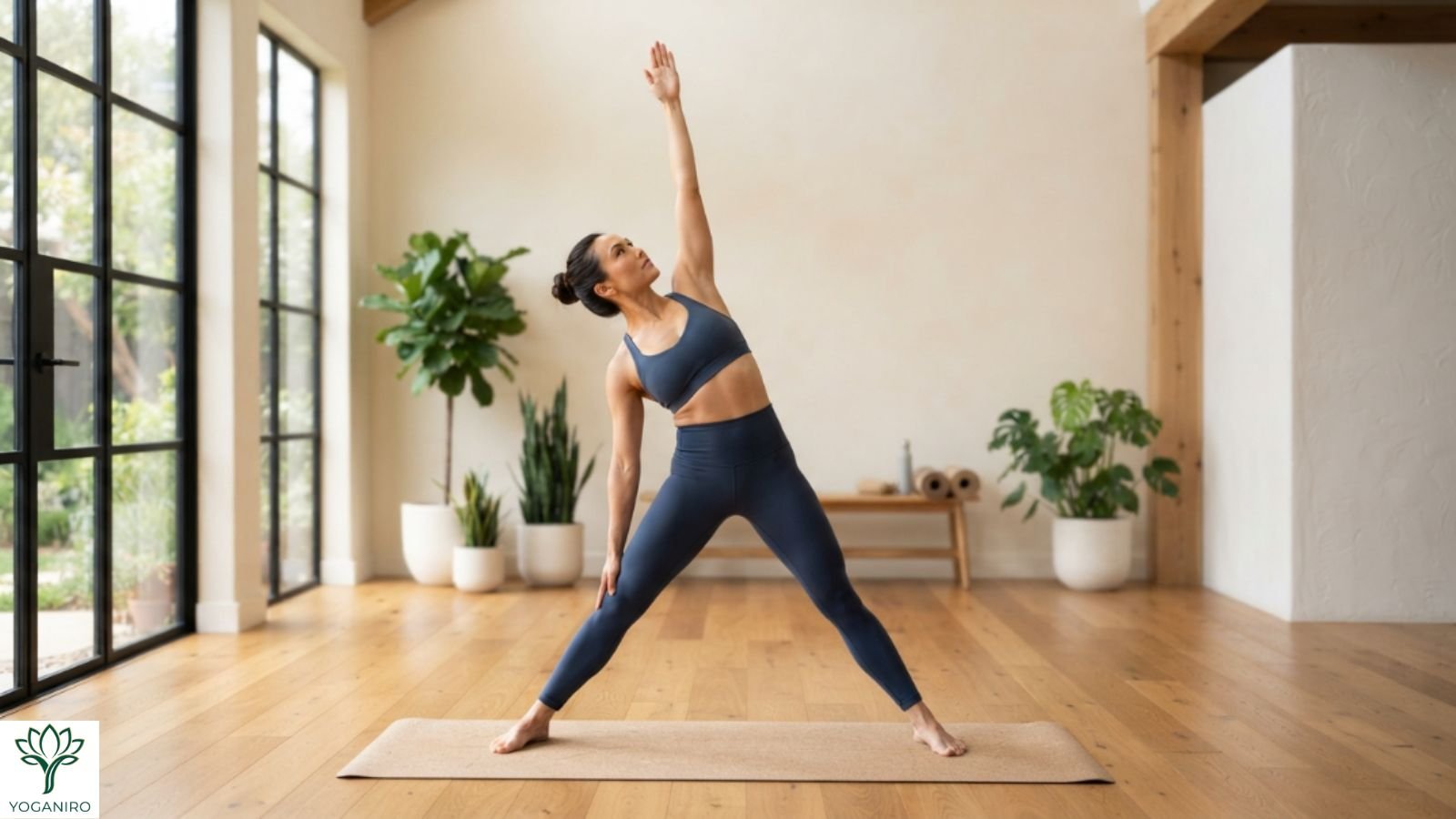
Triangle Pose is a standing yoga pose that forms a series of triangles with your legs, arms, and torso. You stand with your feet wide, straighten both legs, and tip your torso sideways over your front leg while your arms reach in a long vertical line. The shape is steady and open at once. That balance of grounding and expansion is what gives the pose its quiet power.
The pose is also called Extended Triangle Pose, or Utthita Trikonasana in full. It belongs to the foundation of nearly every yoga style, from gentle beginner classes to brisk vinyasa flows. Teachers reach for it early because it builds strength, balance, and body awareness in one clean movement.
What “Trikonasana” means in Sanskrit
The name Trikonasana comes straight from the pose’s shape. “Tri” means three, “kona” means angle, and “asana” means pose or seat. Put together, Trikonasana translates to three-angle pose. Add “utthita,” meaning extended, to name the classic standing version. The Sanskrit isn’t decoration. It tells you exactly what to look for in your body — three clear angles, held with intention.
Which Muscles Triangle Pose Works
Triangle Pose stretches and strengthens at the same time, which is rare for one shape. On the stretch side, you lengthen your hamstrings, groin, hips, and the entire side body from hip to fingertips. Meanwhile, your quadriceps, core, and spinal muscles hold you steady. Your chest and shoulders open as your top arm reaches up. Few standing poses ask so many parts of you to cooperate so gracefully.
What Are the Benefits of Triangle Pose?
Triangle Pose builds strength, flexibility, and steadiness in a single, elegant shape. The deep side stretch releases tight hamstrings and hips, which tend to stiffen from long hours at a desk. At the same time, your legs grow stronger and your spine learns to lengthen rather than slump. Regular practice can leave you standing taller off the mat, which pairs naturally with a focus on yoga for better posture.
The benefits reach past the physical. Triangle Pose asks for focus, balance, and a steady breath, which quiets a busy mind. Many students describe a sense of openness through the chest that feels as emotional as it is physical. Interestingly, the pose is often recommended to ease everyday stress and to wake up sluggish digestion, though you should treat those as gentle wellness benefits rather than medical claims.
How to Do Triangle Pose Step by Step
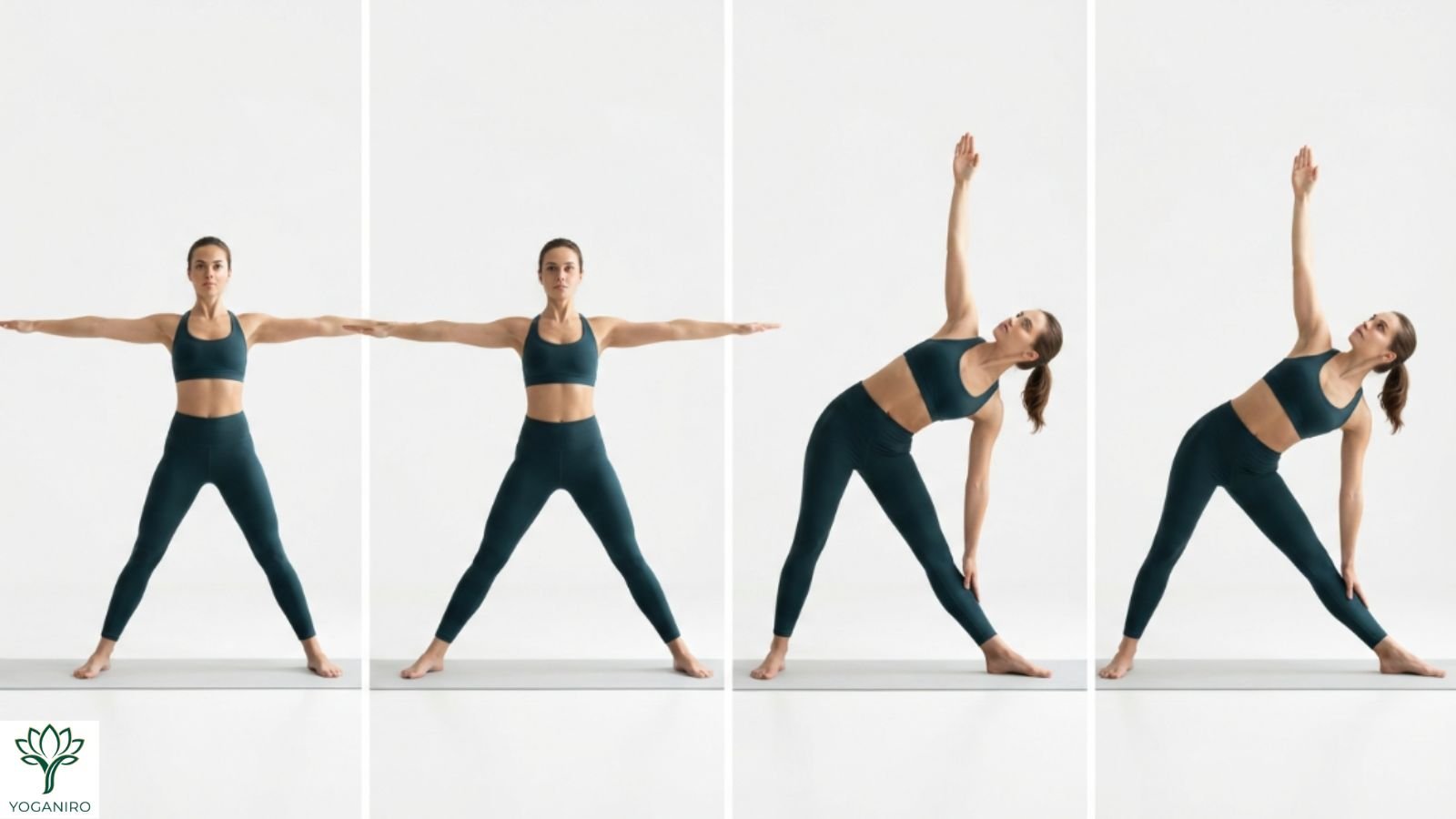
You can move into Triangle Pose in seven clear steps, from a wide stance to the full expression. Read through them once, then try them slowly. Quality matters far more than depth here.
- Stand with your feet 3 to 4 feet apart, facing the long edge of your mat.
- Turn your right foot out 90 degrees so the toes point to the short end of the mat. Angle your left foot in about 30 to 45 degrees.
- Line up your right heel with the arch of your left foot, then root down through both feet.
- Inhale and reach your arms out to the sides at shoulder height, palms facing down.
- Exhale, reach actively through your right hand, then hinge at your right hip and tip your torso to the right.
- Rest your right hand on your shin, a block, or the floor outside your front foot. Reach your left arm straight up so your arms form one vertical line.
- Turn your gaze up toward your top thumb, then stack your left shoulder over your right.
Keep both legs straight without locking your knees. A soft microbend protects the joint while your thigh muscles stay active.
How to Warm Up Before Triangle Pose
A short warm-up makes Triangle Pose safer and deeper. Spend 3 to 5 minutes opening the areas the pose demands most. A few rounds of Cat-Cow loosen the spine. Warrior II wakes up the legs and hips. A gentle standing side bend previews the lateral stretch to come. Skipping the warm-up is the most common way to feel tight and wobbly in the pose. Give your body those few minutes first.
How Long Should You Hold Triangle Pose?
Hold Triangle Pose for 5 slow breaths, up to about one minute, on each side. Beginners do well to start with 3 to 5 breaths and build gradually. Always practice both sides for the same length of time to keep your body balanced. If your breath turns shallow or ragged, that’s your signal to ease up or come out. Steady breathing is the truest measure of the right depth.
What Are the Most Common Triangle Pose Mistakes?
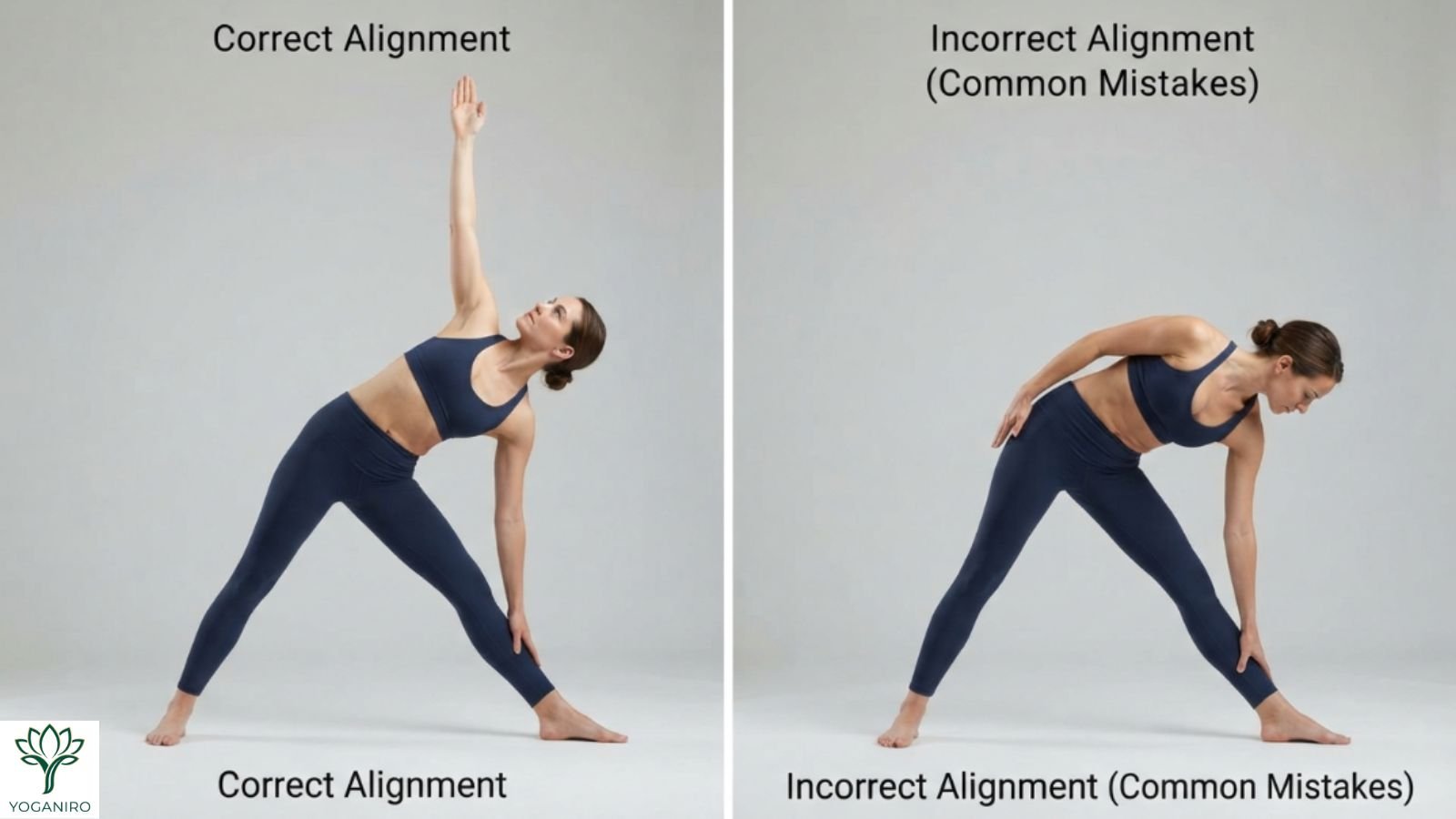
The most common Triangle Pose mistake is collapsing your chest toward the floor to force your hand down. When you chase the floor, your spine rounds and your top shoulder rolls forward, which erases the openness the pose is built for. Lift your bottom hand higher instead — onto your shin or a block — and keep both sides of your waist long. Length always beats depth here.
Two other habits sneak in just as often. The first is locking or hyperextending the front knee, which strains the joint; keep a soft microbend and hug your thigh muscles up. The second is resting your bottom hand directly on your knee, which presses into the joint. Place your hand above or below the knee, never on it. Fix these three habits and your Triangle transforms.
How Do You Modify Triangle Pose for Your Body?
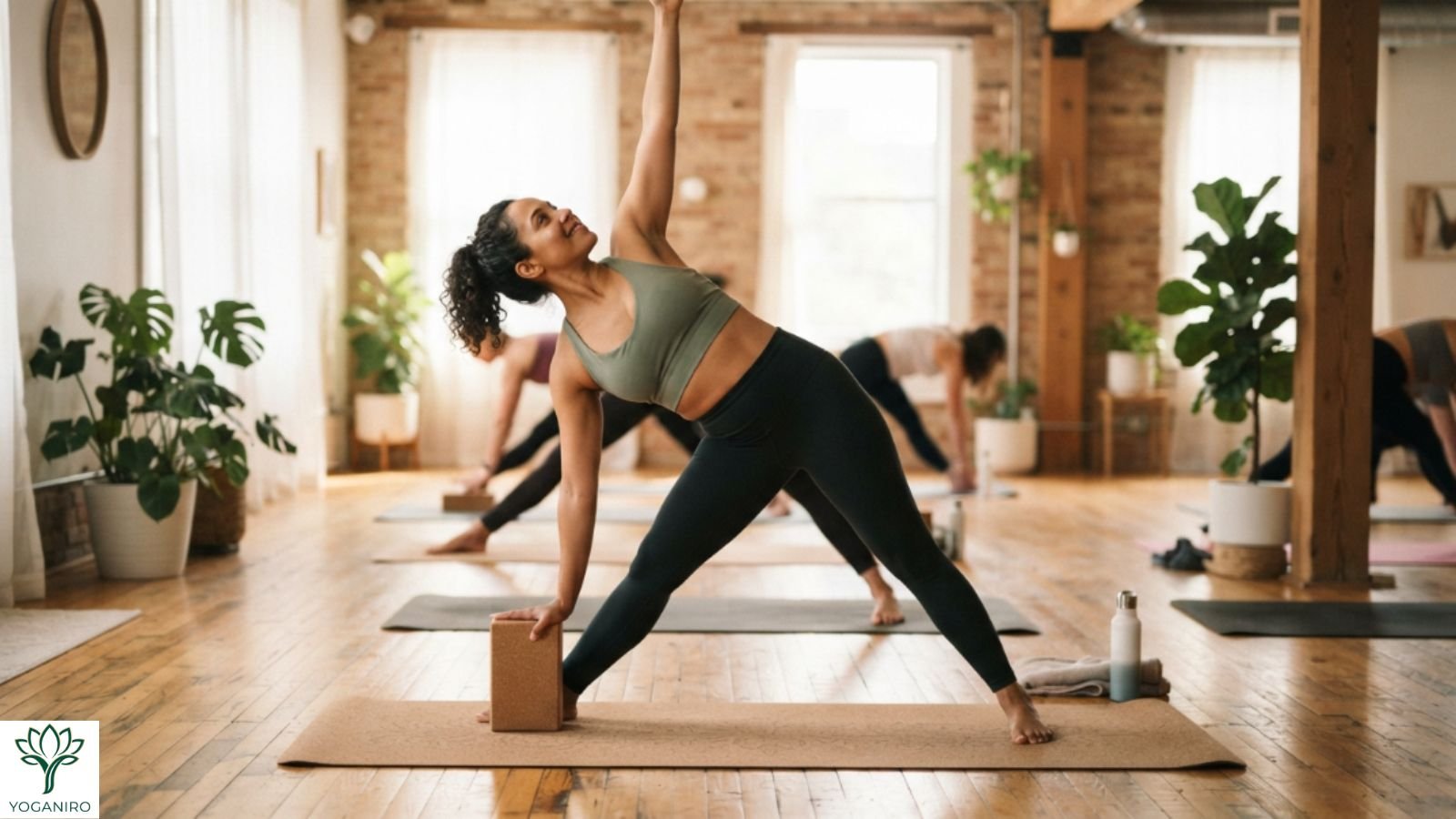
You can modify Triangle Pose to fit your flexibility, experience, and needs. The goal never changes — a long spine and an open chest — but the props and stance can shift to serve you. Small adjustments make the pose feel supported rather than strained.
Using a Block or a Wall
A block or a wall makes Triangle Pose steadier almost instantly. Place a sturdy yoga block or bolster under your bottom hand so the floor effectively rises to meet you. This lets your front leg straighten fully and both sides of your torso lengthen. For balance, practice with your back heel or your back body against a wall. The wall gives you instant feedback about alignment and calms any fear of tipping over.
Modifications for Beginners, Tight Hamstrings, and Pregnancy
Triangle Pose adapts well for beginners, tight hamstrings, and pregnancy with a few simple changes. If you’re new to yoga, shorten your stance and rest your hand high on your shin. Tight hamstrings ease when you use a block and micro-bend the front knee. During pregnancy, widen your stance for stability, avoid deep compression, and always check with your doctor first. Meet the pose where your body is today.
How to Refine Your Triangle Pose Alignment
You refine Triangle Pose by hinging from your hip rather than bending through your waist. Many students tip straight toward the floor, which shortens the lower side of the body and rounds the spine. Instead, draw your top hip back as your torso reaches long over the front leg. Picture keeping the length of a Tadasana, or Mountain Pose, spine even as you tilt sideways.
The teacher B.K.S. Iyengar, who codified much of modern pose alignment in his classic book Light on Yoga, taught Triangle as an exercise in extension, not depth. That principle still holds. Reach your bottom hand only as low as you can go while keeping both sides of your waist equally long. In practice, most students find more benefit resting the hand on a block than straining it to the floor. Length is the goal. The floor is optional.
How Do You Transition Into and Out of Triangle Pose?
You can flow into and out of Triangle Pose smoothly by treating your feet as the anchor and your breath as the timer. The stance stays wide throughout, which means most transitions ask only for a straightening leg and a shifting torso. Move on your exhale to stay grounded.
Entering From Warrior II and Extended Side Angle
Warrior II and Extended Side Angle both flow into Triangle Pose with almost no change to your feet. From Virabhadrasana II (Warrior II), simply straighten your front leg and hinge at the front hip to lower your hand. From Utthita Parsvakonasana (Extended Side Angle), lift your torso as you straighten the front leg and reach your top arm to the sky. Both entries feel seamless because your foundation is already set.
Moving Into Half Moon or Pyramid
Triangle Pose flows naturally into Ardha Chandrasana (Half Moon Pose) and Parsvottanasana (Pyramid Pose). To reach Half Moon, bend your front knee, shift your weight forward, and lift your back leg to hip height. To move into Pyramid, turn your hips to square toward your front leg and fold over the straight front thigh. Viparita Virabhadrasana (Reverse Warrior) offers a graceful windmill entry back into Triangle whenever you want to link poses in a flow.
Triangle Pose vs. Similar Poses: How Is It Different?
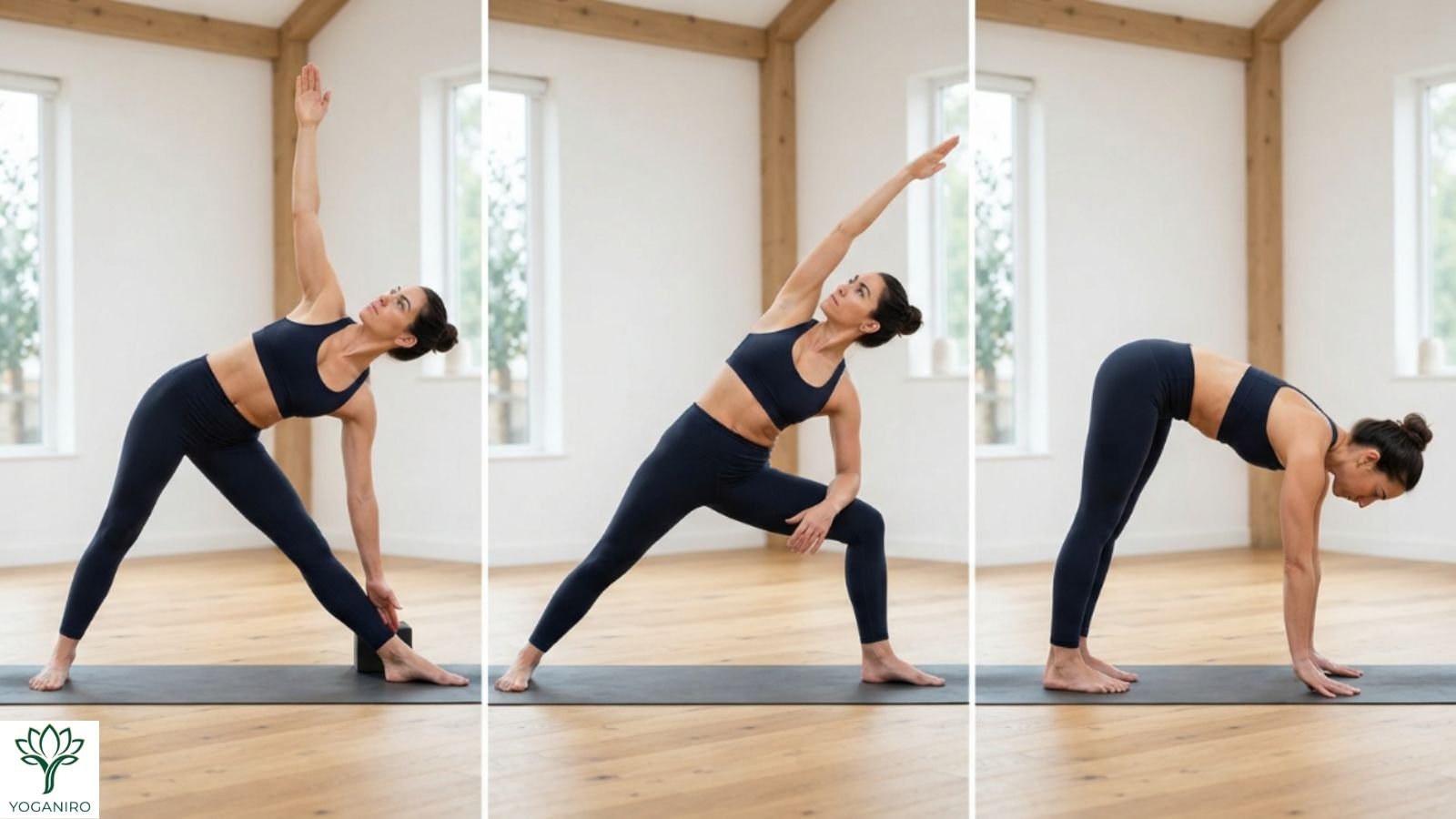
Triangle Pose differs from Extended Side Angle and Pyramid Pose mainly in the front leg and the direction of the stretch. In Triangle Pose, your front leg stays straight and your torso tips directly to the side in a clean lateral bend. In Extended Side Angle (Utthita Parsvakonasana), your front knee bends to about 90 degrees, which drops you lower and shifts the stretch along a longer diagonal from back heel to top fingertips.
Pyramid Pose (Parsvottanasana) is the real point of confusion. The difference is your hips. Pyramid squares both hips forward and folds your torso over a straight front leg, which makes it a forward bend. Triangle keeps your hips and chest open to the side, which makes it a side bend. Naming that distinction — forward fold versus lateral bend — clears up the mix-up for good.
Who Should Avoid or Take Care in Triangle Pose?
You should approach Triangle Pose with care if you have low blood pressure, migraines, or neck and back injuries. Low blood pressure and headaches can worsen with the movement. Skip the pose during a flare. If you have a neck injury, keep your gaze forward rather than turning it up to your top hand. If you have high blood pressure, lower your gaze and avoid reaching your top arm overhead.
A recent hip, back, or shoulder injury is another reason to ease off or skip the pose. Diarrhea is another common reason teachers advise skipping the pose that day. When in doubt, choose a supported version or gentler restorative poses instead. Check with your doctor before practicing if you have any medical concerns. Yoga should always work within your body’s limits, never against them.
Triangle Pose FAQ
Is Triangle Pose good for beginners?
Yes, Triangle Pose is well suited to beginners. It’s one of the first standing poses taught in most yoga styles because it builds strength, balance, and body awareness at once. Use a block under your bottom hand and a shorter stance to start. Focus on a long spine rather than touching the floor.
Why is Triangle Pose so hard?
Triangle Pose feels hard because it asks for flexibility, strength, and balance at the same time. Tight hamstrings and hips make the side bend challenging, while staying upright tests your core and legs. The pose also reveals left-right imbalances. Practicing with a block and steady breath makes it far more accessible within a few weeks.
Should your bottom hand touch the floor in Triangle Pose?
No, your bottom hand does not need to touch the floor in Triangle Pose. Reaching for the floor often collapses the chest and rounds the spine, which defeats the purpose. Rest your hand on your shin or a block instead, then keep both sides of your waist long. Length matters far more than depth.
How long should you hold Triangle Pose?
Hold Triangle Pose for about 5 breaths, up to one minute, on each side. Beginners can start with 3 to 5 breaths and build slowly over time. Practice both sides equally to keep your body balanced. Let your breath guide you — if it becomes shallow, ease out of the pose.
What muscles does Triangle Pose work?
Triangle Pose works your legs, core, and side body most of all. It stretches your hamstrings, groin, hips, and the muscles along your ribs, while strengthening your quadriceps, spine, and core. Your chest and shoulders open as your top arm reaches upward. That mix of stretch and strength is what makes the pose so complete.
Is Triangle Pose safe for your neck and back?
Triangle Pose is generally safe when practiced with care. Protect your neck by keeping your gaze forward instead of turning it up if you feel strain. Protect your back by hinging from the hip and keeping a long spine rather than rounding toward the floor. Anyone with an injury should modify or consult a doctor first.
Trusted Resources
These credible sources informed this guide and offer further reading:
- Yoga Journal — Extended Triangle Pose (Utthita Trikonasana)
- Verywell Fit — How to Do Triangle Pose
- The Art of Living — Trikonasana benefits and contraindications
Explore More from Yoganiro
Keep building your practice with more from the Yoganiro library.
Practice with others
- Partner Yoga Poses for Trust and Yoga Poses for Two People to explore Triangle with a partner
- 3-Person Yoga Poses for playful group practice
Build a mindful routine
- Money Yoga for calm on and off the mat, plus a few yoga quotes to stay inspired
Dress and equip your practice
- What to Wear with Yoga Shorts and the right yoga top for easy movement
- Save on activewear with the Alo promo code and Beyond Yoga promo code
Find a studio near you
Final Thoughts
Triangle Pose rewards patience more than flexibility. The clean line you admire from across the room comes from length and steadiness, not from forcing your hand to the floor. Keep your legs strong, your spine long, and your chest open. The shape takes care of itself. Roll out your mat, set your feet wide, and find your three angles one breath at a time.
About Yoganiro
Yoganiro is a yoga and wellness publication dedicated to clear, honest, and practical guidance. Every guide is fact-checked against credible sources such as Yoga Journal, Harvard Health, and peer-reviewed research before it is published. Questions or corrections? Reach out through our contact page.

Yoganiro was founded by Abdul Rehman with a passion for yoga, wellness, and mindful living. The goal behind Yoganiro is to inspire people through simple yoga practices, wellness tips, and healthy lifestyle content that promotes balance, peace, and overall well-being.
2 thoughts on “Triangle Pose (Trikonasana): 7 Steps to Perfect Alignment”