

By the Yoganiro Editorial Team · Last Updated: August 2026
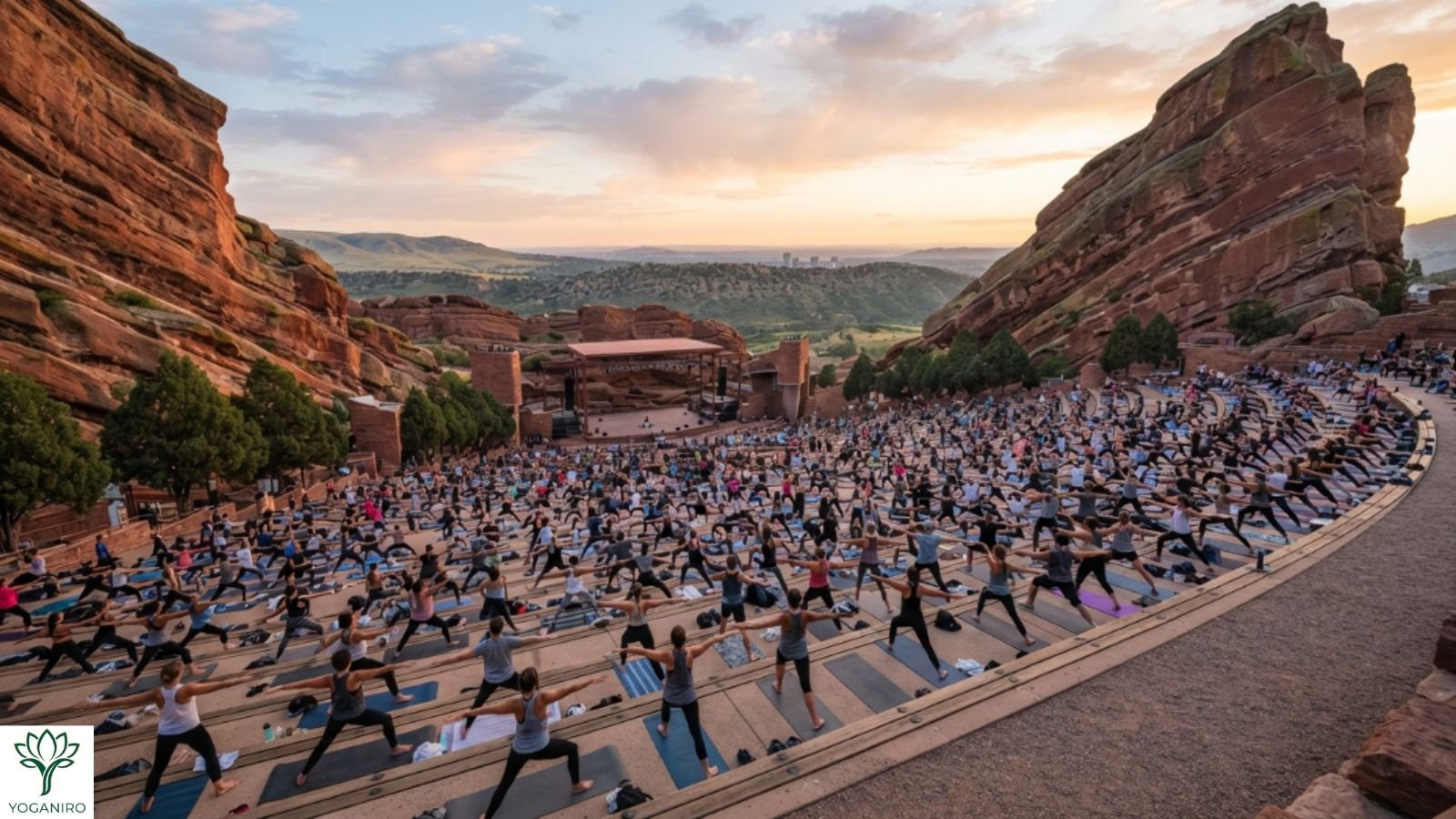
The sun comes up behind you at Red Rocks. Two hundred feet of sandstone rises on either side, the plains stretch flat and gold toward Denver, and two thousand mats are already unrolled across the rows by ten minutes to seven. Almost nobody talks. It is the quietest a nine-thousand-seat amphitheater ever gets.
Then the class begins; somewhere in the second round of sun salutations you notice you’re breathing harder than you should be. That is the part nobody warns you about. Yoga on the Rocks is a genuinely demanding outdoor yoga class held at 6,450 feet on a hard bench. The people who love it are almost always the ones who knew that before they arrived.
Quick Answer: Yoga on the Rocks is a one-hour outdoor yoga class held on summer Saturday mornings at Red Rocks Amphitheatre in Morrison, Colorado, with roughly two thousand people practicing together at sunrise. It suits anyone with a few flow classes behind them. Book early, arrive 30 minutes before the start time, and bring more mat padding than you think you need.
What Yoga on the Rocks Is and Who It Suits
Yoga on the Rocks suits you if you’ve taken a handful of studio classes and can move through a flow without needing every pose named. It suits you less if this would be your first yoga class ever. You practice on the amphitheater seating rows alongside around two thousand other people, facing a stage set against red sandstone, as the sun clears the plains.
Nothing about the sequence is advanced. The challenge comes from the setting, the surface, and the thin air, which is why this ranks among the better outdoor yoga classes near Denver for people who already have a practice rather than a place to begin one.
What Is Yoga on the Rocks at Red Rocks Amphitheatre?
Yoga on the Rocks is a summer outdoor yoga series staged inside Red Rocks Amphitheatre, the naturally formed venue at 17598 West Alameda Parkway in Morrison, Colorado, about fifteen miles west of Denver. The amphitheater sits at 6,450 feet above sea level and seats 9,525 for concerts. The City and County of Denver owns and operates it.
What makes the event unusual isn’t the sequence. It’s the room. Red Rocks is the only naturally occurring amphitheater of its kind, formed between two enormous sandstone monoliths that shape the sound without any help from engineering. Those natural acoustics matter more than you’d expect once class starts. A single voice carries to the back rows in a way it never would in an open field.
Scale changes things too. Two thousand people moving through the same sun salutation at the same moment is a genuinely strange and moving thing to be inside of. You feel it most in savasana, when a crowd that size goes completely still. If you are drawn to practicing somewhere unfamiliar, that is the same appetite that pulls people toward an aerial class, though this one asks far less of you technically.
The 2026 season dates and start times
The 2026 season runs on Saturday mornings with a sunrise start time [VERIFY: exact dates, number of sessions, and start time from redrocksonline.com]. Recent seasons have started at 7:00 a.m. and finished at 8:00 a.m., though the schedule shifts year to year. Treat the official event page as the only reliable source.
Be careful researching this yourself. Older guides to the event still circulate with dates from 2016 and 2024. Most contradict each other outright. Trust the venue’s own page over anything else you find.
Who runs the class and who teaches it
A local yoga studio operates the series each season, though the studio has changed more than once over the years [VERIFY: the 2026 operating studio and teacher lineup]. Teachers rotate week to week; the person leading the first Saturday won’t be the person leading the last.
The event also directs a share of every ticket to a Denver nonprofit partner [VERIFY: the 2026 partner and the per-ticket amount]. That nonprofit partner donation per ticket is a small thing on a receipt. Across two thousand mats a week, it stops being small.
How Do You Get Tickets Before They Sell Out?
Red Rocks sells tickets for Yoga on the Rocks through its official website. The season regularly sells out well before the first Saturday [VERIFY: current on-sale date, platform, and whether the 2026 season has already sold out]. Treat this like a concert on-sale rather than a drop-in studio class. Sessions do not stay available.
The practical move is simple. Find the on-sale date before it happens, set a reminder, and buy in the first hour.
What a spot costs
Organizers have historically priced the series three ways: a single session, a multi-session ticket pack, and a season pass, with the per-class cost dropping as you commit to more [VERIFY: all three 2026 prices]. No figures appear here on purpose. Published prices for this event range from twelve dollars to nineteen dollars per session depending on the year the writer was looking at. A stale number would only mislead you.
What to do if the season is already sold out
If Yoga on the Rocks has sold out, you have three real options. Resale listings appear as the date approaches, though they carry a premium. One attendee reported paying more than double face value a few days out. Signing up for the following year’s notification list costs nothing and puts you ahead of the queue. Failing both, Red Rocks Park is open to the public on non-event mornings, when plenty of people carry a mat up to the rows and practice on their own.
That last option isn’t the event. Still, the sandstone and the sunrise are the same.
Weather cancellations and refunds
Red Rocks staff manage severe weather on site. The venue instructs guests to follow staff direction and shelter either in a vehicle or in the Visitor Center at the top of the amphitheater. The ticketing platform sets refund handling for a weather-affected session, not the studio [VERIFY: the current refund and exchange policy].
Does the Altitude Make Yoga at Red Rocks Harder?
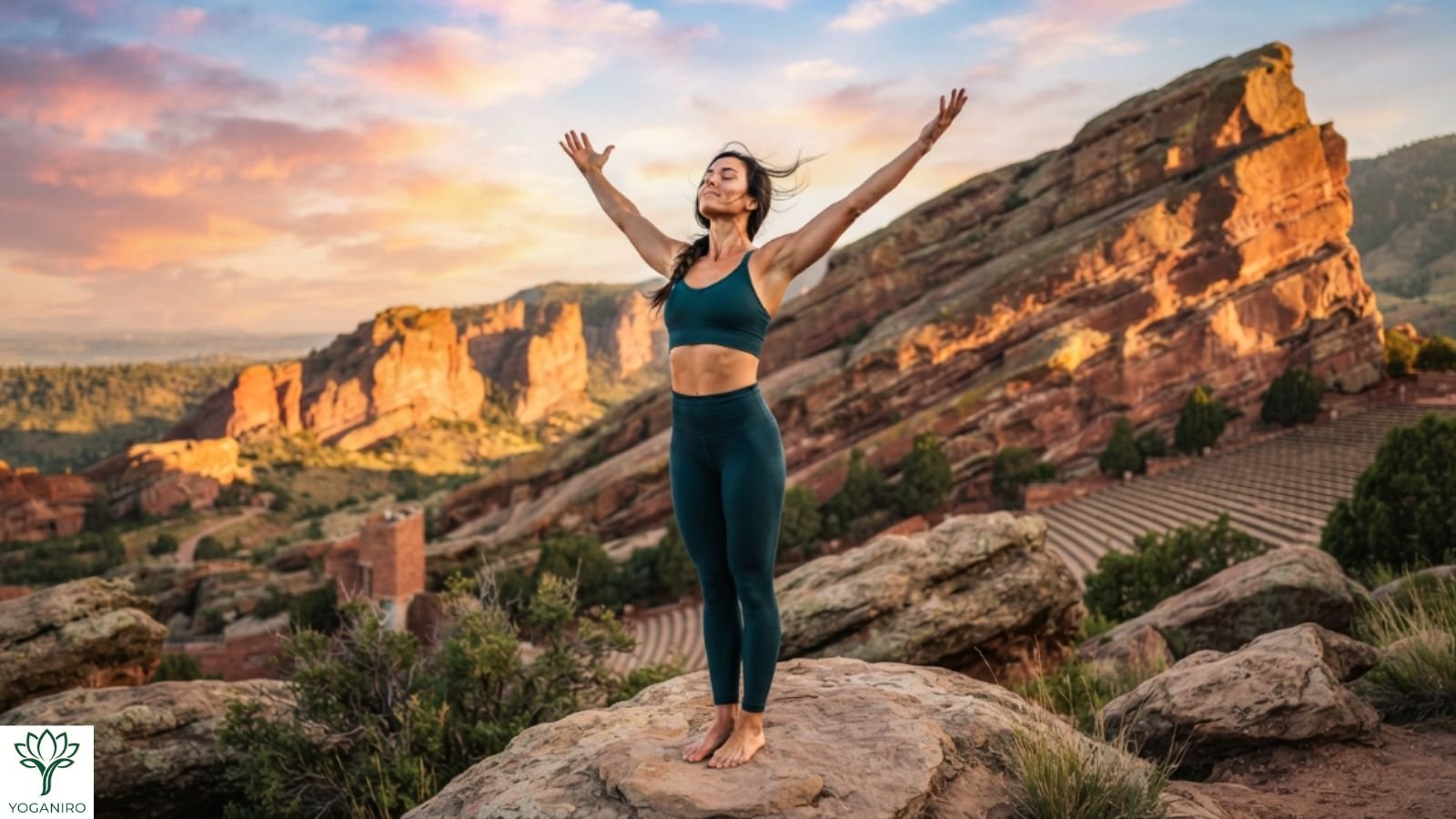
Yes. Red Rocks Amphitheatre sits at 6,450 feet, where a vinyasa flow class feels noticeably harder than the same class at sea level. Your breath runs short earlier. Your heart rate climbs faster. Recovery between poses stretches out longer than you’re used to, which catches most visitors off guard somewhere in the first fifteen minutes.
Here is a clarification worth making, because it gets muddled constantly. This is not altitude sickness. Acute mountain sickness generally begins around 8,000 feet, which puts Red Rocks comfortably below the usual threshold. What you’re feeling is simpler than that. With less oxygen in each breath, moderate effort simply registers as hard effort. The venue itself takes this seriously enough to advise every visitor to drink plenty of water and take the many stairs slowly.
What thinner air does to your breath in a flow class
Expect your breath to break form around the second or third round of sun salutations. That’s the honest timeline for most people arriving from lower ground. Endurance athletes tend to manage it better, largely because breath under load is something they already train. The instinct is to power through, because it feels like a fitness problem. Treating it as one is the beginner mistake that ruins the hour.
Drop to half sun salutations early rather than late. Take child’s pose whenever you want it and don’t apologize for it, because nobody in a crowd of two thousand is watching you. If the class is anything like other flow classes, the pace won’t wait for you. Let it go on without you for a round. It’s a better hour than the one you spend gasping through it.
How to prepare in the two days before
Start hydrating the day before rather than the morning of, since water taken an hour before class does very little. Go easy on alcohol the night before, which is the single most reliable way to make a 6,450-foot morning feel worse than it needs to. If you’re flying into Denver for this, arrive at least a full day early and keep that first day gentle.
Who should skip Yoga on the Rocks
Skip Yoga on the Rocks if you live with uncontrolled asthma, a diagnosed heart or lung condition, or a recent injury that makes stairs painful. The class stacks three demands at once: a 6,450-foot elevation, several flights of steps carrying your own gear, and an hour of continuous movement on a surface with no give. Anyone pregnant, recovering from surgery, or arriving from sea level within the past 24 hours should speak with a clinician before booking, or choose a quiet non-event morning in the park instead.
A note on health. If you live with asthma, a heart condition, or any diagnosed respiratory issue, speak with your clinician before a strenuous class at elevation. This guide is general information rather than medical advice.
What Should You Bring to Yoga on the Rocks?
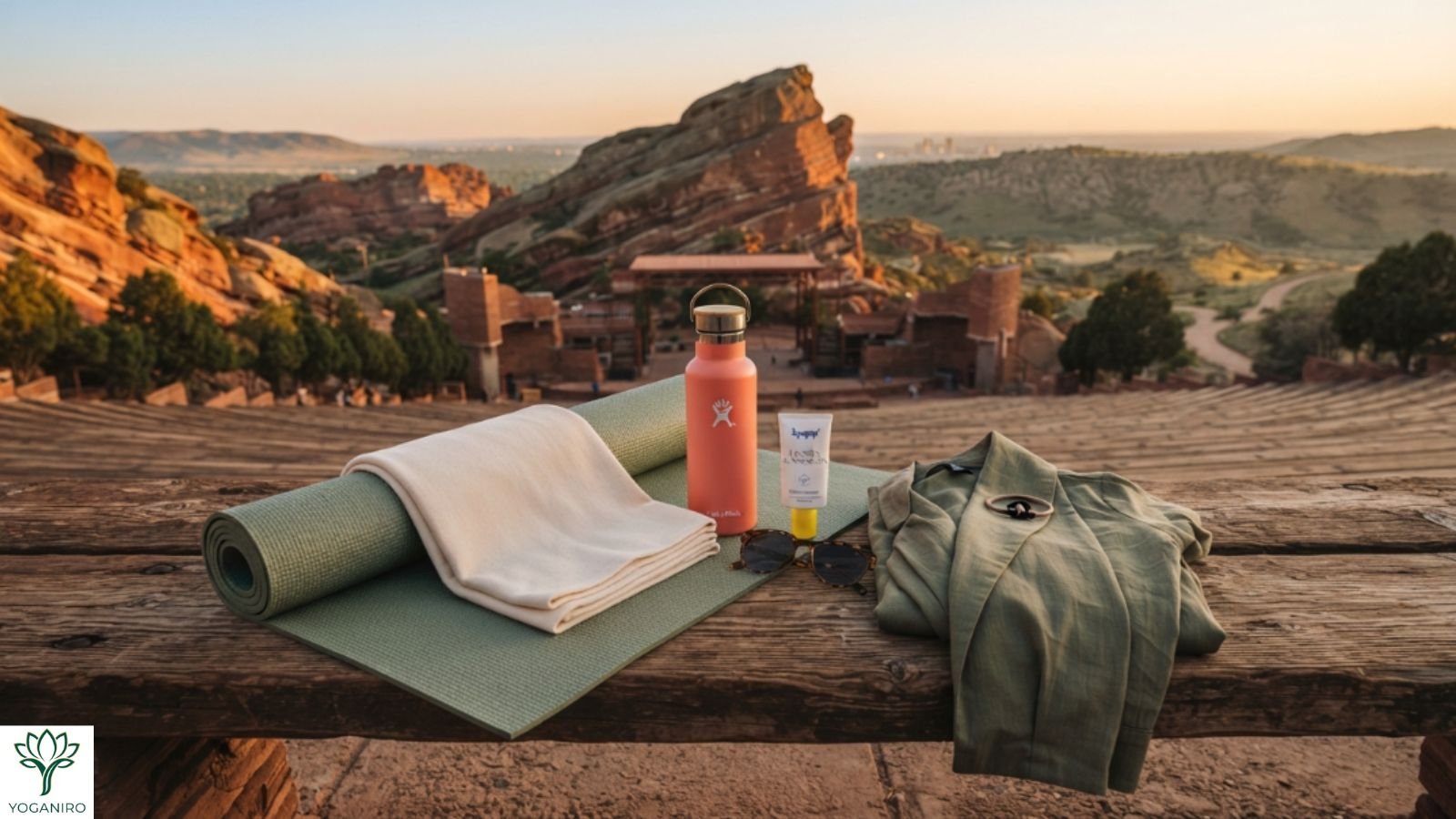
Bring a thicker mat than you’d take to a studio, layers you can shed without standing up, sunscreen, and a full water bottle. Everything else is optional. Because the venue screens every bag at the gate, pack light and pack simply.
A sunrise class in the Colorado foothills starts cold and warms fast. Forty degrees at the first pose and seventy by savasana is an ordinary summer morning at this elevation. Dress for the first ten minutes, not the last ten. A long-sleeve layer over a fitted top handles the swing better than a hoodie you have to wrestle off mid-flow. The same layering logic applies to shorts once the sun is properly up.
Choosing a mat for a hard bench
Use a mat at least 5mm thick. A thin mat plus a folded blanket works just as well. The seating rows are wooden bench planks over stone, with no give at all. Your knees take every bit of that in low lunge; your sit bones take it for the entire seated portion. If you already own props for restorative practice, a folded blanket from that kit is the easiest padding to carry up the stairs.
This is the detail that separates a beautiful morning from a sore one. A studio floor has more cushion than most people realize. A bench plank has none.
The bag policy and what gets stopped at the gate
Red Rocks inspects bags at every gate entrance and screens all guests on entry. Bag size limits and prohibited items change between seasons [VERIFY: the current bag policy on the official Plan Your Visit page]. Check before you drive out, because losing a bag at the entrance after an hour in the car is a miserable way to start a practice.
Is Yoga on the Rocks Good for Beginners?
Yoga on the Rocks suits advanced beginners rather than absolute first-timers. If you’ve taken three or four studio classes, you’ll be fine. If you’ve never taken one, this is a difficult place to start.
The reason is instruction style rather than difficulty. Reported accounts of recent seasons describe a class that names poses without demonstrating or explaining them, which works well when you already know what a chaturanga is and leaves you scrambling when you don’t. Add two thousand people, a hard bench, and thin air. A first class becomes a lot to manage at once.
If you are not sure what to book, a plain guide to the styles will tell you which ones move at this pace. Take a few classes at home first. You’ll spend the hour at Red Rocks looking at the sandstone instead of at the person next to you.
What the class actually covers
The session runs one hour, moves at a steady vinyasa flow pace, and closes with savasana. Sequences stay accessible on purpose, since the class has to work for a crowd with wildly mixed experience [VERIFY: the 2026 class style and level description]. Expect standing poses, sun salutations, gentle balance work, and a long final rest. Standing work leans on the wide-legged shapes, which stay steady even on an uneven row.
Can you hear and see the teacher from the back rows?
Yes. Projection screens show the instructor from the stage, assistant instructors position themselves along the aisles, and the natural acoustics of the rock formations carry sound remarkably well to the upper rows. Some seasons have also featured bilingual instruction in English and Spanish.
Sitting far back costs you less than you’d think here. On the other hand, the walk up is longer, which matters more.
When Should You Arrive, and Where Do You Park?
Arrive at least 30 minutes before the start time. Aim for the upper lot off West Alameda Parkway if you can. Park traffic slows to a crawl on event mornings, when lots fill from the top down. Attendees who target a 6:40 arrival routinely report sitting down closer to 6:50. Larger groups need more margin still, since rows fill unevenly and seating four or five people together gets difficult after about ten to seven.
The upper lot puts you nearly level with the top of the amphitheater. Lower lots add a walk of five to ten minutes on top of the climb [VERIFY: current lot names, locations, and which lots open for the yoga series].
The stair climb nobody warns you about
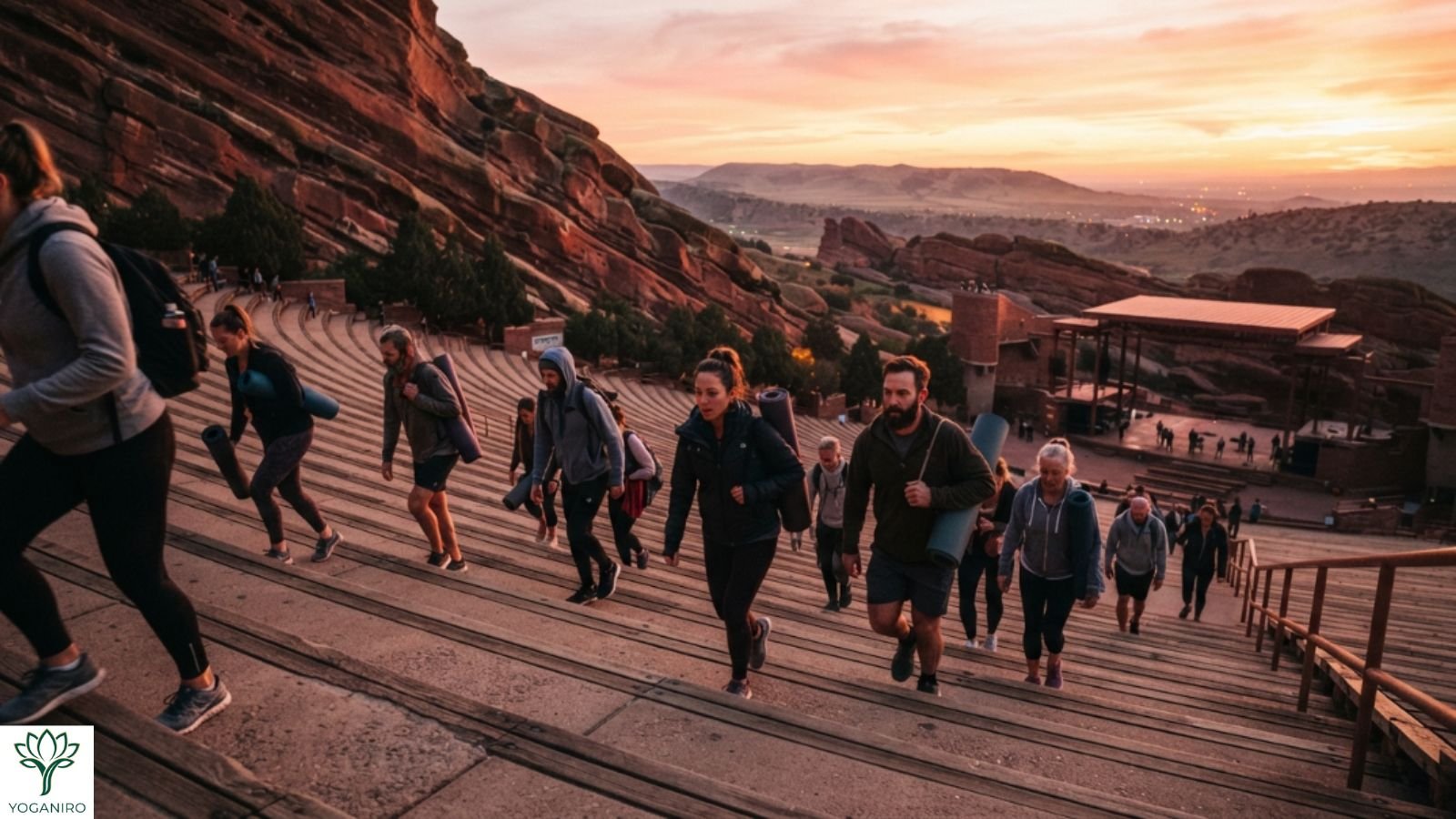
Red Rocks is built on stairs — a lot of them. You’ll carry your mat up several flights at 6,450 feet before you take a single breath of class. The venue’s own guidance is to take them slowly, which is worth following even if you’re fit.
Treat the climb as your warm-up rather than an obstacle. Start early enough that you can walk it at a conversational pace. If knees or mobility are a consideration for you or anyone in your group, factor in extra time and aim for the highest lot available. Steady work on posture and hip mobility in the weeks beforehand pays off on the way back down, which is harder on the knees than the way up.
How to Practice Comfortably on a Stone Tier
Practice on a stone tier by padding generously, shortening your stance, and accepting that the row is narrower than your mat wants it to be. The amphitheater seating rows are long wooden benches set into stone, and each one sits slightly higher than the last. It’s a beautiful surface. It’s an unforgiving one.
Width is the first thing you notice. You have your mat and very little beyond it, with someone on either side within arm’s reach. Nobody minds the closeness. Everyone minds an elbow. Coming with friends helps here, since people who have done partner work or two-person shapes together already know how to share a small square of ground.
Modifications for kneeling, balancing, and a narrow row
Fold your mat double under your knees for low lunge, camel, and any kneeling transition. Take a slightly wider base in standing balance poses, since the surface has a gentle grade and your usual alignment cues will feel a few degrees off. In wide-arm poses, keep your reach a little closer to your body than you would at home.
A small practical tip before you go. Set your mat with the short edge toward the stage rather than trying to square it perfectly to the row. Place your bag at the top edge behind your head. Bags left at the foot of a mat slide down the tier. Nobody wants to spend savasana listening to a water bottle roll away.
What to Do in Morrison Before and After Class

You finish at eight in the morning with the entire day ahead of you, which is the best-kept advantage of a sunrise yoga practice. Two things are worth building into the plan.
The first is the trail system right at the venue. The Trading Post Trail loops through the park from a trailhead within walking distance of the amphitheatre, running roughly 1.6 miles over about 50 minutes on easy, mostly flat ground [VERIFY: current trail distance, difficulty rating, and trailhead access]. You don’t need to move your car. After an hour of flow, a slow walk through the rock formations settles the legs better than sitting down does. Later that evening, long-held floor poses do the rest. A simple hip release is the one most people want after the stairs. A grounding sequence suits the end of a long day outdoors.
The second is breakfast in Morrison. The town sits a few minutes down the road. It’s small and walkable, and by half past eight it’s full of people who were on a mat an hour earlier. Green chili is the local move. The whole morning belongs near the top of any summer bucket list in Denver.
Planning a trip around a single class is a habit worth keeping. It works in Portland, in New York, and in Boston, where the draw is a room full of puppies rather than a sandstone wall.
Yoga on the Rocks FAQs
How many people attend Yoga on the Rocks?
Around two thousand people attend each Yoga on the Rocks session, well below the amphitheater’s concert capacity of 9,525. Organizers cap attendance so every mat has room on the seating rows. That figure has held steady across several seasons, though the exact cap can shift year to year depending on the layout used.
Are yoga mats provided at Yoga on the Rocks?
Bring your own mat to Yoga on the Rocks. The event has not historically provided or rented mats on site. Never assume rental availability at an outdoor event of this size. A mat of at least 5mm thickness works best, since the amphitheatre seating rows are wooden planks over stone with no cushioning.
Can you bring children to Yoga on the Rocks?
Children can generally attend Yoga on the Rocks with a ticketed adult, though the class is designed for adults and runs a full hour without breaks. Ticketing rules for minors vary by season. Confirm on the official event page before buying. Younger children often find the stair climb harder than the practice itself.
Is Yoga on the Rocks accessible for limited mobility?
Red Rocks Amphitheatre offers accessible parking and an accessible route, though the venue is built on steep terrain with extensive stairs throughout. Anyone with mobility limits should contact the venue directly before booking a Yoga on the Rocks session. Arriving early and parking in the highest available lot reduces the climb considerably.
What happens if it rains during Yoga on the Rocks?
Red Rocks staff manage weather on site and will direct guests to shelter in a vehicle or the Visitor Center if conditions turn severe. Light rain rarely stops an outdoor yoga class. Check the refund and exchange policy at the moment you buy, since the ticketing platform handles cancellations rather than the studio.
Is Yoga on the Rocks worth it?
Yoga on the Rocks is worth it if you want the setting rather than the sequence. The class itself is a straightforward one-hour vinyasa flow. What you’re paying for is practicing at sunrise inside a sandstone amphitheater with two thousand other people, which is not an experience a studio can reproduce.
Final Thoughts
The sun clears the plains somewhere around the third sun salutation; the whole amphitheater changes color at once. That’s the moment people remember. Not the pose, not the playlist, just the light arriving all at once across two thousand mats.
Yoga on the Rocks rewards preparation more than most classes do. Book early, hydrate the day before, pad your knees properly, and give yourself an extra twenty minutes for the stairs. Do those four things and you’ll spend the hour where you came to be, which is somewhere between the rock and the sky rather than inside your own breath.
If you want something to carry up the stairs with you, a few lines worth remembering suit a sunrise better than a playlist does.
Trusted Resources
- Red Rocks Amphitheatre — What to Expect for the venue’s official altitude guidance, bag inspection rules, and severe weather procedure.
- CDC — High-Altitude Travel and Altitude Illness for acclimatization guidance and the elevation thresholds where altitude illness becomes a genuine risk.
- Cleveland Clinic — Altitude Sickness for how reduced oxygen affects the body and when symptoms warrant attention.
- Johns Hopkins Medicine — The Yoga-Heart Connection for what the research supports on yoga, breath, and cardiovascular effort.
About Yoganiro
Yoganiro is a yoga and wellness publication dedicated to clear, honest, and practical guidance. Every guide is fact-checked against credible sources such as Yoga Journal, Harvard Health, and peer-reviewed research before it is published. Questions or corrections? Reach out through our contact page.
Disclaimer. This article is general wellness information and not medical advice. Consult a qualified healthcare professional before beginning any new physical practice, particularly at elevation.

Yoganiro was founded by Abdul Rehman with a passion for yoga, wellness, and mindful living. The goal behind Yoganiro is to inspire people through simple yoga practices, wellness tips, and healthy lifestyle content that promotes balance, peace, and overall well-being.