


By the Yoganiro Editorial Team · Last Updated: August 2026
You usually find out in one of two ways. Either you catch the light in a studio mirror halfway through a forward fold or somebody tells you quietly afterward. Translucent leggings announce themselves at the worst possible moment. The reaction is almost always the same: a hot rush of embarrassment, followed by the assumption that something about your body caused it.
Nothing about your body caused it. Sheer fabric is a manufacturing outcome. Whether you call them leggings, yoga pants or gym tights, the cause is the same: knit density, fiber content, dye color and how far the material has been asked to stretch. This guide covers why it happens, how to catch it in two minutes at home, what to look for on a product page before you spend anything and how to rescue the pairs already in your drawer.
Why Leggings Turn Translucent and How to Stop It
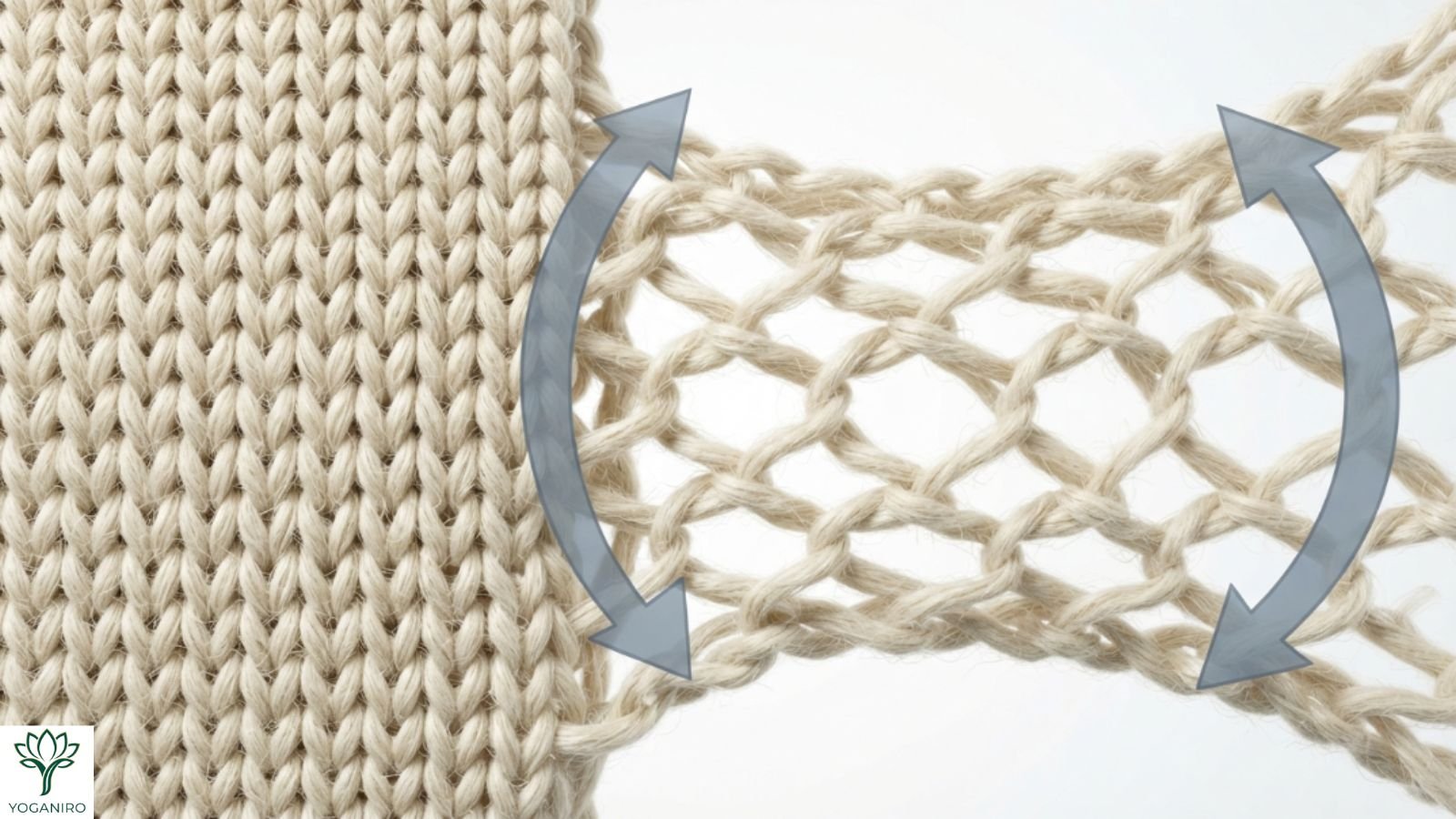
Leggings turn translucent when the knit is stretched past the point its density can cover. The usual causes are a lightweight fabric, a size too small, a pale color or wear that has thinned the yarn over time. Catch it before you commit by folding forward in bright light with a phone camera on the floor behind you. Buy dense, dark, high-recovery knits in a nylon and spandex blend if you want yoga pants that stay opaque through a full class.
What Does Translucent Actually Mean on a Pair of Leggings?
Translucent means enough light passes through the fabric to reveal what is underneath. On leggings that almost always happens under stretch rather than at rest, which is why a pair can look completely solid on the hanger and fail the moment you fold forward.
Four words describe the same failure and the market uses all of them. Translucent is the polite one, sheer is the industry term and see-through is what people actually type into a search bar. Not squat-proof is what brands say when they want to sound technical. All four name the same problem in the same garment, whether it sells as gym leggings, workout tights or yoga pants. That scattering across four vocabularies is why the answers have been so hard to find.
One completely different product borrowed the same word. Faux-translucent thermal tights are fleece-lined leggings built to look bare-legged from a distance while staying opaque and warm underneath, which makes them a winter fashion item rather than a fabric fault. If those brought you here, the rest of this guide covers the opposite problem: fabric that turns sheer when it is not supposed to.
Why Do Leggings Go See-Through When You Stretch?
Because a knit fabric is a grid of interlocking loops rather than a solid sheet. Pull that grid in two directions at once and the loops open, the gaps between them widen and more light travels through. Every cause below is a variation on the same mechanism.
Fabric weight. A lighter fabric has less material per square inch to begin with, which means it reaches transparency sooner. Brands choose lightweight knits for breathability and a barely-there feel. Both are real benefits. Opacity is what gets traded away for them.
Stretch without recovery. Stretch measures how far a fabric will travel. Recovery measures whether it comes back. Four-way stretch fabric moves along both axes at once, which is why recovery matters more in a pair of leggings than in almost any other garment you own. A knit with generous stretch and poor recovery sits permanently slightly opened after a few wears, which is why some pairs are fine for a month and never quite the same afterward.
Knit density. Two fabrics can carry an identical fiber label and behave nothing alike. A tightly knitted blend with fine yarns holds its opacity far better than a loose single jersey with the same composition on the tag. Double-knit and interlock constructions stack two layers of loops where a single jersey puts one, which is the most reliable structural answer to transparency. Composition tells you what a fabric is made of rather than how tightly it was built.
Wear. Friction thins yarn. The seat and the inner thigh take the most abrasion from sitting, from mats and from machine washing. Those are exactly the areas that fail first.
The Size-Down Mistake
Buying a size smaller for a tighter, more compressive feel is the most common self-inflicted cause of sheer fabric. A knit already near the limit of its stretch while you are standing still has nothing left to give when you fold, lunge or lift a leg.
Compression is engineered into a garment through knit structure and fiber blend rather than through wearing a smaller size. If a pair feels loose in a way you dislike, the answer is a different construction rather than a different number on the label. Sizing down buys you tension at rest and transparency in motion.
Why Color Matters More Than Darkness
The standard advice is to buy black. The better advice is to think about contrast.
A fabric reads as opaque when there is little visible difference between the fabric and whatever sits behind it. Skin tone is part of that equation, which is why the same pale gray legging can look fine on one person and fail on another. Deep, saturated shades work across a wider range of people because they sit further from every skin tone.
Lighting is the other half of that equation and you do not control it. A window-lined morning room at a New York studio and a dim evening class at a Portland one will read the same fabric differently. Test at home in the harshest light you can find.
Three finishes fail more often than their color alone would suggest. Marled and heathered knits mix light and dark yarn, with transparency starting in the lighter of the two. Pastels carry very little pigment. Bright white is the hardest color in activewear to make opaque at any weight.
The same logic explains why matching underwear works. Underwear that matches the legging rather than your skin disappears more reliably than a nude shade. Seamless styles remove the outline at the same time.
The Down Dog Test: A Better Check Than the Squat Test
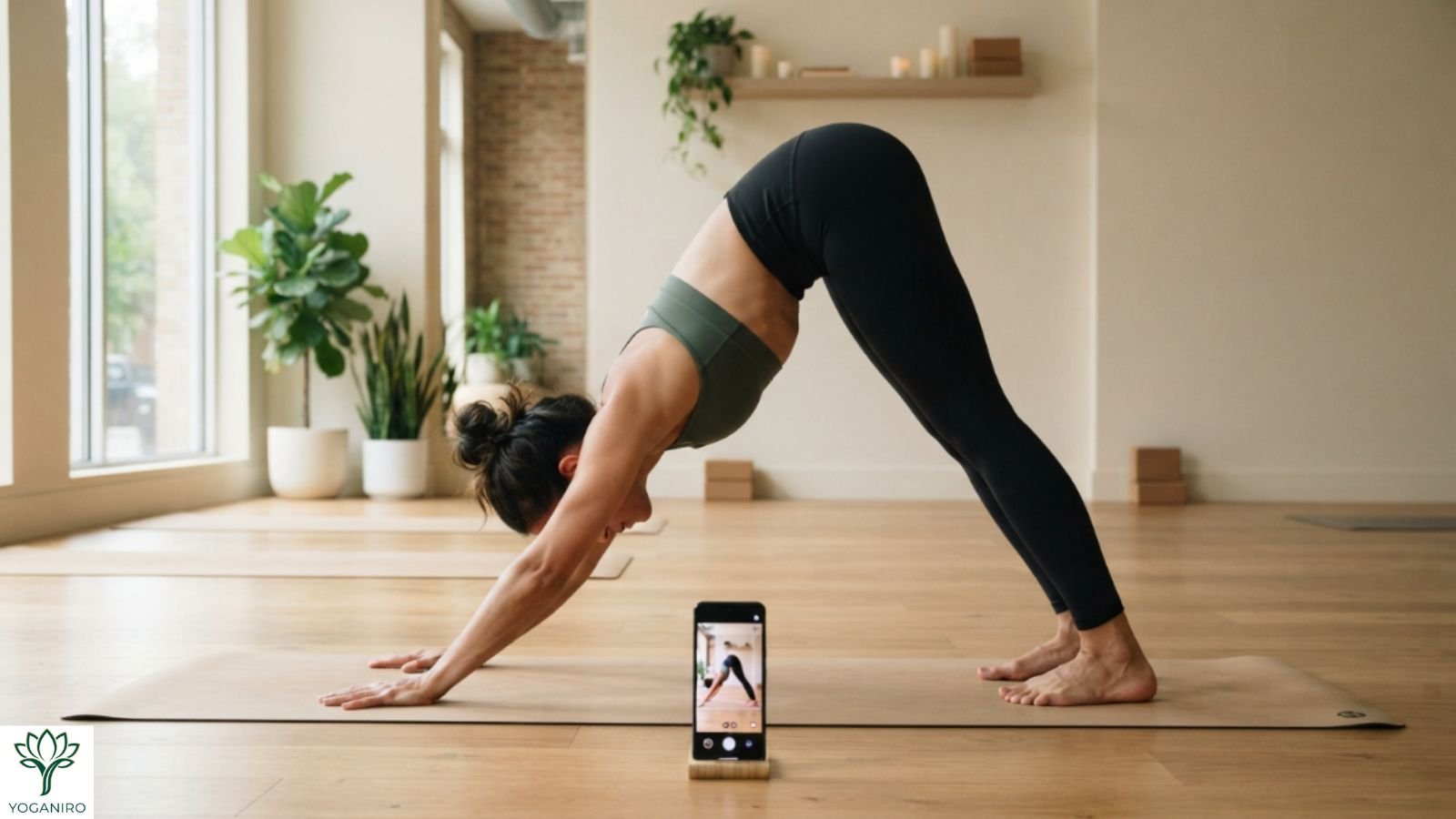
Every guide on this subject tells you to squat. For a yoga practice, the squat is the wrong test.
A squat stretches the seat fabric while your hips stay relatively square and your torso stays upright. A wide-legged forward fold does something harder. It flexes the hips deeply, spreads the fabric across two axes at once and holds it there for the length of several breaths rather than a single rep. Downward-facing dog, adho mukha svanasana, does the same thing with your seat as the highest point in the room. If a pair of leggings is going to fail, it will fail in those two shapes long before it fails in a squat.
Run this before your first class in a new pair.
- Find bright, even light. A window in the middle of the day beats overhead lighting.
- Prop your phone on the floor a few feet behind you, camera facing you, recording video.
- Step your feet a leg length apart and fold forward into prasarita padottanasana, the same stance you use to set up triangle pose. Hold for five slow breaths. Skip this stance if forward folds are not available to you.
- Walk your hands forward into down dog, then step the feet slightly wider than usual. Hold for five more breaths.
- Watch the video back at full screen brightness. Look at the seat seam and at the widest part of the hip.
The pair passes if the fabric holds the same color from calf to seat and you cannot identify the color of what is underneath. It fails if the color lightens across the seat, if a seam appears as a darker line through the fabric or if you can read anything through it at all.
Deep hip flexion is the common factor, which is why the same fabric will also show its limits in happy baby and in any long-held shape that opens the hips.
The same applies to two-person shapes and three-person balances, where somebody is directly beneath you at close range. That is a reason to test before class rather than during it.
Three Faster Checks Before You Commit
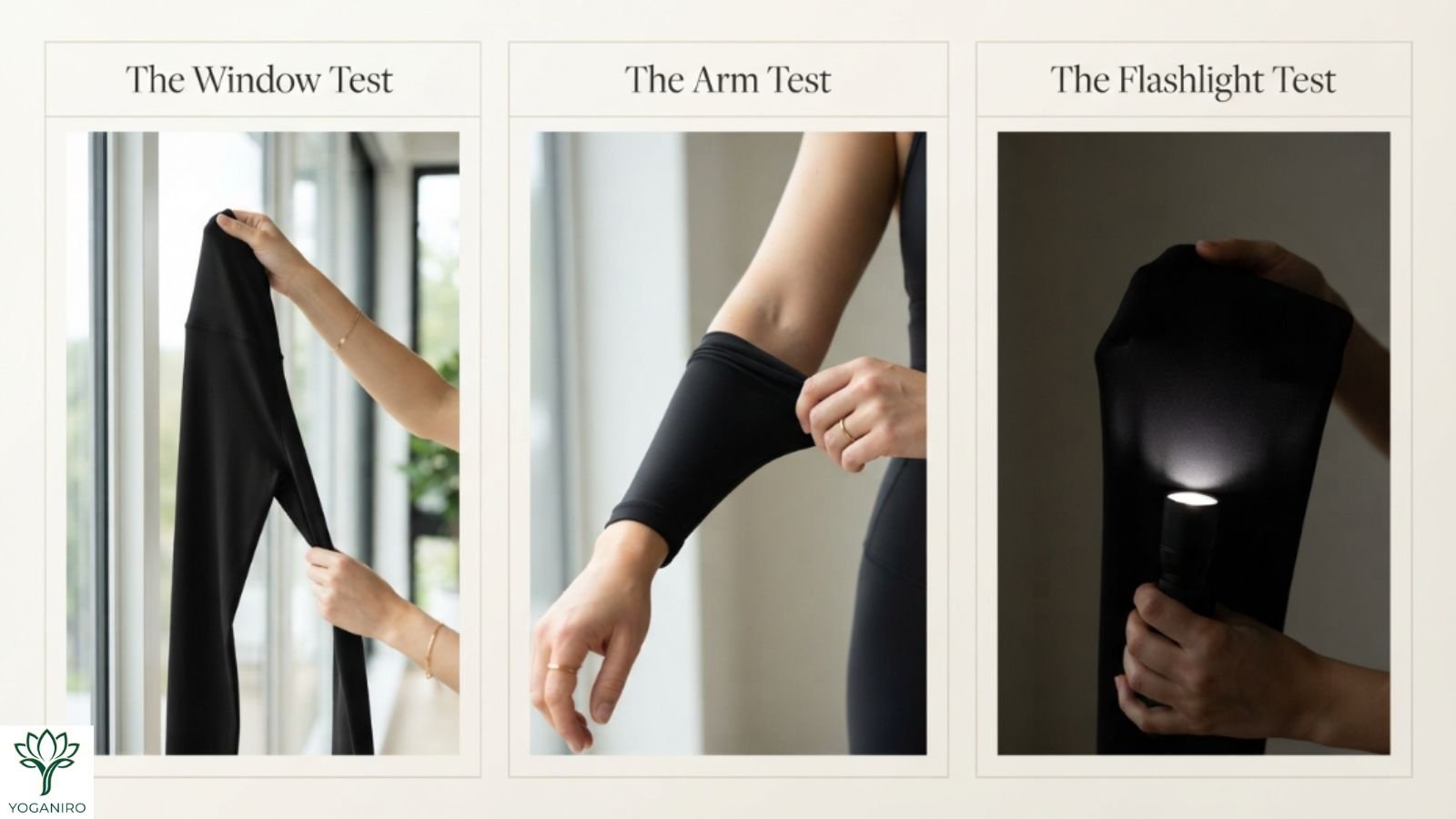
The window test. Hold the fabric flat against a bright window. This shows the baseline density before any stretch, which is the fastest way to eliminate an obviously thin pair.
The arm test. Push your forearm through one leg so the fabric stretches across it, ideally over a contrasting sleeve or a bracelet. Stretch is what exposes the weakness. Your forearm applies it without you needing to change clothes.
The flashlight test. Stretch the fabric over your phone with the flashlight on. This one is deliberately harsh. Almost everything transmits some light under a direct beam. Treat it as a way to compare two pairs against each other rather than as a pass or a fail.
Test With the Tags Still Attached
This is the single most practical habit in this article and almost nobody mentions it. Run every test above at home, before the tags come off and before the pair goes anywhere near a studio floor.
Once the tags are gone the return window usually closes, which leaves you owning a pair you will never wear. Testing first costs two minutes and gives you something specific to say in a return request, which tends to move faster than a general complaint.
How to Spot Translucent Leggings on a Product Page
Most advice on this subject assumes you already own the leggings. The more valuable skill is reading a listing well enough to avoid the purchase.
Composition. Look for a nylon-dominant blend with a moderate elastane content. Elastane, spandex and Lycra are three names for the same fiber. Do not read a spec sheet as though they are different materials. Nylon yarns are typically finer and denser than polyester at the same weight, which generally means better coverage and better moisture wicking under sweat. Very high spandex percentages usually signal a fabric engineered for four-way stretch rather than for opacity.
Published fabric weight. If a brand publishes a weight in grams per square meter, that is a good sign in itself, because brands using light fabric rarely advertise the number. Use it to compare two products rather than as a pass mark. No independent standard defines an opacity threshold. Any article handing you a single magic number is guessing.
Color. Apply the contrast logic from the previous section before you fall for a shade.
Construction. Look for a gusseted crotch, a high-waisted doubled waistband and flatlock or bonded seams. The panel that brands market as tummy control is usually just two layers of fabric, which is a genuine opacity advantage whatever it is called. Paneling and contour seams add layers exactly where stretch concentrates.To learn more about sustainable performance textile materials and fiber standards, visit the Textile Exchange.
The reviews. Search inside the reviews for the words sheer, see through and squat. If a fabric has an opacity problem, somebody has already said so in plain language. Check the return policy in the same visit.
GSM, Denier and Which One Applies
These two measurements get used interchangeably even though they describe different things.
Denier measures the mass of an individual yarn and it is the standard for hosiery. On tights, roughly 10 to 20 denier reads as ultra-sheer, 30 to 40 as a light veil and 50 and above as opaque. It is a genuinely useful scale when you are buying tights.
Grams per square meter, usually shortened to GSM, measures the weight of a finished fabric across its area and it is the relevant number for knitted activewear. Two fabrics can share a yarn thickness and differ enormously in coverage, because coverage depends on how tightly those yarns were knitted together.
If a leggings listing quotes a denier figure, treat it as marketing borrowed from hosiery. If it quotes a fabric weight, treat it as a comparison tool rather than a promise.
What the Seamless Label Really Means
One widely shared guide claims that choosing seamless leggings guarantees zero transparency. That is not true. Correcting it matters because the claim pushes people toward exactly the wrong product.
Seamless describes how a garment is built rather than how dense its fabric is. Seamless leggings are circular-knitted in one piece, which removes side seams and produces a very smooth, close fit. That construction is genuinely comfortable. It also tends to use finer yarn and a more open knit to achieve the smoothness, which is the opposite of what opacity requires.
Seamless is a fit feature. Judge it on fit. Judge opacity on weight, knit density and color. Test the pair regardless of what the label says.
What Fabrics and Construction Actually Hold Up
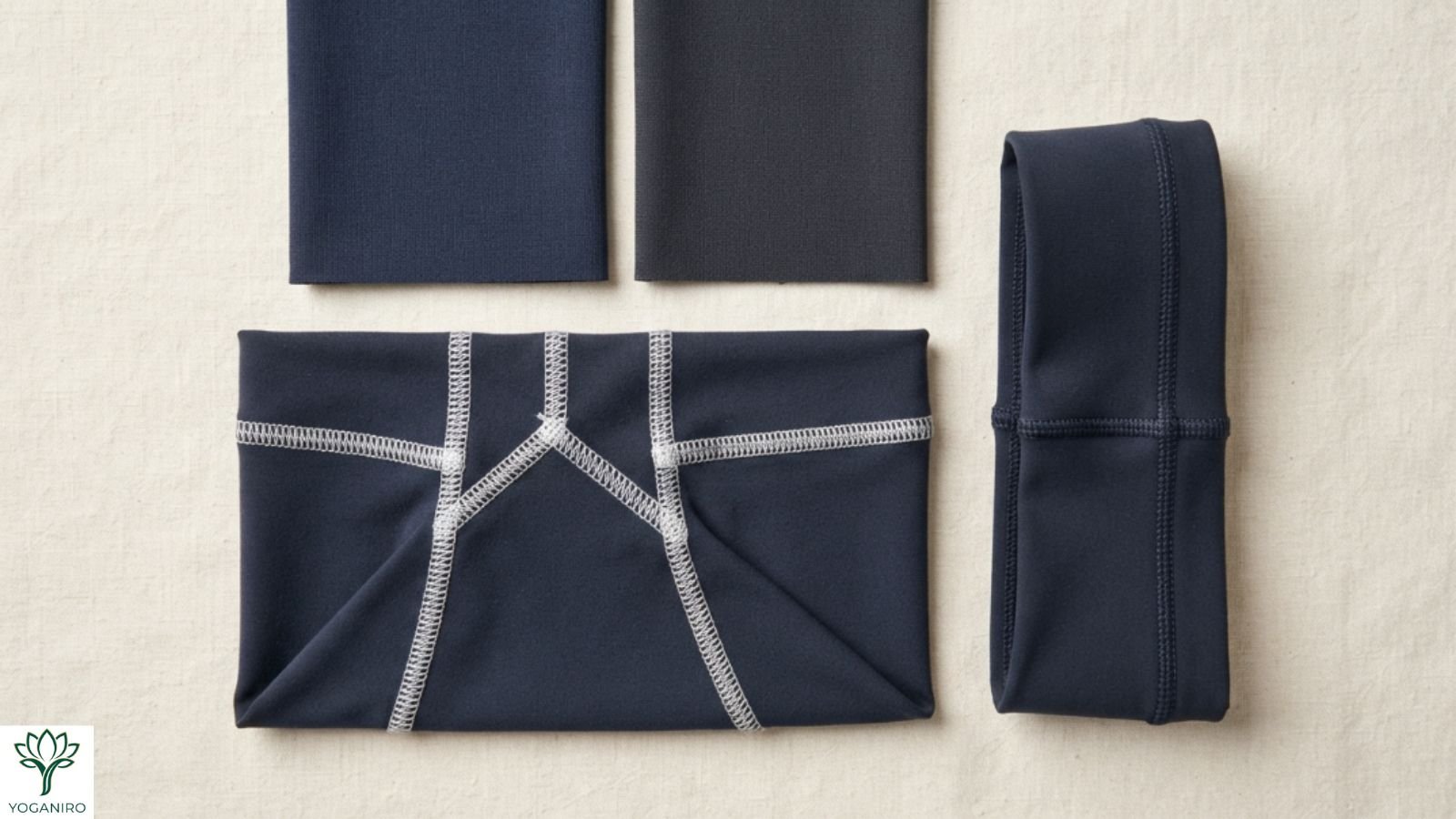
The pairs that stay opaque share four things: a dense knit, fine yarns, a fiber blend with real recovery and construction that adds fabric where stretch concentrates.
Recovery deserves more attention than it gets. Stretch is easy to manufacture and it sells well on a product page. Recovery is what determines whether a fabric returns to its original density after every fold, lunge and long hold. A pair with excellent recovery is still opaque in month eight. A pair with poor recovery is a different garment by month three.
Construction does the rest. A gusset removes the seam that would otherwise sit at the point of maximum stretch. A doubled high waistband adds two layers across the hip, while bonded or flatlock seams keep the fabric flat rather than puckered. Puckering is where light finds a way through.
Density has a cost and it would be dishonest to skip it. A heavier, denser knit is warmer and slower to wick moisture than a light one. In a hot room that matters. The compromise most people land on is a dense fabric below the waist and a lighter, more breathable layer on top.
Some formats demand more of a fabric than others. Match the pair to the style you actually practice. Long holds keep fabric at full stretch for minutes at a time rather than seconds. Opacity that survives a flowing vinyasa class can still fail in a slower, longer-held practice. The same applies to supported restorative work, where a single shape propped over a bolster can last five minutes or more. Inversions put the seat fabric above eye level for everyone in the room, which matters before an aerial class.
The honest brands admit this themselves. Gymshark’s own help center tells customers plainly that no pair can promise to be completely squat-proof for everyone. That is a more useful statement than any marketing claim on a product page. It is also the reason the test matters more than the label.
Why Your Favorite Leggings Became Sheer Over Time
A pair that passed every test in month one can fail in month eight, which nobody warns you about. Opacity is not a fixed property; it degrades over time. Most of that damage happens in the laundry rather than in the studio.
Fabric softener. Softener works by depositing a thin coating on fibers. On cotton that feels pleasant. On elastane it clogs the fiber, reduces its ability to rebound and accelerates the loss of recovery that turns fabric sheer. Skip it entirely on activewear.
Heat. Elastane is the most heat-sensitive component in a legging. A hot wash and a hot dryer shorten its working life faster than anything else you can do to it. Cold wash and air dry, every time.For additional clothing care recommendations, see the American Cleanin Institute clothing care guidance.
Chlorine. Chlorine attacks elastane directly. If a pair goes in a pool or a hot tub, rinse it in cold water immediately afterward.
Friction. Wash leggings inside out and separately from anything with a zipper, a hook or a rough weave. Pilling is thinning in progress. Once the seat has pilled, the fabric there is already lighter than it was.
Storage. Fold leggings rather than hanging them by the waistband. A waistband held under its own weight for months loses recovery in the exact place you need it most.
One accelerant catches people out. If you cycle in them, saddle contact adds abrasion at the seat that a yoga mat never will, which matters if the same pairs cover cycling and class.
What to Do With the Pairs You Already Own
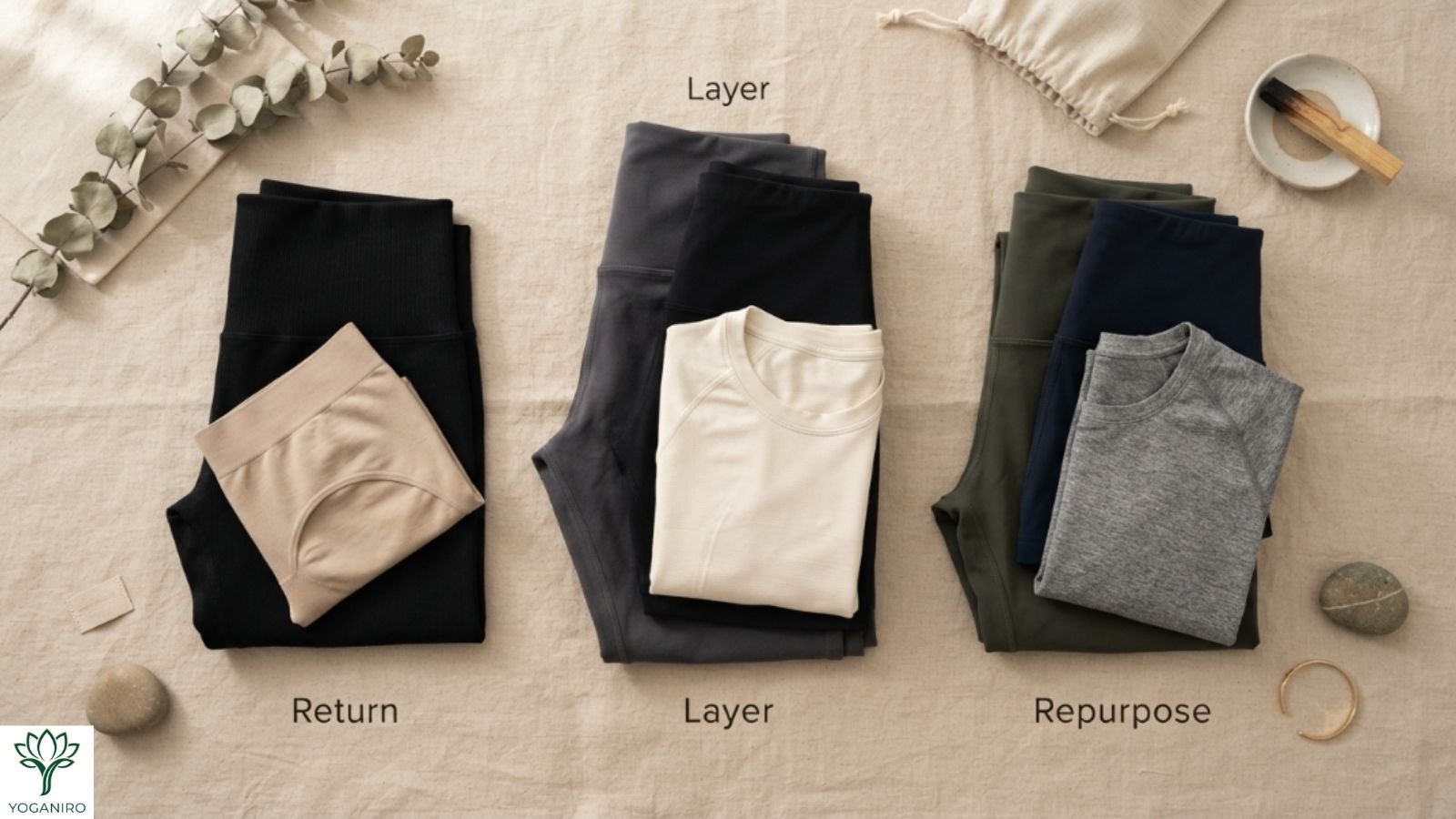
Most guides stop at buy a better pair. Here is a more useful answer: sort them into three piles.
Returnable. If the tags are still on or the return window is still open, send them back and say specifically that the fabric becomes transparent under stretch. That is a product fault rather than a preference.
Wearable with one change. Matching underwear rather than nude underwear solves a surprising number of cases on its own, because the problem is often contrast rather than raw transparency. A longer top covering the seat solves most of the rest. Seamless underwear removes the visible panty line at the same time, without changing anything else about the outfit. Layering shorts over leggings works too, which reads as a deliberate look rather than a workaround. There is a whole set of pairings built around that idea.
Repurposed. A sheer pair is still a good base layer under snow gear, under a dress in winter or under looser pants. It is fine for walking, for weights, for gentle standing and alignment work and for anything that does not put you in deep hip flexion in front of other people.
Classes that get photographed turn a passing glance into a permanent image. A puppy yoga session is exactly where you want a pair you have already tested.
What none of this deserves is the mental space. A fabric failed a test it should have passed at the factory. That is the whole story.
Replacing a pair? Run the composition check and the down dog test on whatever you buy next, whatever it costs. If you are shopping premium brands, we keep current offers on our Alo discount page and our Beyond Yoga discount page.
Translucent Leggings FAQs
Are expensive leggings less likely to be see-through?
Not reliably. Price reflects branding, design and marketing as much as fabric. Plenty of premium pairs fail the stretch test while mid-range pairs pass it. Weight, knit density and color predict opacity far better than cost does. Test an expensive pair with exactly the same care you would give a budget one.
Do men’s leggings go see-through too?
Yes. Men’s leggings go see-through for identical reasons. Fabric weight, knit density, color and fit determine opacity regardless of who wears the garment. Men’s activewear tends toward heavier knits and darker colorways, which is why the complaint surfaces less often. Every test here applies unchanged.
What color leggings are least see-through?
Deep, saturated shades such as black, charcoal, navy, forest green and deep burgundy. What matters is the contrast between fabric and what sits behind it rather than darkness alone. Pale pastels, bright white and marled or heathered grays are the most likely to disappoint at any fabric weight.
Can you fix leggings that have already gone sheer?
No. Once a knit has lost density through wear or lost recovery through heat, no treatment restores it. What you can change is what sits underneath and what sits on top. Matching underwear, a longer top or a layered short will handle almost every situation you would otherwise avoid.
What should you wear under see-through leggings?
Match your underwear to the legging rather than to your skin and choose a seamless style to remove the outline. For a pair that is genuinely sheer, a fitted layering short or a longer tunic-length top is more reliable than anything worn underneath. Nude shades only work when the fabric already sits close to your own tone.
Does washing make leggings see-through?
Washing itself does not. Fabric softener, hot water, hot dryers, chlorine and friction against zippers all do. Elastane is the fragile component in the blend and heat degrades it fastest. Wash cold and inside out, skip the softener and air dry. A pair treated that way holds its opacity considerably longer.
Do leggings look more see-through in sunlight?
Yes. Outdoor classes are where most people find out. Direct sun passes through a knit far more aggressively than indoor lighting does, especially at the low angles of early morning and late afternoon. If you practice outside at all, run your test in daylight rather than under a ceiling light.
What does squat-proof actually mean?
It means the fabric stays opaque at full stretch rather than only at rest. No independent standard defines the term. Brands apply it to themselves, which makes it a statement of intent rather than a specification. The only version that means anything is the test you run yourself.
Are seamless leggings squat-proof?
Not automatically. Seamless describes construction rather than fabric density. Seamless knits often use finer yarn and a more open structure to achieve their smooth finish, which can work against coverage. Some seamless pairs are perfectly opaque. Judge each one on weight, knit and color, then run the test yourself.
Final Thoughts
Translucent leggings are a fabric problem. They are not a body problem, a sizing failure on your part or a sign that you should be practicing in something looser. A knit either has the density to stay opaque under deep stretch or it does not. The factory settles that long before the pair reaches you.
What you control is the test and the purchase. Two minutes in bright light with a phone on the floor behind you will tell you more than any product description ever will. Run it before the tags come off. Buy for density, recovery and color rather than for a smooth finish. Wash cold and skip the softener.
If a stranger ever mentions it at the studio door, the accurate response is that the manufacturer got it wrong.
About Yoganiro
Yoganiro is a yoga and wellness publication dedicated to clear, honest, and practical guidance. Every guide is fact-checked against credible sources such as Yoga Journal, Harvard Health, and peer-reviewed research before it is published. Questions or corrections? Reach out through our contact page.

Yoganiro was founded by Abdul Rehman with a passion for yoga, wellness, and mindful living. The goal behind Yoganiro is to inspire people through simple yoga practices, wellness tips, and healthy lifestyle content that promotes balance, peace, and overall well-being.
1 thought on “Translucent Leggings: 9 Proven Fixes for Full Coverage”